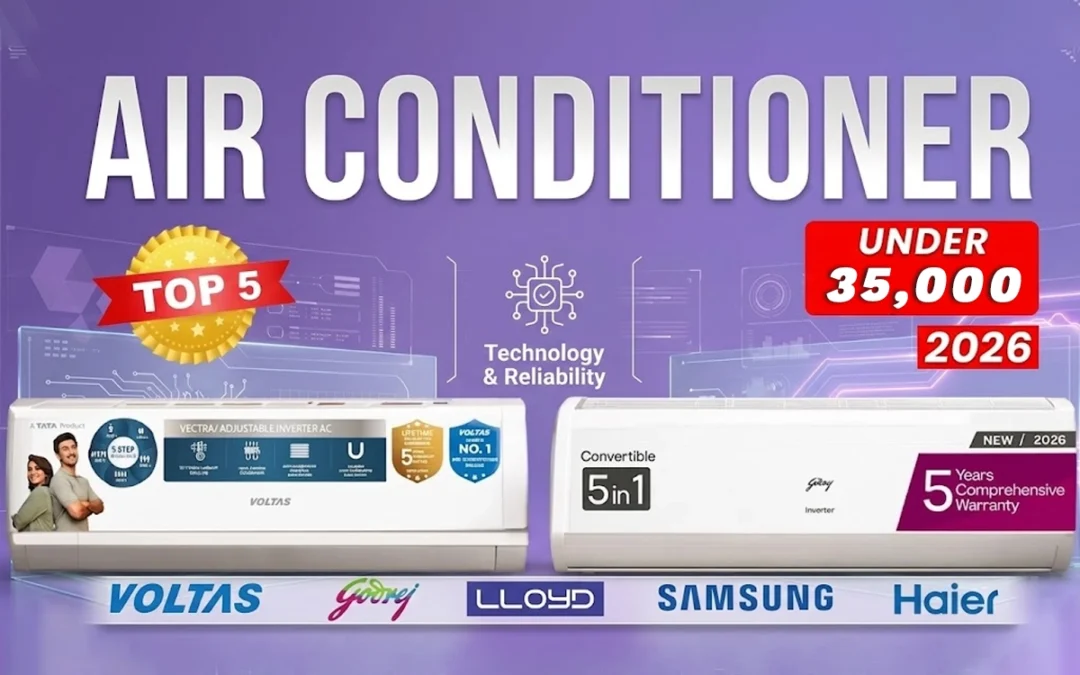
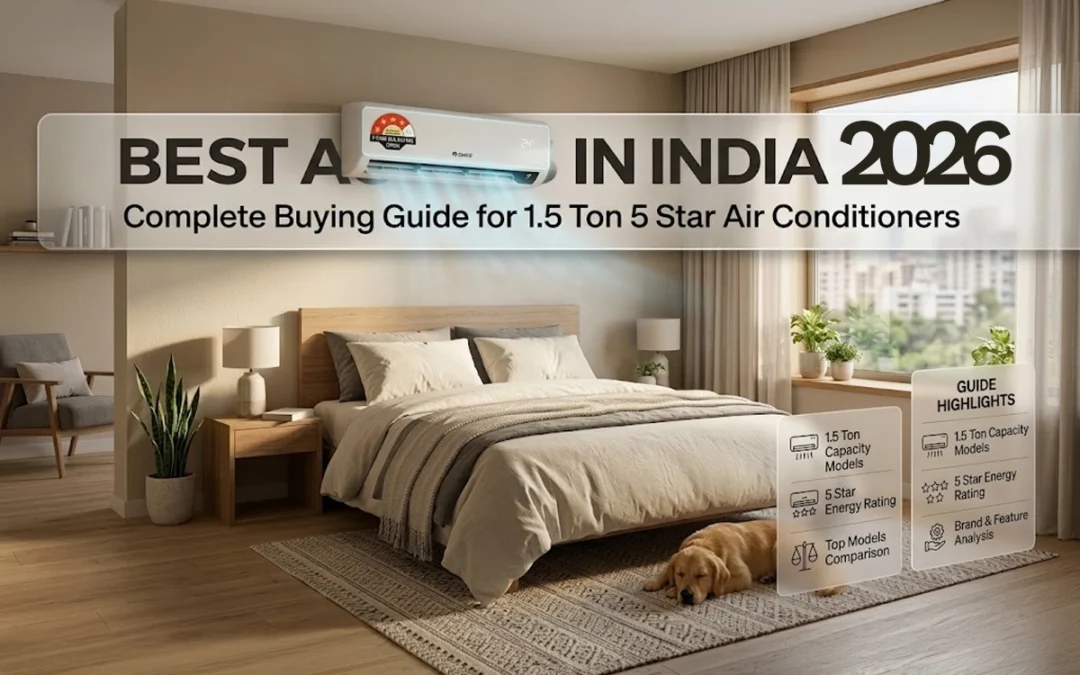
Finding the best AC under 35000 can feel overwhelming with so many brands and features available. The good news is that you do not need to overspend to enjoy powerful cooling and reliable performance. Modern inverter ACs in this price range offer excellent energy efficiency, smart features, and durable build quality.
This comprehensive guide will help you choose the best AC in India for 2026, understand key buying factors, and compare the top models from trusted brands like Voltas, Godrej, Lloyd, Samsung, and Haier.
New to AC buying altogether? Start with our complete AC Buying Guide first.
In This Post
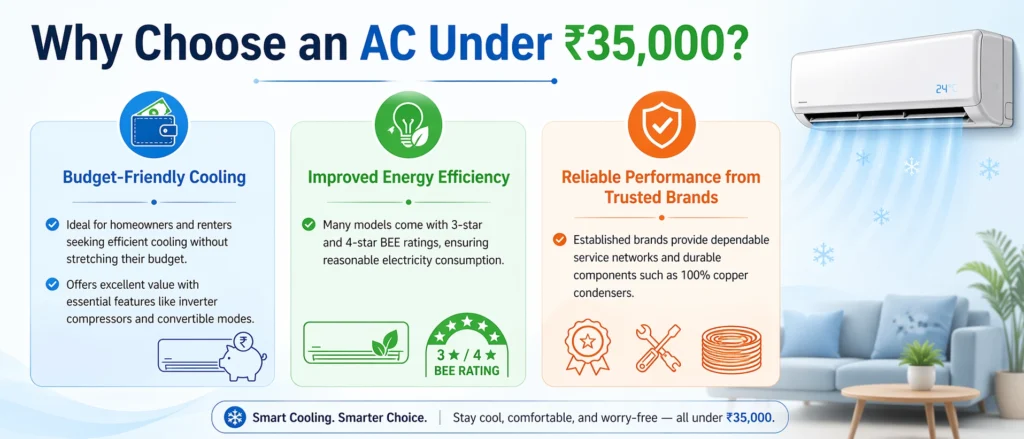
Why Choose an AC Under ₹35,000?
Budget-Friendly Cooling
Ideal for homeowners and renters seeking efficient cooling without stretching their budget.
Offers excellent value with essential features like inverter compressors and convertible modes.
Improved Energy Efficiency
Many models come with 3-star and 4-star BEE ratings, ensuring reasonable electricity consumption.
Reliable Performance from Trusted Brands
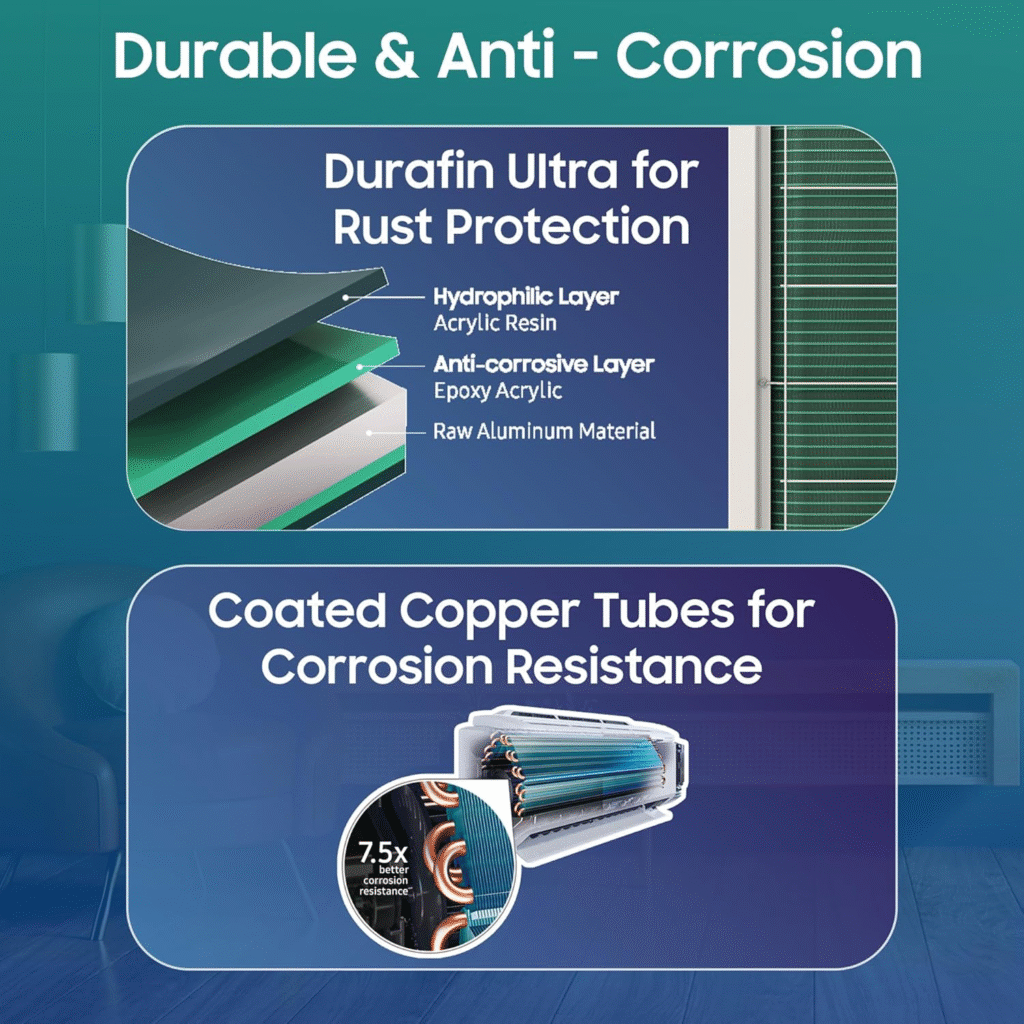
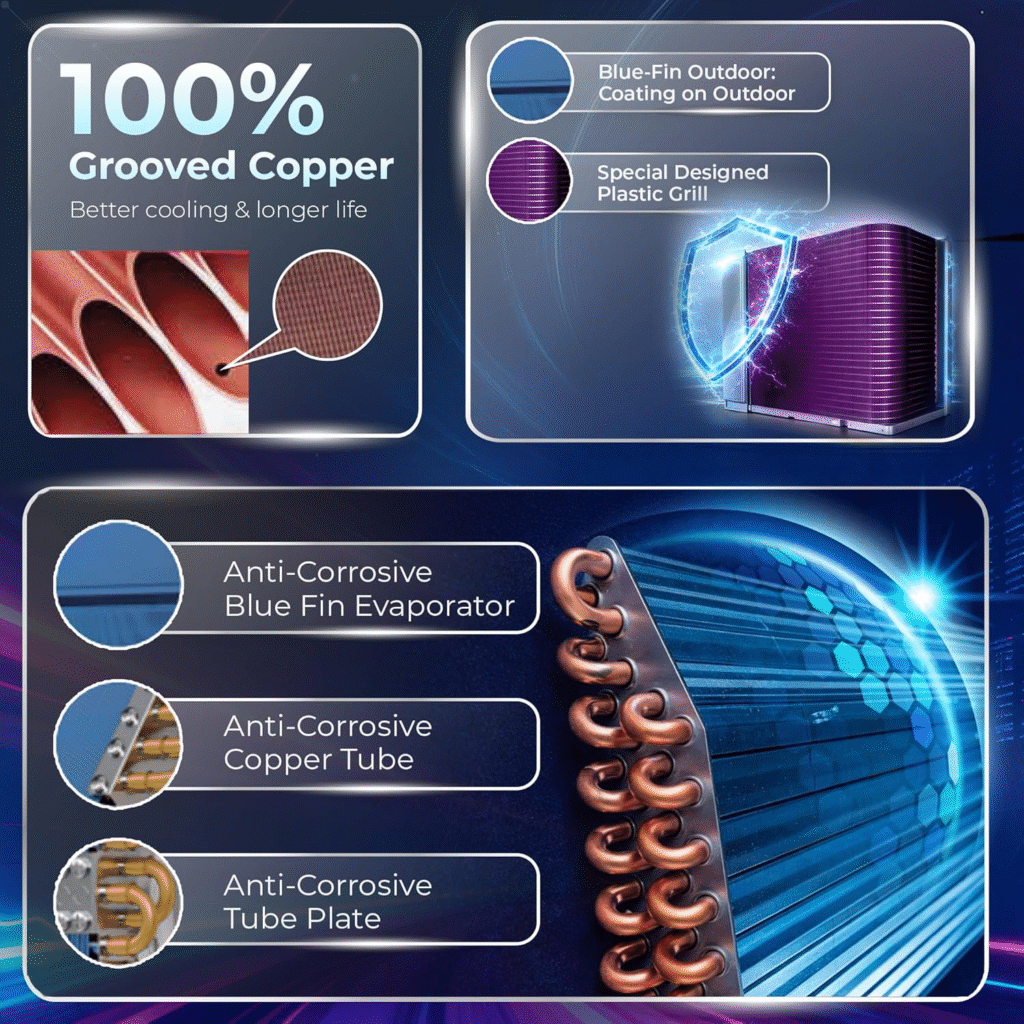
Established brands provide dependable service networks and durable components such as 100% copper condensers.
Images sourced from Amazon. All copyrights belong to their respective owners.
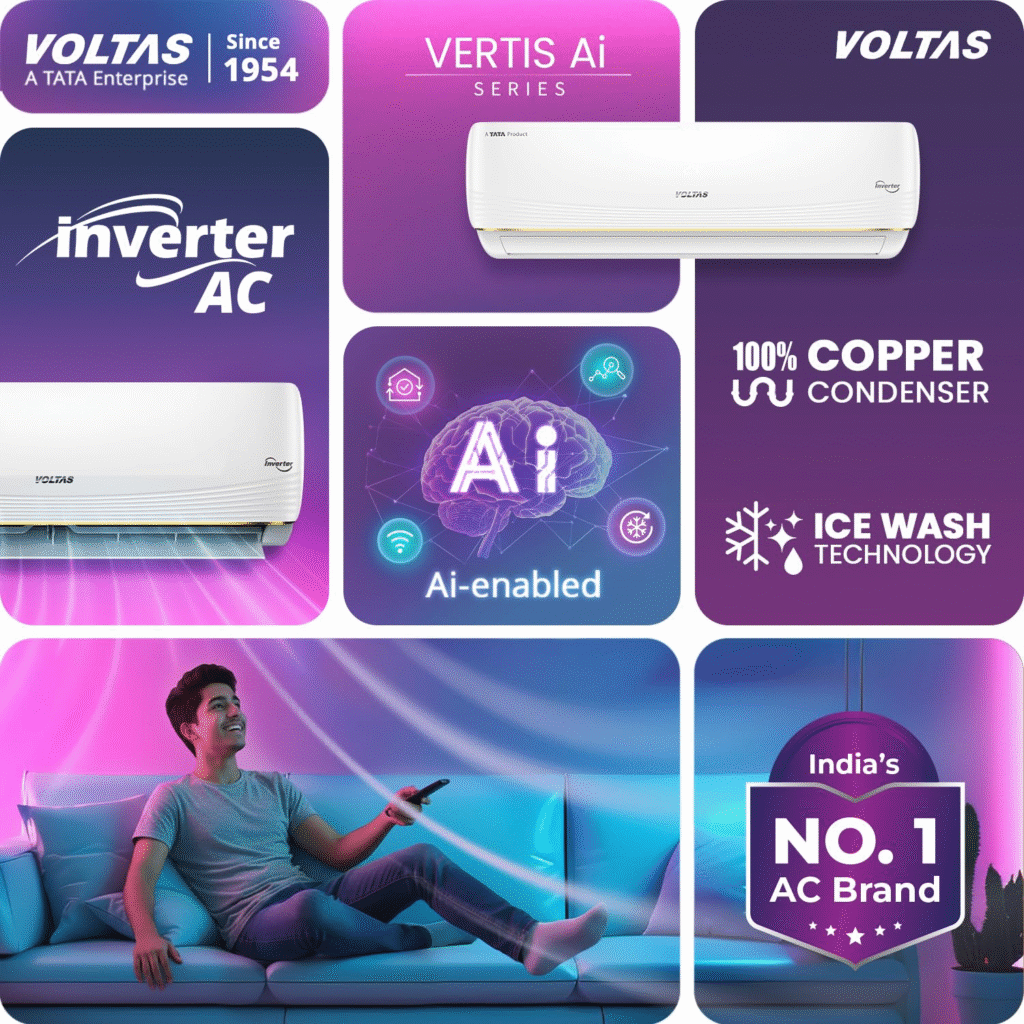
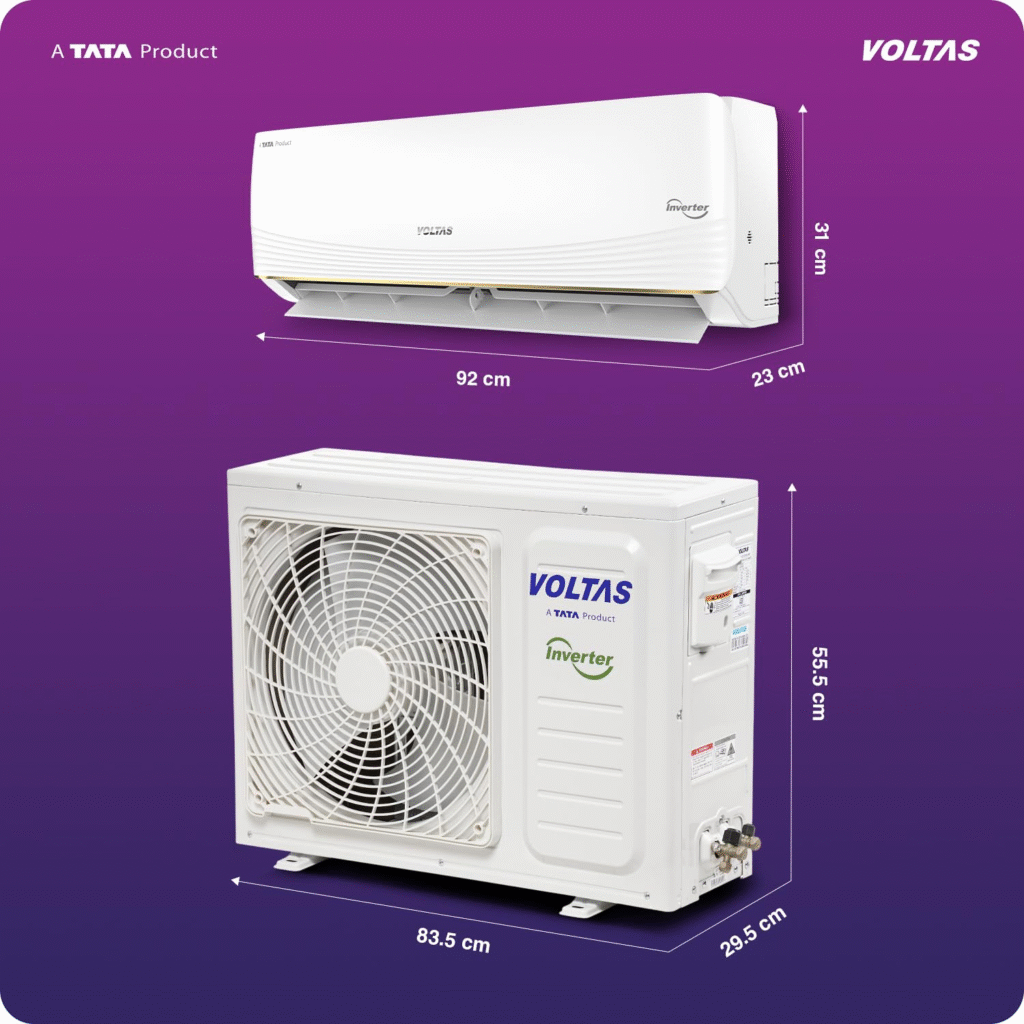
If your priority is simple—strong cooling without any drama—this is the one. It delivers higher real cooling than most in this range, so rooms up to 170–180 sq. ft. cool faster and more evenly. The airflow is strong, build quality is solid with full copper components, and it skips unnecessary features to focus on performance. Add a reliable service network and straightforward warranty, and you get an AC that just works when it matters.
Images sourced from Amazon. All copyrights belong to their respective owners.
If you want to save on electricity without paying extra upfront, this one makes a lot of sense. You’re getting a 4-star AC at almost 3-star pricing, which is rare, and that directly translates into lower power bills over time. Cooling is solid for standard rooms (up to ~150 sq. ft.), nothing extreme but reliable, and features like i-Sense help direct cooling where you actually are. The biggest win here is the strong, no-nonsense warranty, which most brands don’t match in this range. It’s not about flashy features—it’s about balanced performance with long-term savings.
Images sourced from Amazon. All copyrights belong to their respective owners.
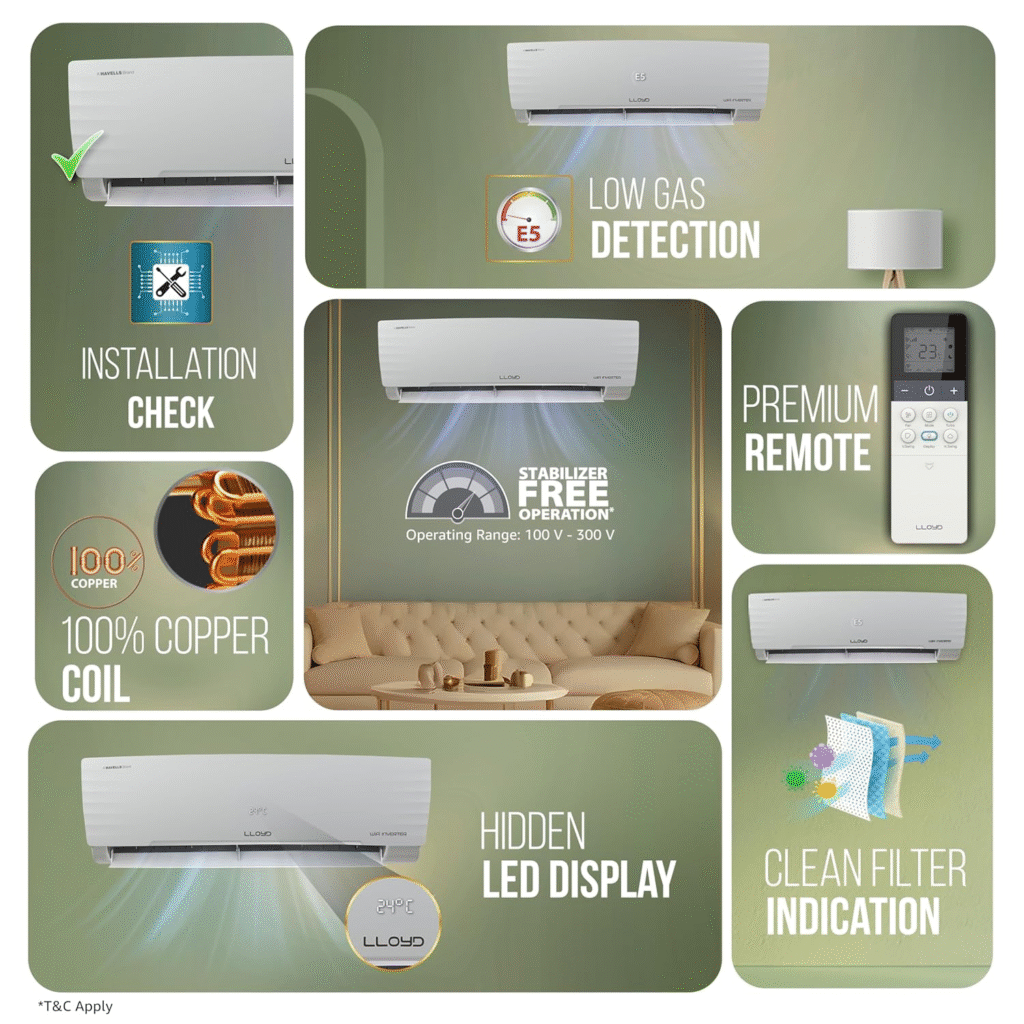
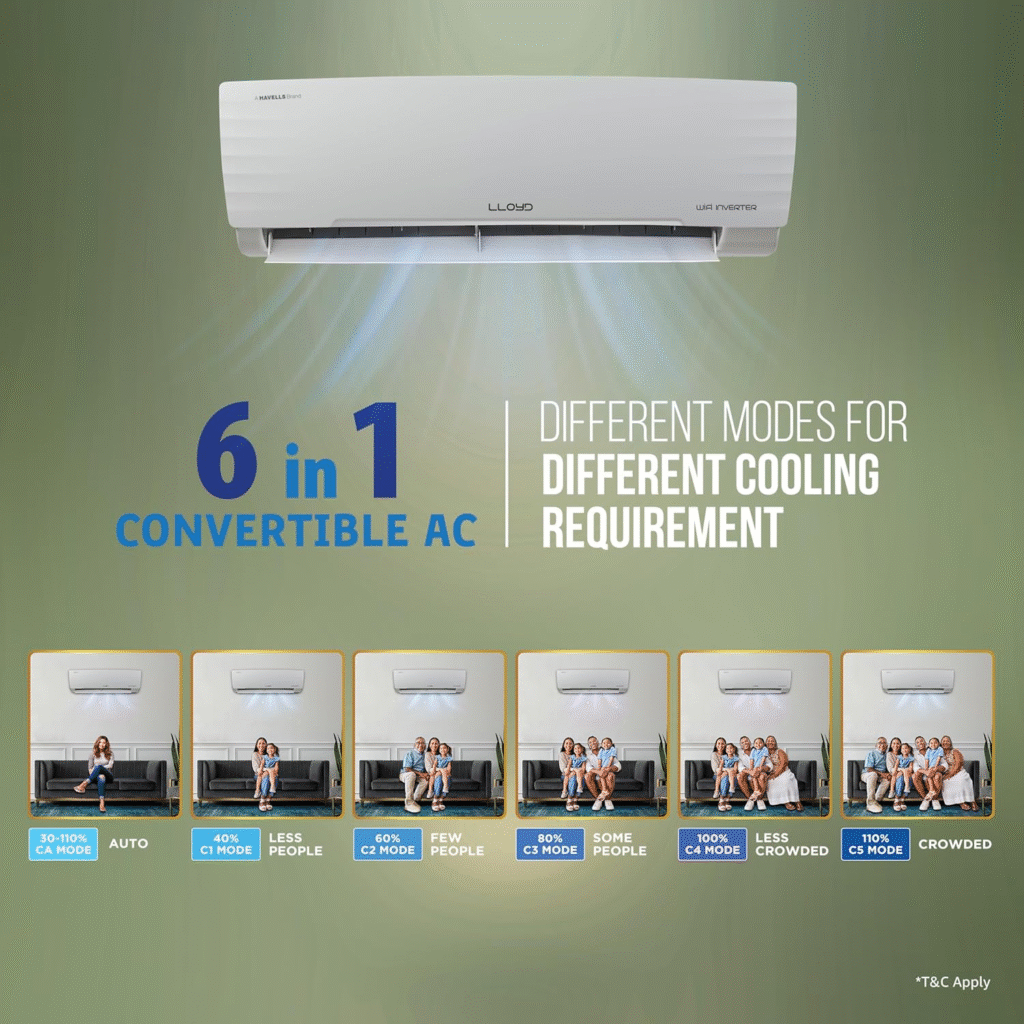
If you’re someone who likes extra features without spending extra money, this AC makes sense. Cooling is standard (~1.36 ton), so it works well for rooms up to 150 sq. ft., but the real focus here is usability. You get things like Ice Clean technology for self-cleaning and 6-in-1 convertible modes, which give you more control than most ACs in this range. It’s not the strongest in cooling or warranty, and you don’t get Wi-Fi, but for the price, it packs in more functionality than expected. It’s a feature-first choice for budget buyers who want a bit more than just basic cooling.
Images sourced from Amazon. All copyrights belong to their respective owners.
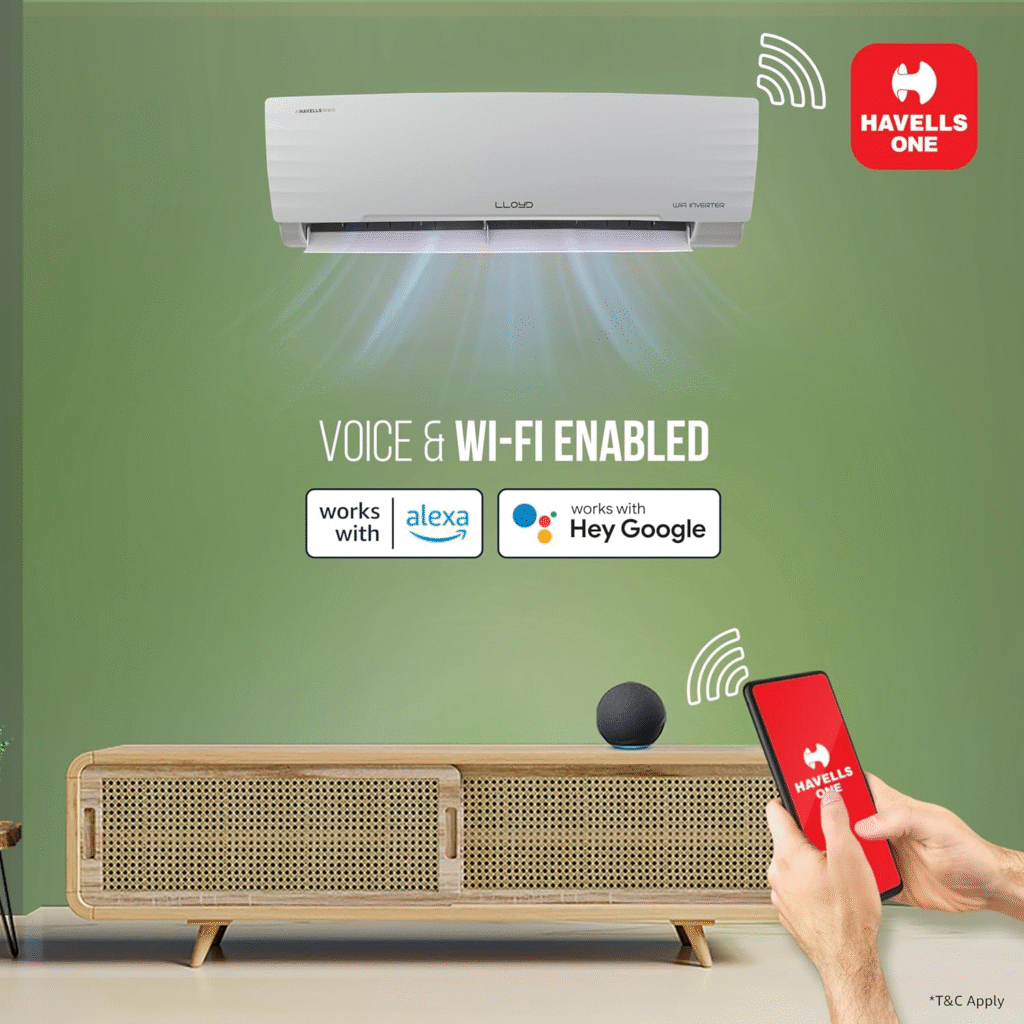
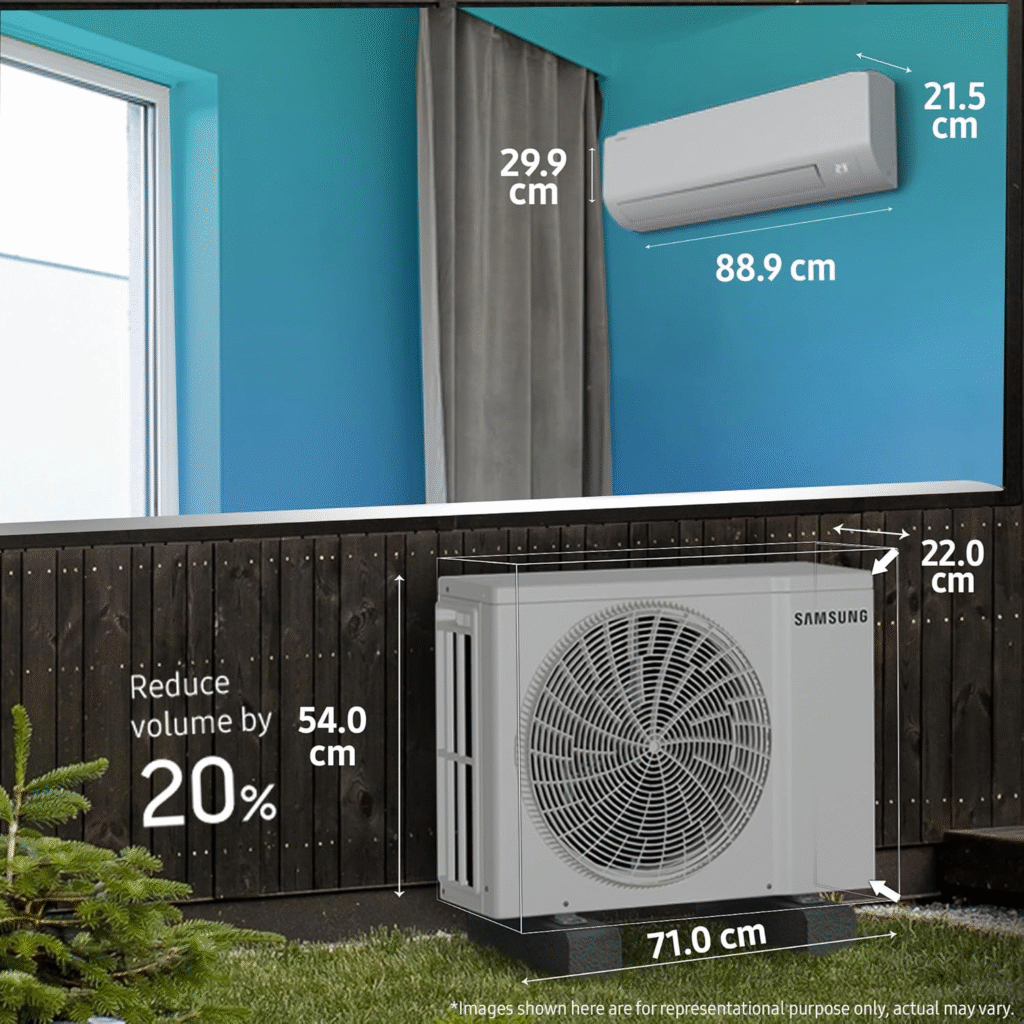
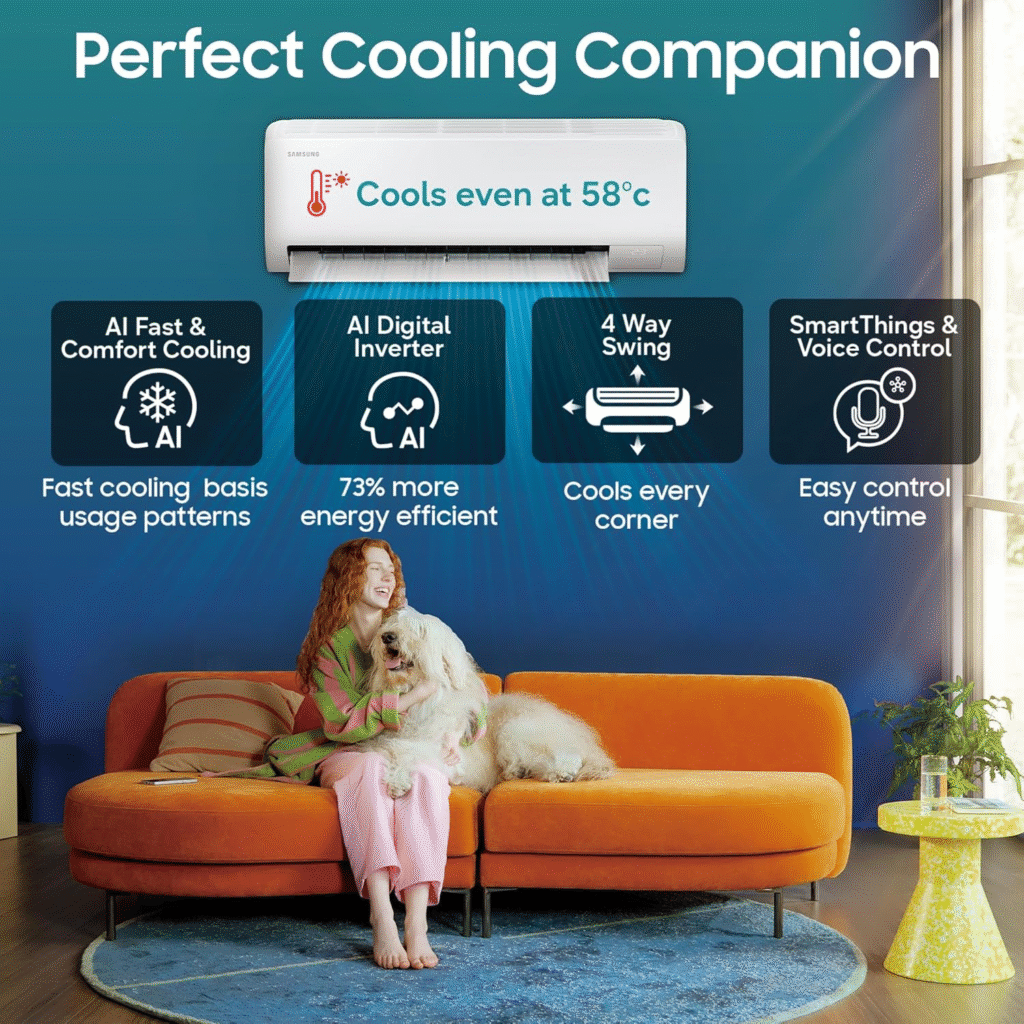
If you want an AC that feels a bit more modern and convenient, this is where Samsung stands out. Cooling is slightly better than most (~1.38 ton), but the real advantage is comfort and control—you get 4-way air swing for more even cooling and Wi-Fi connectivity to control everything from your phone. It also runs quieter than most in this range, which you’ll notice at night. It does cost a little more, and you still don’t get air filters, but the strong warranty and smart features make it a solid choice if you want more than just basic cooling.
Images sourced from Amazon. All copyrights belong to their respective owners.
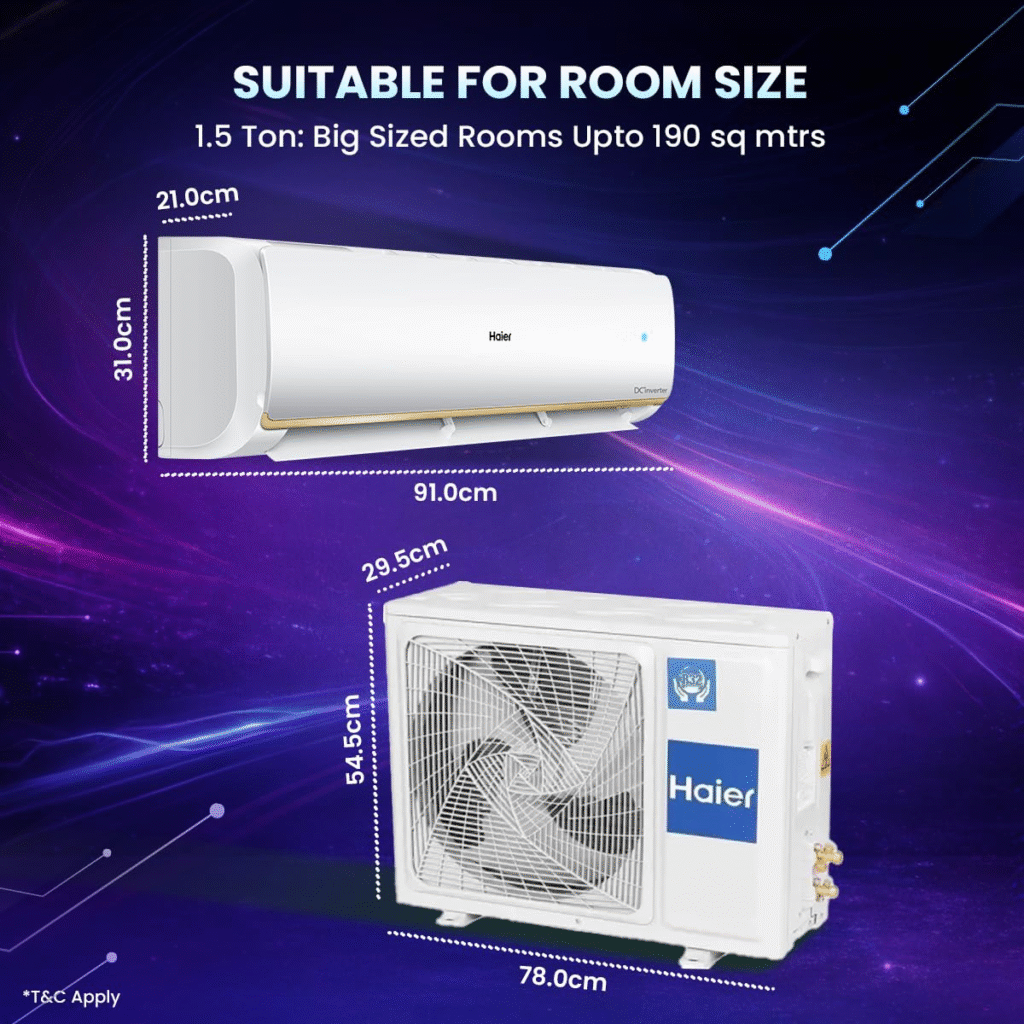
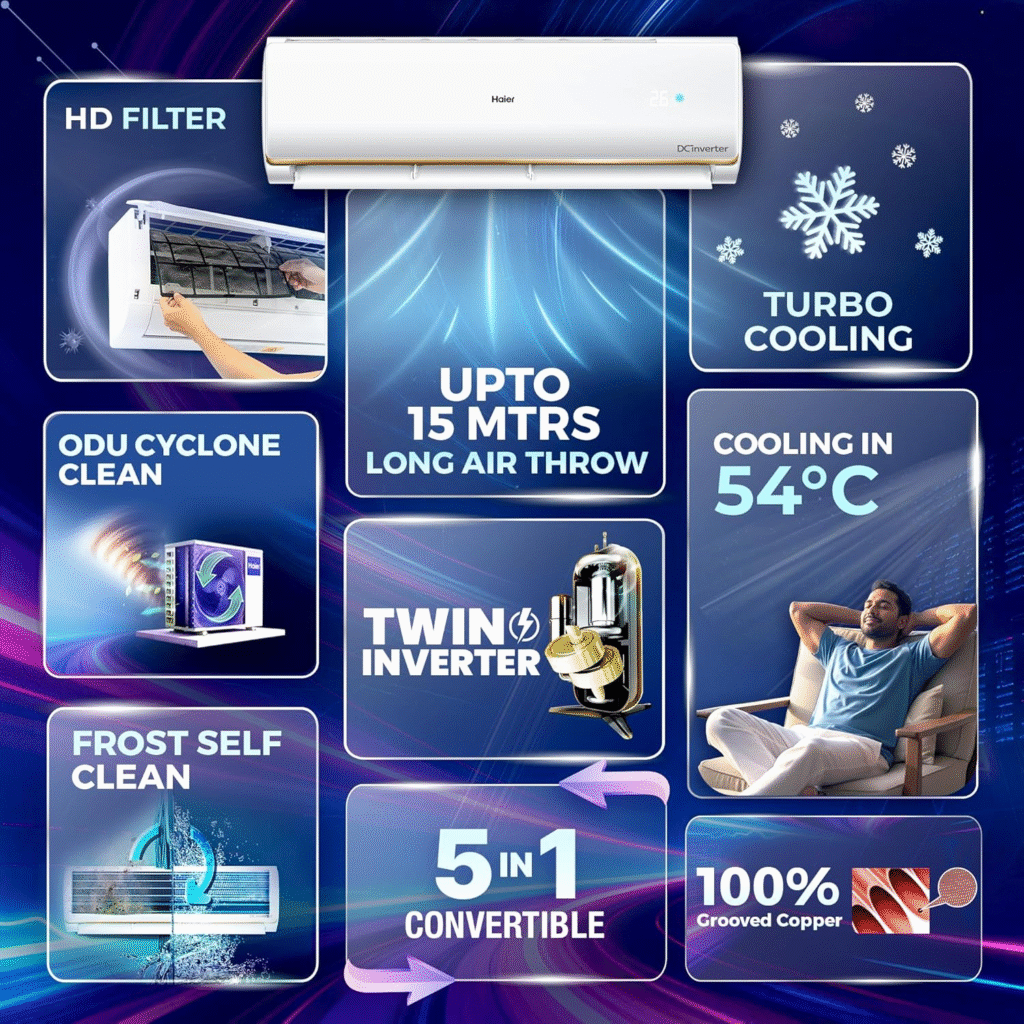
If you’re looking for something a bit different in this price range, Haier goes in a slightly more tech-focused direction. Cooling is pretty standard at around 1.36 ton, so it works well for rooms up to 150 sq. ft. Nothing surprising there. Where it stands out is the twin inverter compressor, which helps the AC run smoother and adjust better to load. You also get features like frost self-clean and an outdoor cleaning mode, which actually help keep performance consistent over time. The build quality is solid overall, no major complaints. The only thing you need to be careful about is the warranty—it’s not as straightforward as others, so read the terms properly. If you’re okay with that, this is a good option for getting more tech at a similar price.
Inverter compressors adjust power consumption based on cooling demand.
Provides faster cooling and future-proofs your purchase if you move to a larger room.
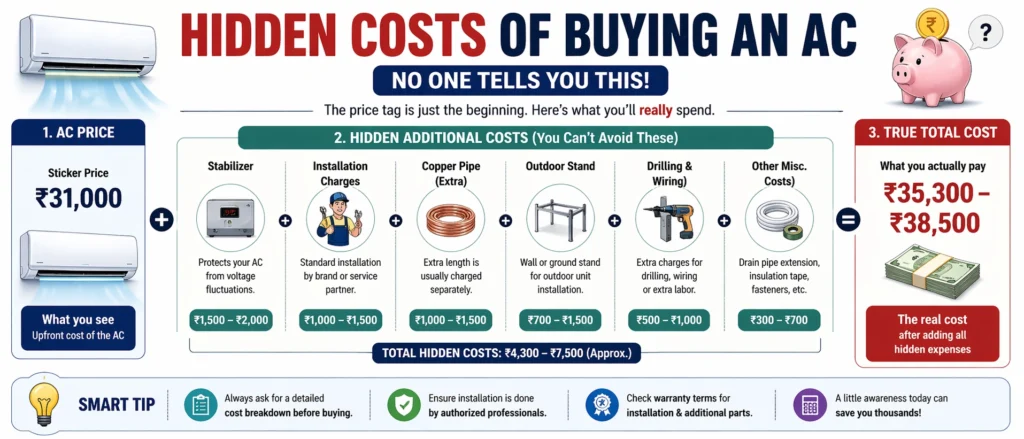
Additional Costs to Consider
Expense
Estimated Cost
Stabilizer
₹1,500 – ₹2,000
Installation Charges
₹1,000 – ₹1,500
Outdoor Unit Stand
₹500 – ₹1,000
Extra Copper Piping
As required
Pro Tip: Always ensure the installer performs vacuuming of copper pipes before the first use to maximize efficiency and lifespan.
How to Choose the Right AC for Your Home
Assess Room Size
Ensure the AC capacity matches your room dimensions for optimal performance.
Evaluate Energy Efficiency
Consider long-term electricity savings when comparing star ratings.
Check Warranty and After-Sales Service
A strong service network is essential for maintenance and repairs.
Compare Features vs Price
Avoid paying extra for features you may not use.
Conclusion
Choosing the best AC under 35000 in India is easier when you focus on cooling capacity, energy efficiency, warranty, and essential features. The Voltas 1.5 Ton 3-Star Inverter AC stands out as the best overall option due to its powerful cooling and reliability. However, if energy efficiency or smart features are your priority, Godrej and Samsung offer excellent alternatives.
Evaluate your room size, usage pattern, and budget to make a confident and informed decision that keeps you comfortable throughout the summer.
FAQs
1. Which is the best AC under 35000 in India?
The Voltas 1.5 Ton 3-Star Inverter AC is widely considered the best due to its powerful cooling and reliability.
2. Is a 3-star AC sufficient for home use?
Yes, a 3-star AC is ideal for moderate usage of 4–6 hours per day during the summer months.
3. How much electricity does a 1.5 ton inverter AC consume?
On average, it consumes between 0.8 to 1.5 units per hour, depending on usage and efficiency.
4. Do I need a stabilizer for an inverter AC?
Although many ACs support stabilizer-free operation, using a stabilizer is recommended for protection against voltage fluctuations.
5. Which AC brand offers the best warranty?
Godrej and Samsung typically provide some of the most comprehensive warranty packages in this price range.
Buying an AC feels simple… until you actually try.
Tonnage, star ratings, inverter vs non-inverter, ISEER, copper coils — suddenly everything feels like a tech exam you never signed up for.
Don’t worry. I’ll make this simple.
This guide to the Best 1.5 Ton 5 Star AC in India 2026 is based on real testing — not spec-sheet reading or unboxing videos. Every AC mentioned here was actually purchased, installed, and used to give you an honest and reliable recommendation.
New to AC buying altogether? Start with our complete AC Buying Guide first.
Let’s get into it.
In This Post
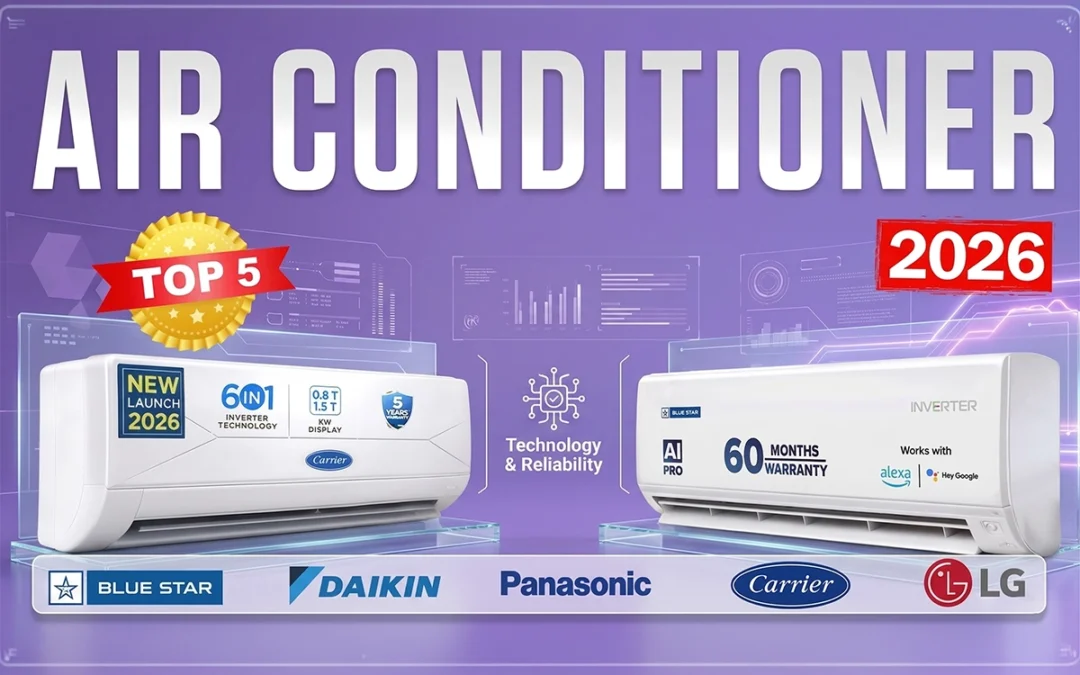
Best 1.5 Ton 5 Star AC in India 2026
Here’s the ranking — based on real usage, real testing, real rooms.
Images sourced from Amazon. All copyrights belong to their respective owners.
Best for: Rooms up to 150–155 sq ft | Budget: ~₹42,000
Let’s start with Carrier.
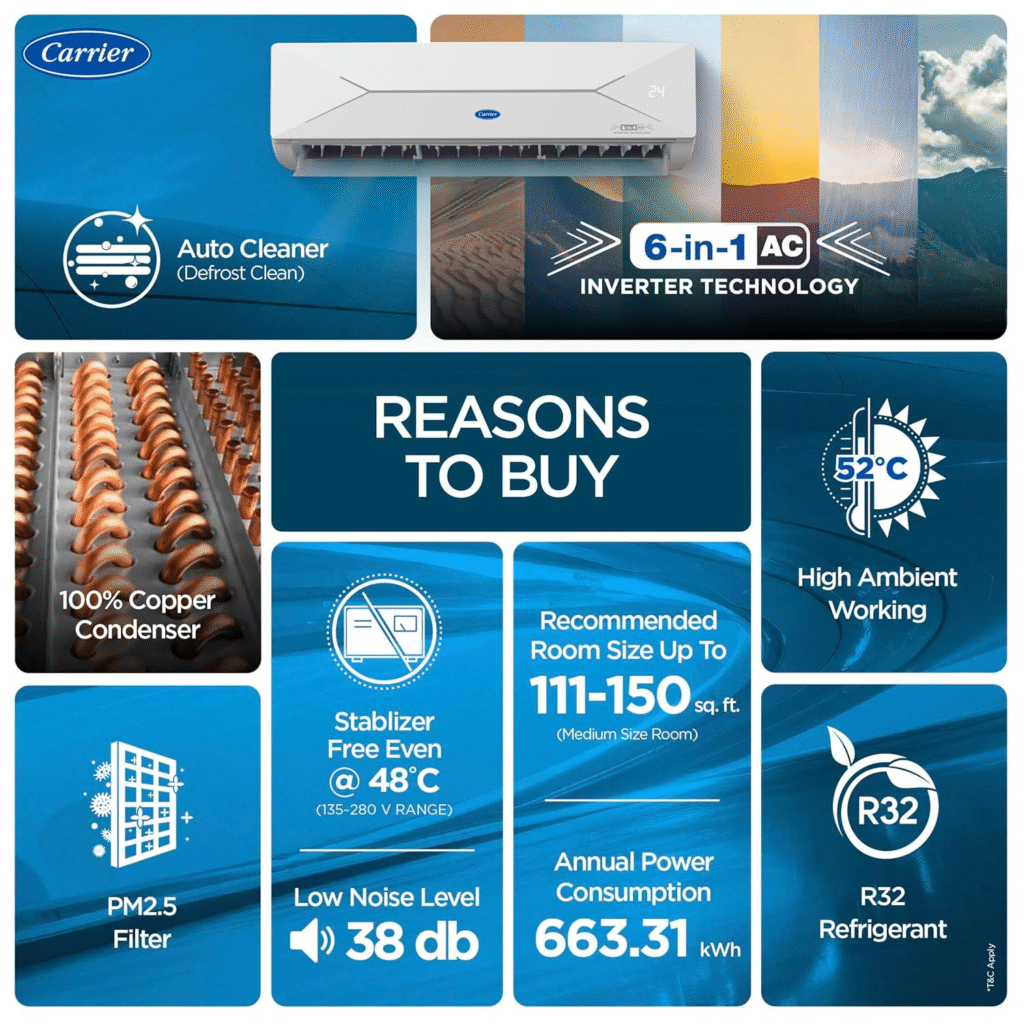
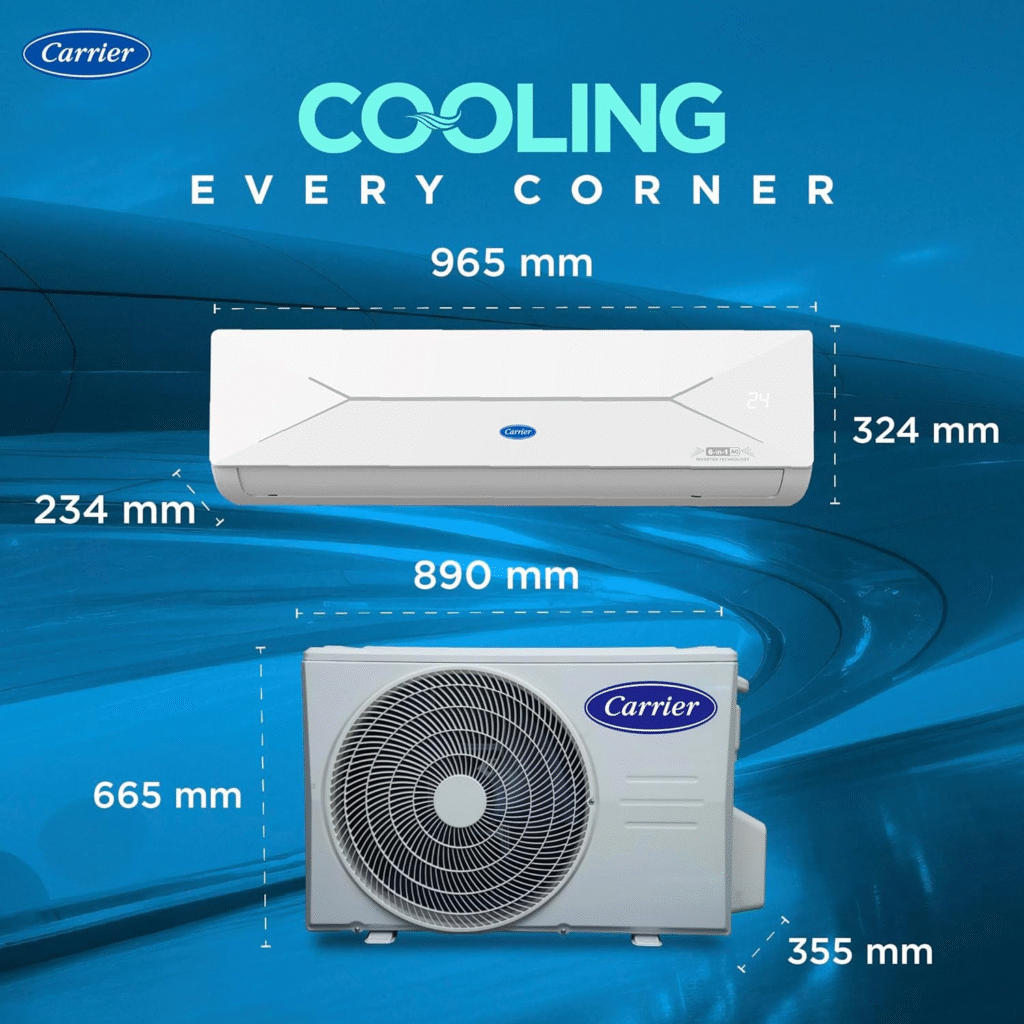
The first thing to know — the actual cooling capacity here is 1.36 tons. Not 1.5. So if your room is larger than 155 sq ft, just skip this one.
Here’s where it gets interesting — Carrier compensates with a solid ISEER rating of 5.6, which is very good. Lower cooling capacity, but more efficient use of the electricity it draws.
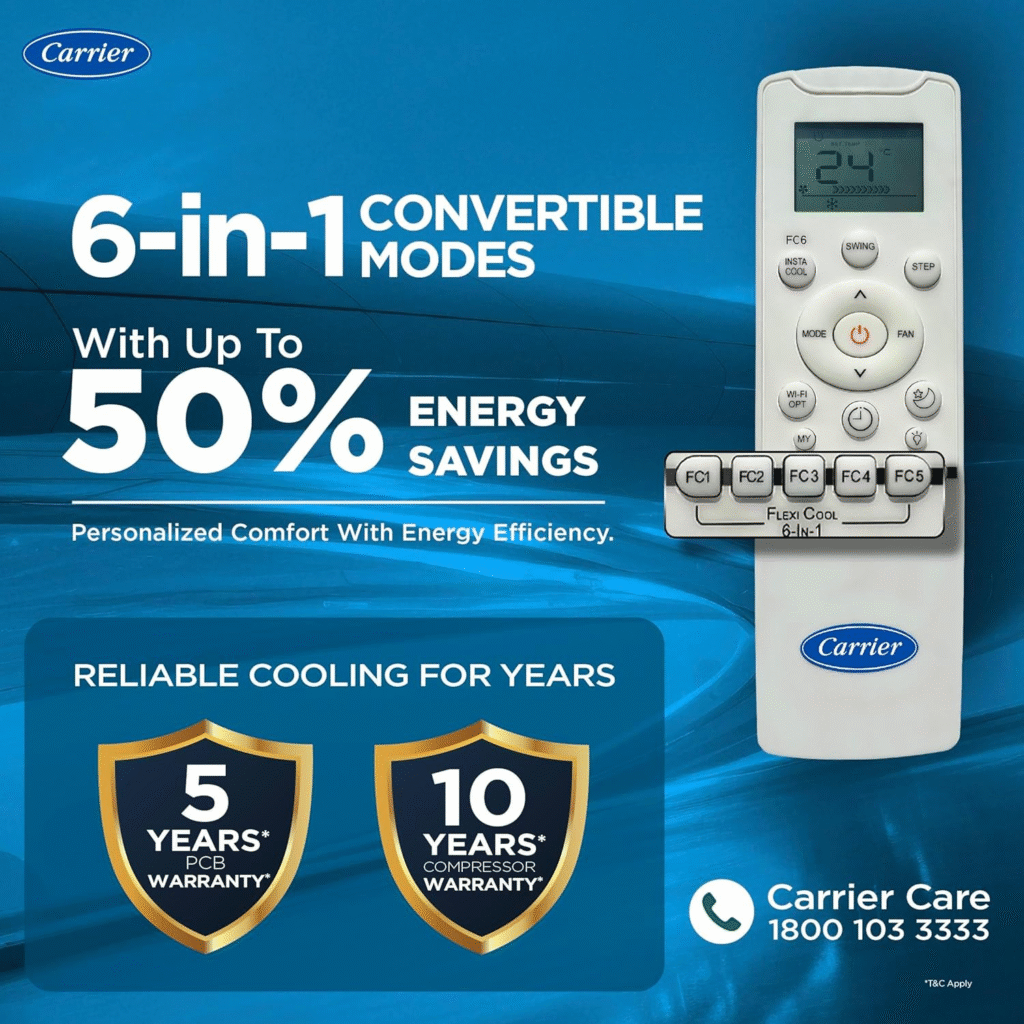
You get Carrier’s AI Flexi Cool inverter tech with convertible 6-in-1 modes, ranging from 0.8 ton to 1.7 ton in theory.
Common mistake: Getting excited about the 1.7 ton “turbo” mode. At full blast, this AC will run at that mode for only 20–25 minutes before automatically dropping back to auto. So don’t expect sustained high-capacity cooling.
That said — in the right room size (150–155 sq ft), this AC performs brilliantly. Tested it in a challenging setup with more open area than a normal room, and it handled the load well.
Quality check passed: 100% copper condenser and tubes — verified by opening the unit before installation. Carrier’s Aqua Clear coating on outdoor coils and Hydro Blue coating on indoor coils are genuinely good anti-corrosion protection.
You also get dual filtration — HD filter + PM 2.5 filter — and auto-clean technology that actually works.
The one real con: No Wi-Fi. Carrier mentions “AI mode” but without connectivity, it’s more of a marketing label than a real feature.
Noise level: Around 40 decibels in real use (company claims 38 dB).
Warranty: 1-year comprehensive | 5 years on PCB | 10 years on inverter compressor
My recommendation: If your room is 150 sq ft or under and your budget is around ₹42,000 — this is a solid buy. If your room is bigger, look at the options below.
Images sourced from Amazon. All copyrights belong to their respective owners.
Best for: Rooms up to 160–165 sq ft | Budget: ~₹47,500
LG is LG. Six years of buying and testing their ACs, and the consistency never disappoints.
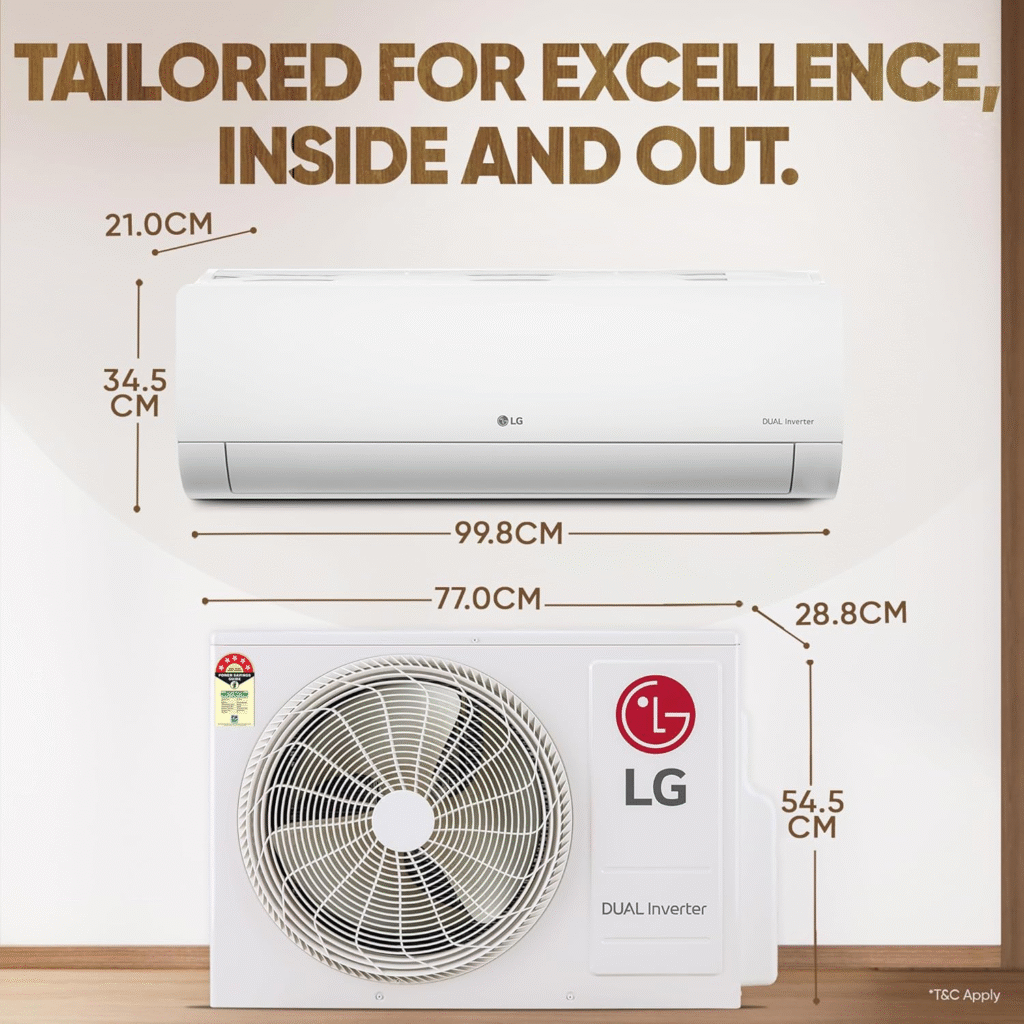
Cooling capacity here is 1.42 tons — same as last year’s model, but the ISEER has improved significantly to 5.7. How? The compressor hasn’t changed much — it’s the motor that’s been upgraded. Same cooling, less electricity. That’s the right kind of progress.
LG’s Dual Rotary Inverter Compressor is one of the best in this price range. Tested extensively across rooms and multiple years — performance doesn’t degrade over time. Noise levels don’t increase. That long-term consistency is rare.
Here’s where it gets interesting: LG gives you four-way air swing. This sounds like a small feature. It’s not. When you use it in a bedroom — where the AC placement is rarely perfect — four-way swing means the cold air actually reaches every corner. You’ll feel the difference the first week.
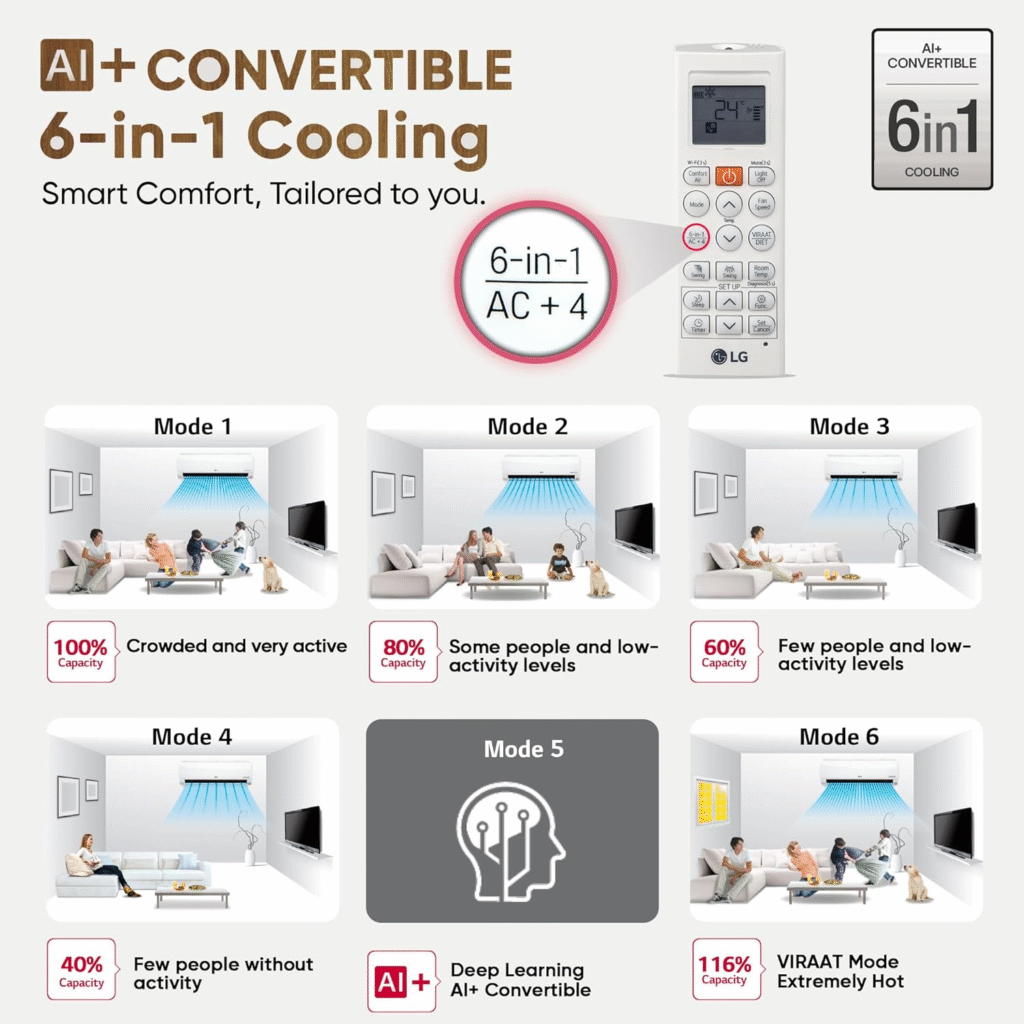
Also get: AI convertible 6-in-1 modes (40% to 110%), Virat mode (LG’s name for the turbo boost we discussed), Gold Fin Plus and Ocean Black Protection on coils, auto-clean, smart diagnosis.
Quality check: Inner grooved copper tubes — a detail most brands skip. The refrigerant passes through faster, meaning slightly better cooling efficiency. Verified before installation.
The cons — and I’ll be direct:
No Wi-Fi. In 2026. That’s a real miss. If you want Wi-Fi on LG, you’re paying ₹2,500 extra for a separate model — which already puts it above Blue Star pricing.
Also no PM 2.5 filter — just the standard HD filter. For Indian air quality, that’s a gap.
Noise level: LG claims 31 decibels. Ambient noise in a room is already 37–38 dB, so you literally cannot measure 31 dB. What this means in practice: you can barely hear it’s on.
Warranty: 1-year comprehensive | 5 years on PCB (both indoor and outdoor — important detail) | 10 years on compressor
Note on gas charging warranty: Only covered for the first year. After that, gas top-ups are at your expense.
My recommendation: If cooling performance and long-term reliability are your priority, and Wi-Fi is not a deal-breaker — LG is an excellent choice for rooms up to 165 sq ft.
Images sourced from Amazon. All copyrights belong to their respective owners.
Best for: Rooms up to 165–170 sq ft | Budget: ~₹46,500
Last year this was my #1. This year it’s tied at #2 with LG — and honestly, it could easily be argued as the better pick of the two.
Cooling capacity: 1.45 tons — the highest among the #2 and #3 picks. Tested it in a 170 sq ft room. It handled it. That’s not what the spec sheet says is recommended — that’s what actually happened in the test.
ISEER of 5.63 — incredibly good for the capacity it’s delivering.
The AI Pro inverter compressor with 5-in-1 convertible modes (40% to 110%) works flawlessly. Quality check before installation: 100% copper tubes, compressor blanket covering — everything top notch. Anti-corrosive Blue Fins on indoor and outdoor coils — proper chemical coating, not marketing.
What Blue Star gets right that LG doesn’t:
Wi-Fi. Built-in. Works with Alexa, Google Assistant, and the Blue Star app. No extra cost, no separate model needed.
And the warranty — this is where Blue Star genuinely pulls ahead. 5-year comprehensive warranty (covering all technical faults, except plastic parts and remotes). That kind of assurance at this price is rare. Plus 10 years on the compressor.
Four-way air swing — yes, same as LG. Both have it.
The one real con: No PM 2.5 filter. Just a basic dust filter. In 2026, in Indian cities, this is genuinely frustrating. Blue Star, if you’re reading this — please fix it.
Noise level: Very quiet. Comfortable for bedrooms.
My recommendation: If you want Wi-Fi, a stronger warranty, slightly more cooling capacity, and a room up to 170 sq ft — Blue Star edges ahead of LG. The only thing LG does better here is the PM 2.5 filter (which Carrier has, but Blue Star and LG don’t offer at this tier).
Images sourced from Amazon. All copyrights belong to their respective owners.
Best for: Rooms up to 160–165 sq ft | Budget: ~₹48,000–50,000
This is where it gets interesting.
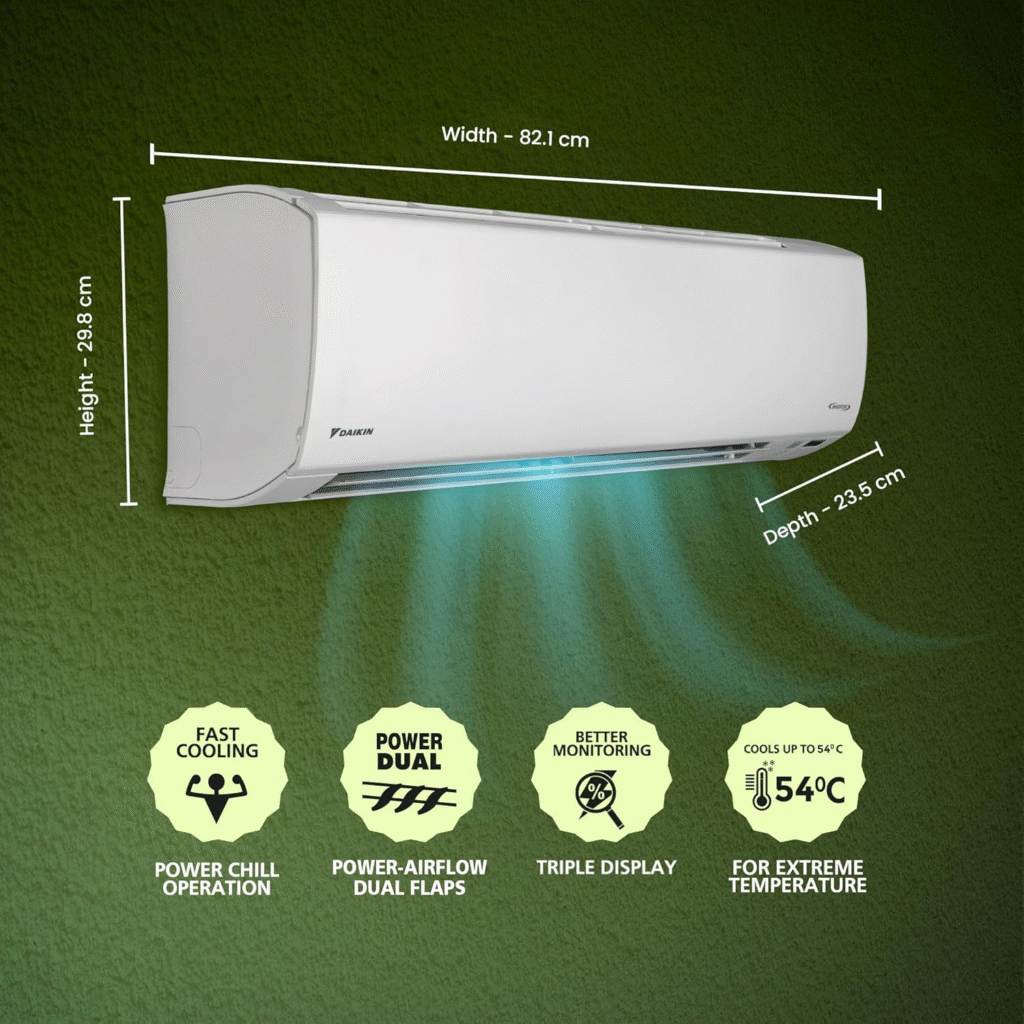
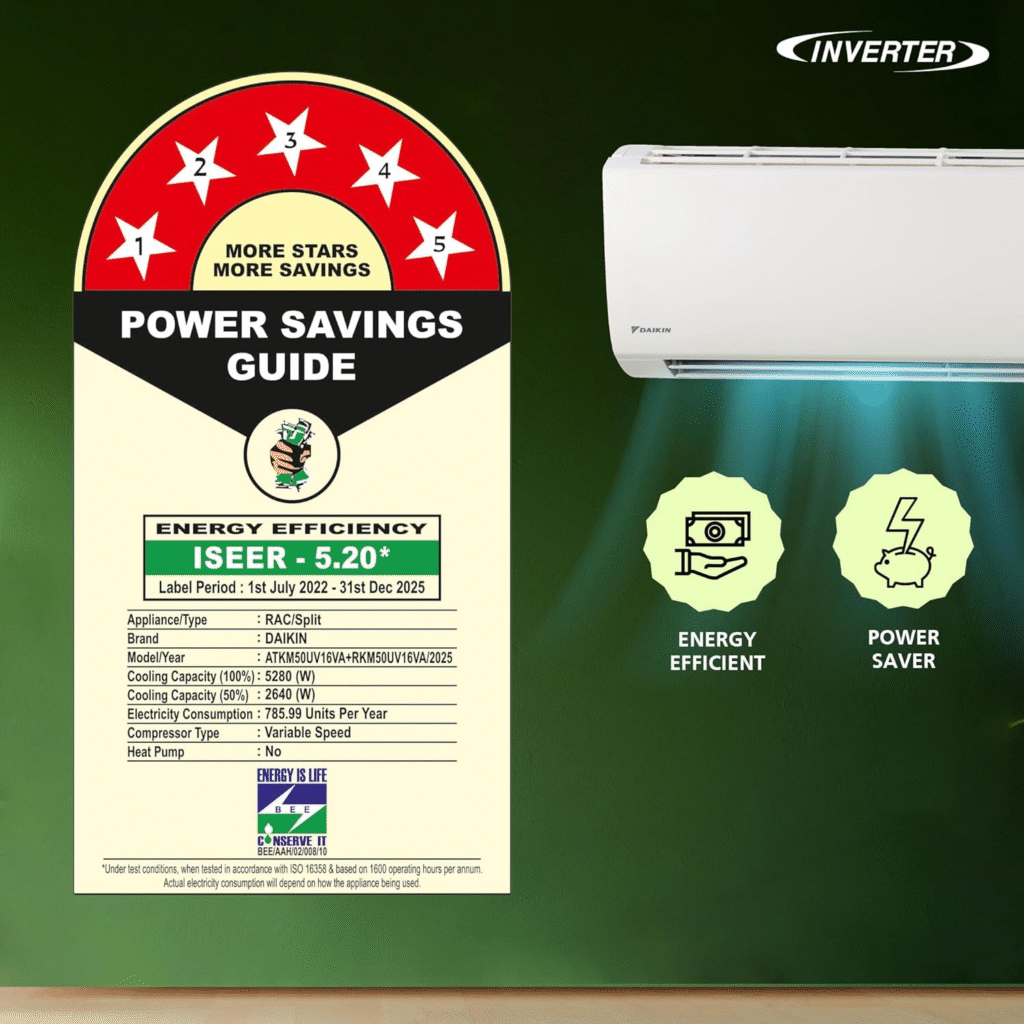
Cooling capacity dropped this year — 1.42 tons, down from a full 1.5 tons last year. That’s disappointing on paper.
But here’s the truth: it doesn’t matter. Because this is Daikin. The technology they pack into that 1.42-ton capacity makes it perform like other brands’ 1.5-ton units. Tested it. Compared it. The result is unbeatable cooling in its room size range.
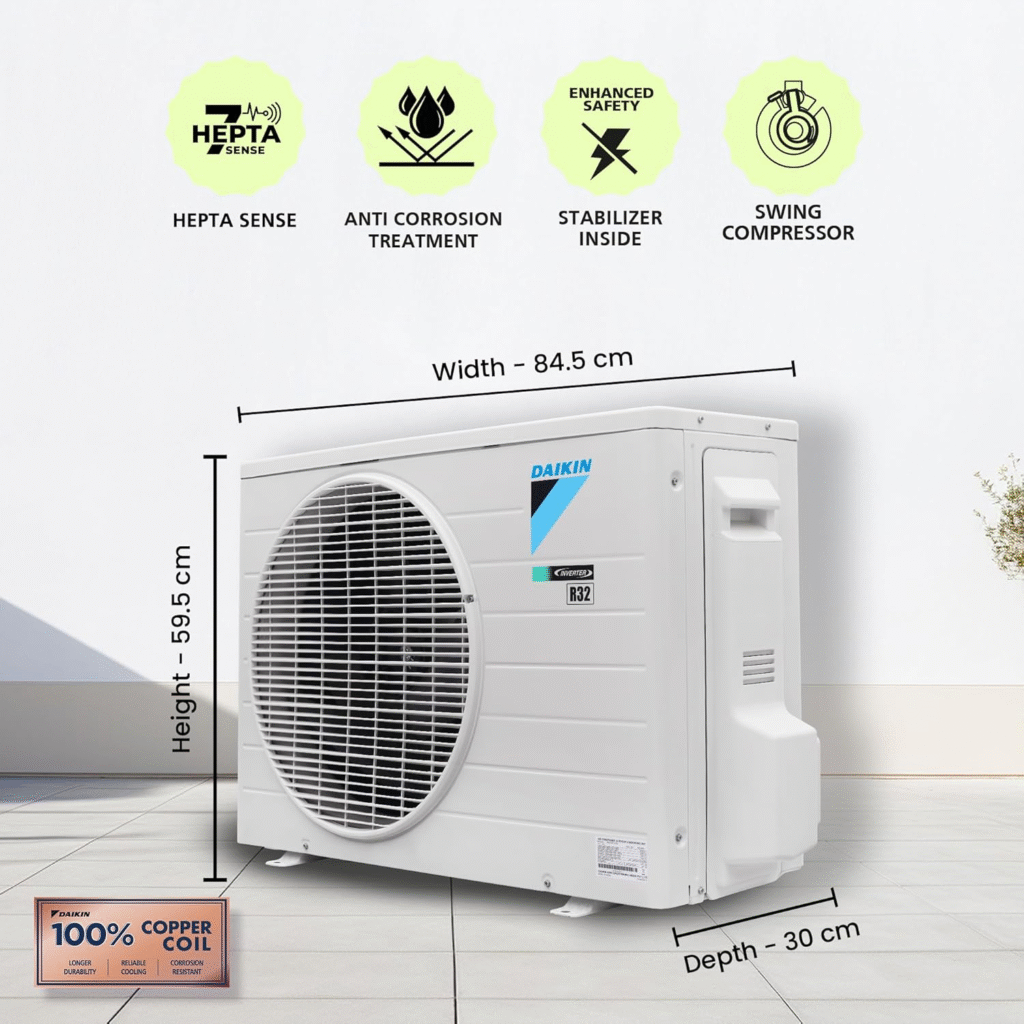
Swing Inverter Compressor technology, 100% copper condenser coils, Coanda air flow — all verified before installation. Quality is just what you expect from a Japanese brand that’s been doing this longer than most.
New addition in 2026: PM 2.5 filter + Active Carbon filter. Both. That’s a significant upgrade for air quality inside your room — especially in Delhi, Mumbai, or any metro.
The honest con: No convertible modes. Daikin’s philosophy is that convertible modes make an inverter AC behave like a non-inverter — and they’re not wrong in principle.
But here’s the thing — as a user, having that option is convenience. We can choose not to use it. Brands taking that choice away from us, even with good intentions, is still a limitation.
This has been a Daikin con for 5 years. It’s still a Daikin con in 2026.
Also no Wi-Fi — which in 2026 feels increasingly like a miss at this price point.
Noise level: Claims 34 dB. Essentially silent in practice.
Voltage range: 130V–285V. Very good.
Warranty: Standard — 1-year comprehensive, 5 years PCB, 10 years compressor.
My recommendation: If your priority is pure, reliable, Japanese-quality cooling — Daikin is still one of the best you can buy. Room size up to 165 sq ft. Accept the lack of convertible modes and Wi-Fi if those aren’t essential for you.
Images sourced from Amazon. All copyrights belong to their respective owners.
Best for: Rooms up to 170+ sq ft | Budget: ~₹48,000–50,000
If you’re going to spend ₹48,000–50,000, this is where I’d personally put that money.
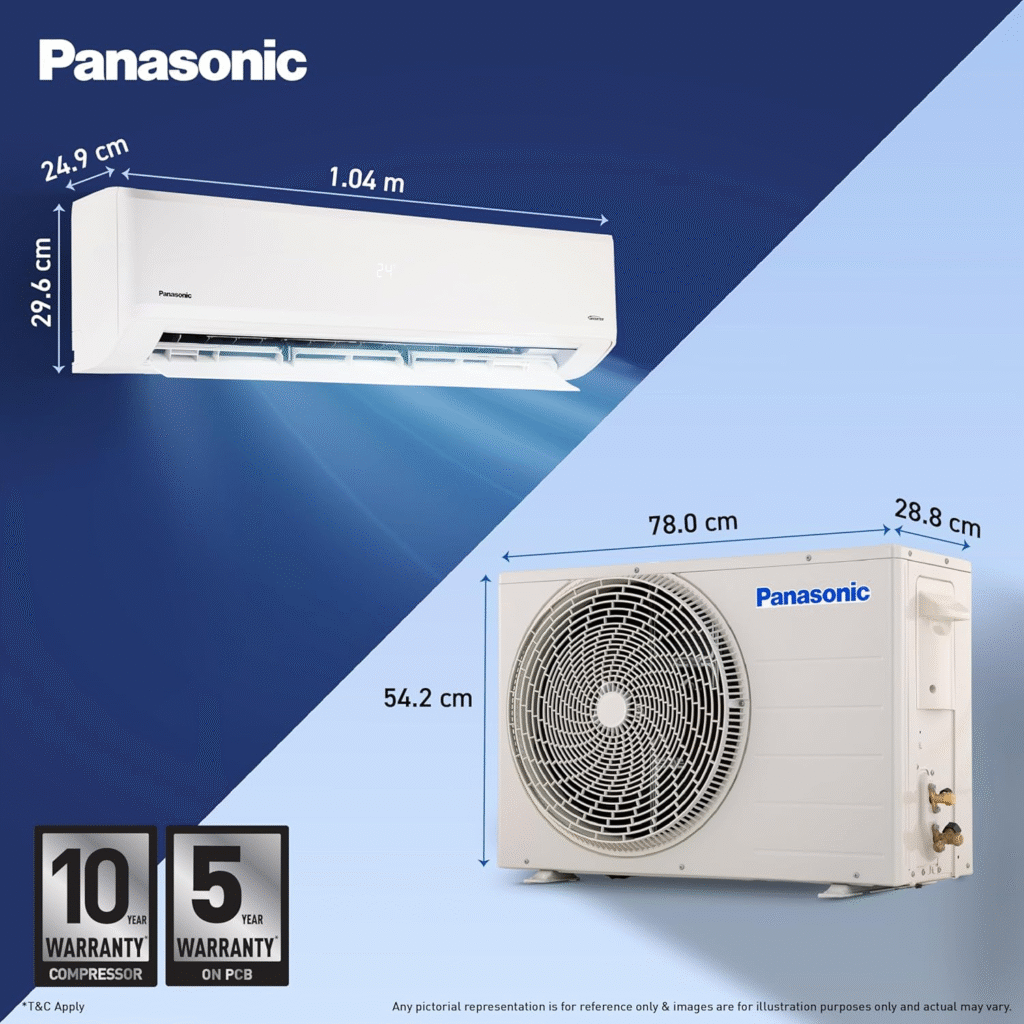
Cooling capacity: 1.45 tons — same as last year, but this year Panasonic made significant internal changes.
ISEER: 5.8 — the best in this entire list. More cooling capacity AND better efficiency. That’s not easy to pull off.
Here’s what’s new in 2026:
The indoor blower has been upgraded — physically larger. Air flow has jumped to 730 cubic feet per minute (from around 500–550 earlier). That is a massive increase. You feel it the moment you turn it on.
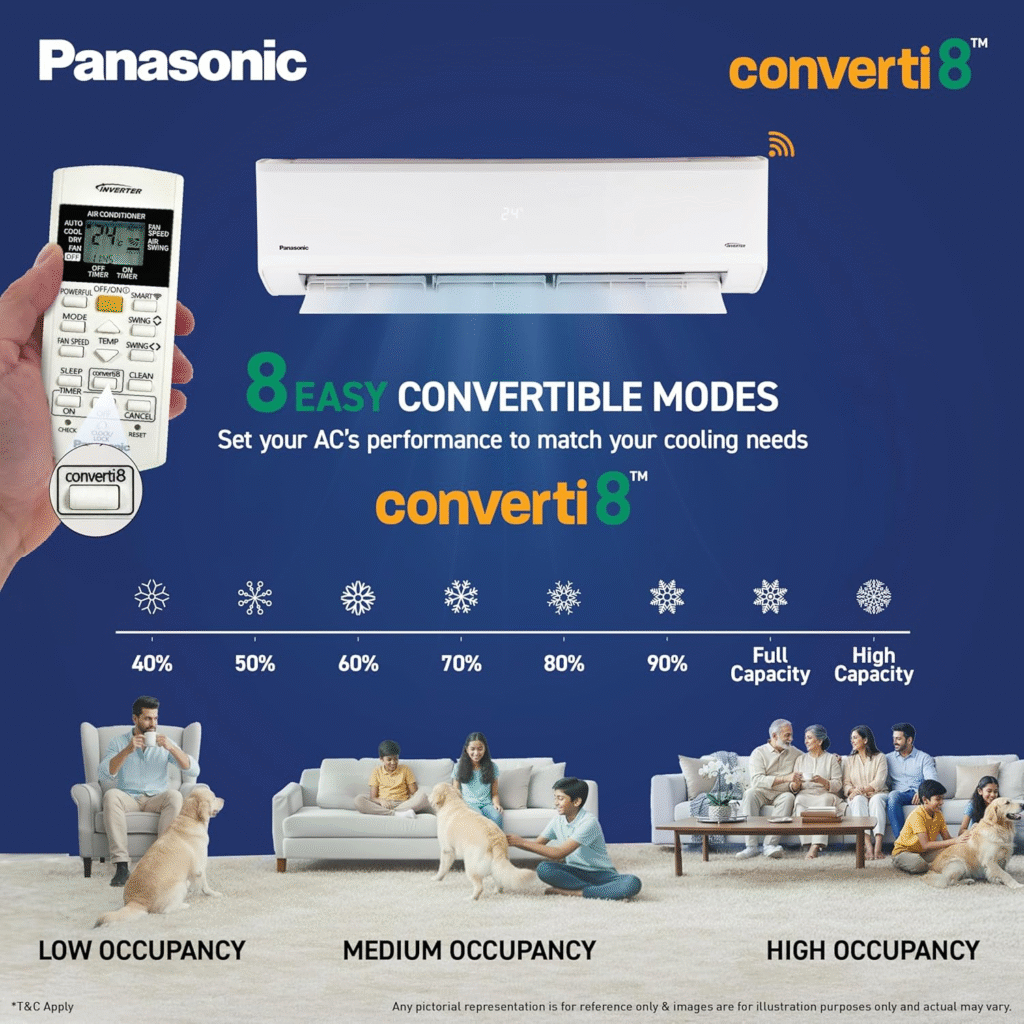
Also upgraded to 18-in-1 convertible modes — from 40% to 110%, at every 10% step. Delhi summer? Use 100%. Kerala humidity? Drop to 60%. Mumbai monsoon? 70%. The AC stays the same; you adjust it to your city and your needs.
Features that actually matter:
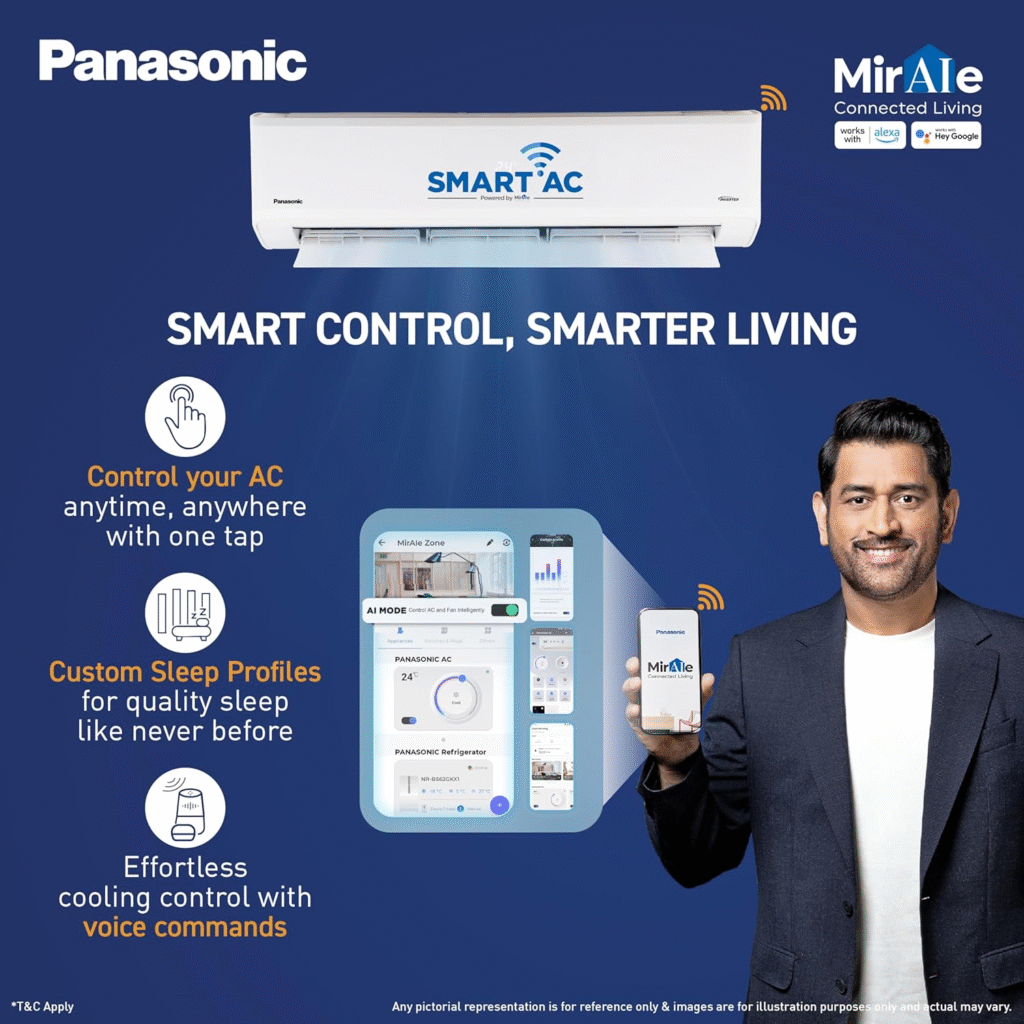
Wi-Fi built-in — and the mAir app is genuinely the best AC companion app available. You can create sleep profiles, set family member preferences individually, control via Alexa or Google Assistant.
Dust Buster — when you switch off the AC, the outdoor unit runs the fan in reverse to clean dust and sediment off the outdoor coils automatically. No other AC in this list does this.
Four-way air swing — same as LG and Blue Star.
Shield Blue Technology — chemical coating on both indoor and outdoor coils. Quality verified before installation. Top notch.
Noise level reduced to 34 dB this year (was 36–38 dB last year). Effectively silent.
Voltage range: 100V–290V. The widest range in this list.
The con — and it’s a small one:
The indoor unit is slightly larger than other brands because of the bigger blower. Not a dealbreaker, but worth noting for tight wall spaces.
Warranty: 1-year comprehensive | 5 years PCB | 10 years compressor.
My recommendation: If you want the best of everything — cooling capacity, efficiency, Wi-Fi, app quality, air flow, and smart features — Panasonic is the answer. It’s the one AC in this list where I genuinely have no major complaints.
Final Decision Guide — Pick Your AC in 60 Seconds
If your room is under 155 sq ft and budget is ₹42,000: → Go with Carrier. No overthinking needed.
If your room is 155–165 sq ft and Wi-Fi doesn’t matter: → LG. Best long-term reliability, incredibly quiet, inner grooved copper tubes.
If your room is 155–170 sq ft and you want Wi-Fi + strong warranty: → Blue Star. Better warranty than LG, Wi-Fi included, slightly more cooling capacity.
If you want Japanese build quality and don’t need Wi-Fi or convertible modes: → Daikin. Pure cooling performance, PM 2.5 + Active Carbon filter, unbeatable reliability.
If you want the absolute best and you’re willing to pay for it: → Panasonic. Best ISEER, highest airflow, best app, Dust Buster, 18-in-1 modes. The complete package.
Before You Pick Any AC — Read These 3 Points First (Best 1.5 Ton 5 Star AC in India 2026)
Most people skip this part. That’s exactly why they regret their purchase later.
Star Ratings Changed in 2026 — Here’s What That Actually Means
Here’s the truth: the star rating system was completely revised in January 2026.
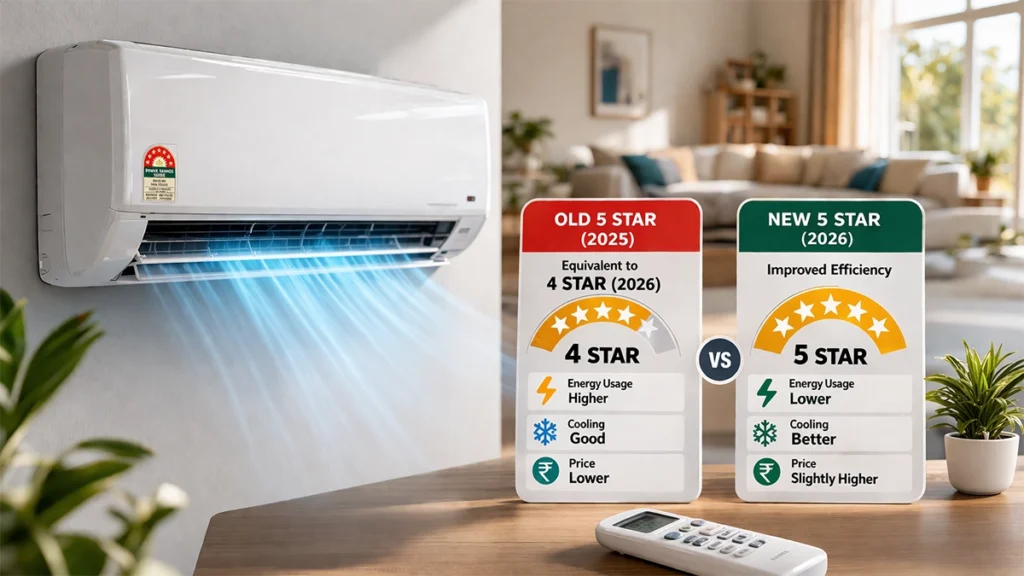
Any AC that was rated 5-star in 2025 is now technically a 4-star AC under the new norms. The government raised the bar.
The new 2026 five-star ACs consume slightly less electricity while delivering the same cooling. Sounds great, right?
But here’s the practical part — the actual savings difference between a 2025 model and a 2026 model is not dramatic enough to justify a ₹4,000–5,000 price premium.
Simple rule: If you find a 2025 model of the Best 1.5 Ton 5 Star AC in India 2026 at a significant discount right now — just buy it. Don’t let the star label on the box make the decision for you. Your electricity savings won’t cover that price gap anytime soon.
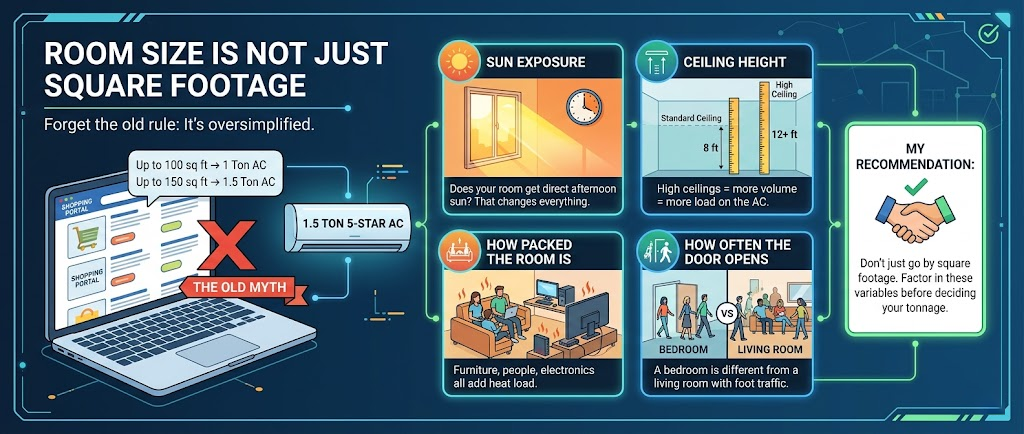
Room Size Is Not Just Square Footage
You’ve seen this everywhere on Flipkart and Amazon:
Up to 100 sq ft → 1 Ton AC
Up to 150 sq ft → 1.5 Ton AC
Forget that. It’s oversimplified.
For a 1.5 Ton 5-Star AC, the right room size depends on:
Sun exposure — Does your room get direct afternoon sun? That changes everything.
Ceiling height — High ceilings = more volume = more load on the AC.
How packed the room is — Furniture, people, electronics all add heat load.
How often the door opens — A bedroom is different from a living room with foot traffic.
My recommendation: Don’t just go by square footage. Factor in these variables before deciding your tonnage.
We’ve covered room size calculation in detail in our complete AC guide — worth a read before you decide.
Cooling Capacity ≠ Tonnage Category
This is where most people get fooled.
Every brand will call their AC “1.5 Ton.” But the actual cooling capacity inside that 1.5 Ton label varies brand to brand. One brand’s 1.5 Ton might actually cool at 1.36 tons. Another might deliver 1.45 tons.
Here’s the truth: 1.5 Ton is a category, not a fixed spec. Always check the actual cooling capacity in the technical details — not just the headline tonnage.
I’ll tell you the exact cooling capacity for every AC in this list. That’s what will actually help you decide.
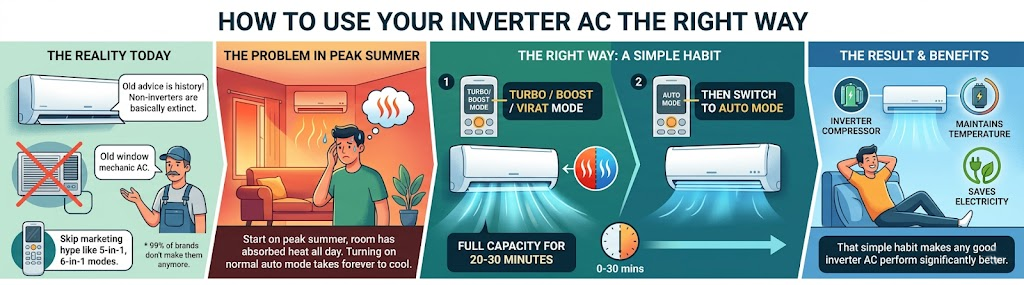
How to Use Your Inverter AC the Right Way
Still confused about inverter ACs? Let’s make this simple.
Non-inverter ACs are basically extinct in the residential market now. 99% of brands don’t even make them anymore. So whatever your old mechanic told you about “inverter ACs having expensive repairs” — that advice is from another era. Move on.
Here’s where it gets interesting —
Every inverter AC today comes with convertible modes. You’ll see 5-in-1, 6-in-1, 8-in-1. Don’t get excited about those numbers — it’s mostly marketing.
What actually matters is how you use it:
When you turn on your AC in peak summer, your walls are hot. The room has absorbed heat all day. If you start the AC on auto mode, it’ll take forever to cool down.
Common mistake: Turning on the AC at normal mode and then complaining it doesn’t cool fast enough.
The right way:
Start on Turbo/Boost/Virat mode (whatever your brand calls it) — full capacity for 20–30 minutes.
This cools down your hot walls fast.
Then switch to Auto mode.
The inverter compressor takes over, maintains the temperature, and saves electricity.
That’s it. That simple habit will make any good inverter AC perform significantly better.
Before Installation — Don’t Skip These Steps
Copper Pipe Vacuuming
When your AC gets installed, insist on vacuuming the copper pipes before the unit is switched on.
If the installation team says they don’t have a vacuum pump — stop them. That’s a red flag. Don’t let them proceed without it. Skipping this step can damage your AC over time.
Budget for Extra Costs
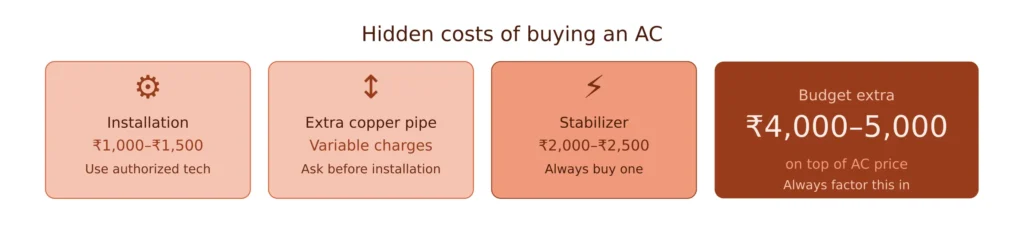
Your AC price is not your total cost. Here’s a realistic breakdown:
AC price — what you see online
Installation charges — up to ₹1,500 (always use the brand’s authorized installer; warranty depends on it)
Extra copper pipe — if your indoor and outdoor units are more than 3 meters apart, you’ll pay extra per foot
Stabilizer — ₹2,000–2,500
Total extra budget to keep aside: ₹4,000–5,000 over and above the AC price.
Do You Actually Need a Stabilizer?
Every brand will tell you their inverter AC has built-in voltage stabilization. And that’s true — to a point.
But if there’s a voltage surge in your home and your ₹47,000 AC gets fried, the brand may not honor the warranty claim.
A ₹2,000–2,500 stabilizer is cheap insurance for an expensive appliance. Just buy it.
What About Samsung, Mitsubishi, and Voltas?
Fair question.
Mitsubishi and General are genuinely excellent ACs and could easily compete for the title of the Best 1.5 Ton 5 Star AC in India 2026. Their build quality and cooling performance are hard to fault.
But here’s the catch — they’re not easily available on platforms like Amazon or Flipkart, and their service networks are strongest in Tier 1 cities.
If you live in a Tier 2 or Tier 3 city, make sure you check service availability and spare parts access before making the purchase.
The product might be outstanding; the after-sales experience could be the real challenge.
Samsung will be covered separately — it deserves its own detailed review.
Voltas is a different category and price point — worth considering if budget is the primary constraint.
One Last Thing
If I had to recommend just one thing from this entire Best 1.5 Ton 5 Star AC in India 2026 guide — get the tonnage and room fit right. Everything else is secondary.
A ₹50,000 AC in the wrong room size will always underperform a ₹42,000 AC in the right room size.
That’s the one mistake that no brand, no warranty, and no feature can fix.
Get that right. Everything else falls into place.
Frequently Asked Questions (FAQs)
1. Which Is the Best 1.5 Ton 5 Star AC in India (2026)?
Panasonic offers the best combination of performance, efficiency, and smart features, closely followed by Daikin.
2. Is it worth buying a 2026 model over a 2025 model?
If the price difference exceeds ₹4,000–₹5,000, a 2025 model can provide better value with minimal efficiency compromise.
3. What room size is suitable for a 1.5 Ton AC?
Typically, 150–170 sq. ft., depending on sunlight exposure, insulation, and ceiling height.
4. Do I need a stabilizer for an inverter AC?
Yes. Although many ACs support stabilizer-free operation, an external stabilizer offers additional protection against voltage fluctuations.
5. Which brand provides the best warranty?
Blue Star stands out with its 5-year comprehensive warranty, offering significant peace of mind.
Prices mentioned are approximate at time of testing. Always check current prices and available offers before purchasing. Use authorized brand installers to keep your warranty valid.
So you’ve finally decided to buy an AC. Maybe the last summer broke you, or maybe you’re just done pretending that a ceiling fan is “enough.” Either way — welcome to this AC buying guide 2026. You’re in the right place.
I’ve been through this whole process myself, and honestly? It’s way more confusing than it needs to be. Tonnage, BEE star ratings, inverter compressors, split vs window, Wi-Fi enabled, PM 2.5 filters… it feels like you need an engineering degree just to buy something that blows cold air.
So let me break it all down for you — simple, honest, and without the fluff. This AC buying guide 2026 covers everything from the absolute basics to the stuff even “experienced” buyers miss.
Let’s get into it.
In This Post
Too many brands. Too many features. Too many misleading terms.
If you choose wrong, you will:
Waste electricity
Get poor cooling
Regret your purchase for years
This guide simplifies everything. No technical jargon. No fluff.
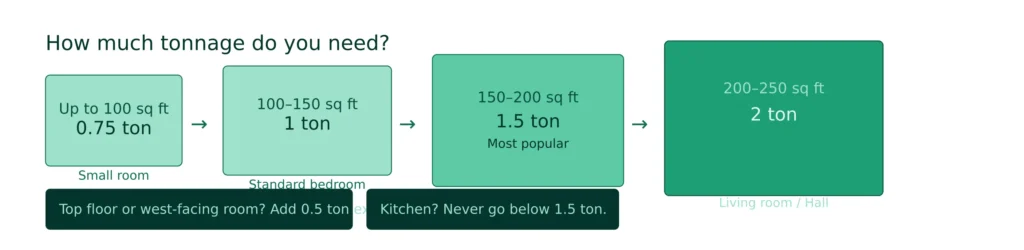
How much ton you need
Here’s a simple formula that works for Indian conditions:
If you don’t want to read everything, here’s the simple rule:
Room Size
Recommended Tonnage
Small room Up to 100 sq ft
0.75 ton
100 – 150 sq ft
1 ton
Medium room 150 – 200 sq ft
1.5 ton
Large room 200 – 250 sq ft
2 ton
Living room250 sq ft and above
2+ ton
For most Indian homes: 1.5 Ton 5 Star Inverter AC is the safest choice
But wait — room size alone isn’t the full story.
A few things can change your AC ton requirement:
Top floor flat? Add 0.5 ton. The roof absorbs a ton of heat (pun intended).
West-facing room? Same — add 0.5 ton. Afternoon sun is brutal.
More than 4–5 people regularly in the room? Bodies generate heat. Factor that in.
Large windows with direct sunlight? Consider going up a size.
Kitchen? Never go below 1.5 ton regardless of size.
Not sure which size is right? Read our detailed guide on 1 Ton vs 1.5 Ton AC
The common mistake is people buy a 1-ton AC because it’s cheaper, put it in a 180 sq ft room, and then wonder why it runs all day without cooling properly. Undersized AC = higher electricity bill + shorter AC lifespan + you still sweating.
Types of AC (AC Buying Guide 2026)
1. Split AC (Best for Most People)
The one with an indoor unit on your wall and an outdoor unit outside. This is what most people buy today and for good reason.
Pros:
Quieter operation (compressor is outside)
Better cooling distribution
Sleeker look
Available in higher tonnage and efficiency ratings
More brands and models to choose from
Cons:
Requires professional installation (drilling, piping)
Installation cost: ₹2,000–₹4,000 extra
If you move houses, reinstallation is a hassle and cost
Best choice for bedrooms and living rooms
2. Window AC
The single unit that sits in a window or wall opening.
Pros:
Easier installation
Cheaper upfront
Good for rentals where you might move frequently
No separate outdoor unit to worry about
Cons:
Noisier (compressor is right inside the unit)
Less efficient options available
Limited to smaller rooms
Good for budget buyers
My take: If you own your home or plan to stay for 2+ years — split AC, no question. If you’re a renter who moves every year, window AC makes more sense practically.
3. Portable AC (Avoid)
Easy to move
Poor cooling
Not worth it in Indian heat
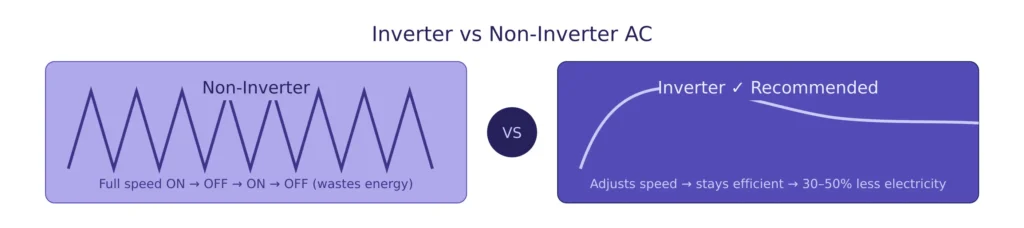
Inverter vs Non-Inverter AC — Just Buy Inverter
Non-Inverter AC
The compressor runs at full speed, then shuts off, then runs again at full speed, then shuts off. It’s like driving a car by flooring the accelerator and then hitting the brakes repeatedly.
Old technology
High electricity consumption
Inverter AC (Recommended)
The compressor adjusts its speed based on how much cooling is needed. Once the room is cool, it slows down and maintains the temperature. Much more efficient.
Adjusts speed automatically
Saves electricity
Better cooling control
The result? Inverter ACs use 30–50% less electricity compared to non-inverter ACs. In India, where electricity bills in summer can be painful, this matters a lot.
My recommendation: Always go inverter. No exceptions.
The only scenario where non-inverter makes sense is if you’re using the AC for very short periods (like 2–3 hours a day at most). For regular daily use — inverter, always.
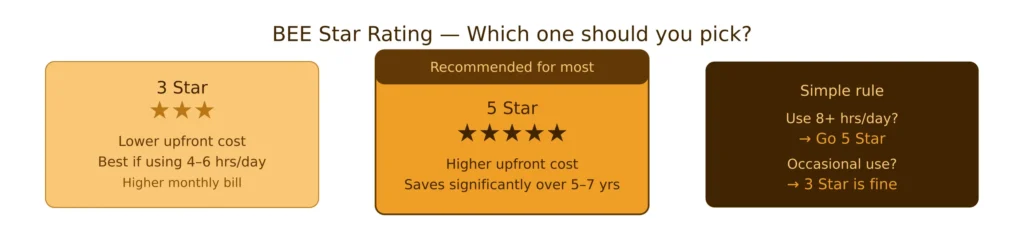
3 Star vs 5 Star AC (Don’t Buy Anything Below 3 Star in 2026)
The BEE (Bureau of Energy Efficiency) star rating tells you how energy efficient an AC is. More stars = less electricity consumed.
For 2026, here’s what I’d recommend:
Star Rating
Who Should Buy
3 Star
Budget buyers, limited usage (4–6 hrs/day)
4 Star
Good balance of cost and efficiency
5 Star
Daily heavy usage, long-term savings priority
5 Star AC
Higher efficiency
Lower electricity bills
Higher price
3 Star AC
Cheaper
Higher electricity consumption
Simple Rule:
If you’re running your AC 8+ hours a day (which most people in Delhi, Mumbai, or Chennai do in peak summer), go 5-star. The electricity savings over 5–7 years are significant.
Still confused? Check full comparison: 3 Star vs 5 Star AC – Which One Should You Buy
Link → 3 Star vs 5 Star AC
Pro tip: Check the ISEER value on the label, not just the stars. Higher ISEER = better efficiency. Two 5-star ACs can have different ISEER values, and the higher one will save you more money.
Use AC daily → go for 5 Star
Use occasionally → go for 3 Star
2026 Star Rating Change (Important)
In 2026:
Old 5 star → now 4 star equivalent
New models are slightly more efficient
But savings are small
If a 2025 model is ₹4000–5000 cheaper, buy that instead
One thing I always tell people — check the service network in your city before buying. A great AC from a brand with no service center nearby is a headache waiting to happen.
What’s the Actual Cost? (2026 Price Guide)
Here’s a rough price range to set your expectations:
Type
Tonnage
Star Rating
Price Range
Split Inverter
1 ton
3 Star
₹28,000 – ₹35,000
Split Inverter
1 ton
5 Star
₹38,000 – ₹48,000
Split Inverter
1.5 ton
3 Star
₹33,000 – ₹42,000
Split Inverter
1.5 ton
5 Star
₹45,000 – ₹60,000
Split Inverter
2 ton
5 Star
₹58,000 – ₹80,000
Window AC
1 ton
3 Star
₹22,000 – ₹28,000
Window AC
1.5 ton
3 Star
₹28,000 – ₹35,000
Add ₹2,000–₹4,000 for installation (split AC). Always get it done by the brand’s authorized installer — DIY or local electricians can void your warranty.
Where to buy: Flipkart, Amazon, and brand websites frequently run good deals especially during January–March (off-season pricing). If you’re buying offline, Reliance Digital and Croma often price-match online rates if you ask.
Common Mistakes to Avoid
Buying based on price alone. The cheapest AC in the showroom will cost you more in electricity over 5 years.
Ignoring tonnage. I said it before, I’ll say it again. Undersized AC is the #1 mistake.
Skipping AMC (Annual Maintenance Contract). The first year is usually free under warranty. After that, get an AMC — ₹1,500–₹3,000/year for regular servicing. It keeps the AC efficient and extends its life significantly.
Not servicing regularly. Clean the filter every 2–3 weeks in heavy use months. Get professional servicing once a year. A dirty AC can use 15–20% more electricity.
Buying last year’s unsold stock without checking. Always check the manufacture date. If a dealer is pushing a “new” AC that was manufactured 2 years ago — that’s 2 years off your warranty effectively.
Learn how to reduce bills: How to Save Electricity with AC
AC Buying Checklist 2026 (AC Buying Guide 2026)
Before you finalize your purchase, run through this:
Measured room size accurately
Accounted for top floor / west-facing / extra heat sources
Chosen inverter AC (not non-inverter)
Minimum 3-star rating (5-star if using 8+ hours/day)
Checked ISEER value on the energy label
Verified brand has service center in your city
Confirmed stabilizer-free operation range
Budgeted for installation cost
Asked about AMC options
Final Thoughts
Buying an AC isn’t complicated once you know what to look for. In this AC Buying Guide 2026, get the tonnage right, go for an inverter AC, choose the right star rating based on your usage, and pick a brand with a strong service network in your area. Everything else is secondary.
If I had to give you one piece of advice: don’t rush it. Spend 20 minutes getting the basics right, and you’ll be happy with your purchase for the next 8–10 years. Rush it to save ₹2,000, and you might regret it every month on your electricity bill.
Hope this AC buying guide 2026 helped.
If you want to go deeper:
Best AC under ₹40,000
1 Ton vs 1.5 Ton AC
AC electricity saving tips
If you follow this guide, you will:
Save money
Get better cooling
Avoid long-term regret
FAQs
1. What size AC should I buy for my room?
If your room is up to 120 sq ft, go for 1 ton. For 120–170 sq ft, 1.5 ton works best. Bigger rooms need 2 ton. Always consider sunlight and room heat, not just size.
2. Is inverter AC better than non-inverter AC?
Yes. Inverter AC adjusts power based on need, cools faster, and saves electricity. Non-inverter is outdated and less efficient.
3. Should I buy a 3 star or 5 star AC?
If you use AC daily for long hours, go for 5 star. If usage is limited, 3 star is enough and saves upfront cost.
4. What is the most important thing in an AC buying decision?
Cooling capacity and correct tonnage. If that is wrong, no feature or brand can fix poor cooling.
5. What does this AC Buying Guide 2026 recommend for most users?
This AC Buying Guide 2026 recommends a 1.5 ton inverter AC with a good star rating and strong service support, as it suits most Indian homes and usage patterns.