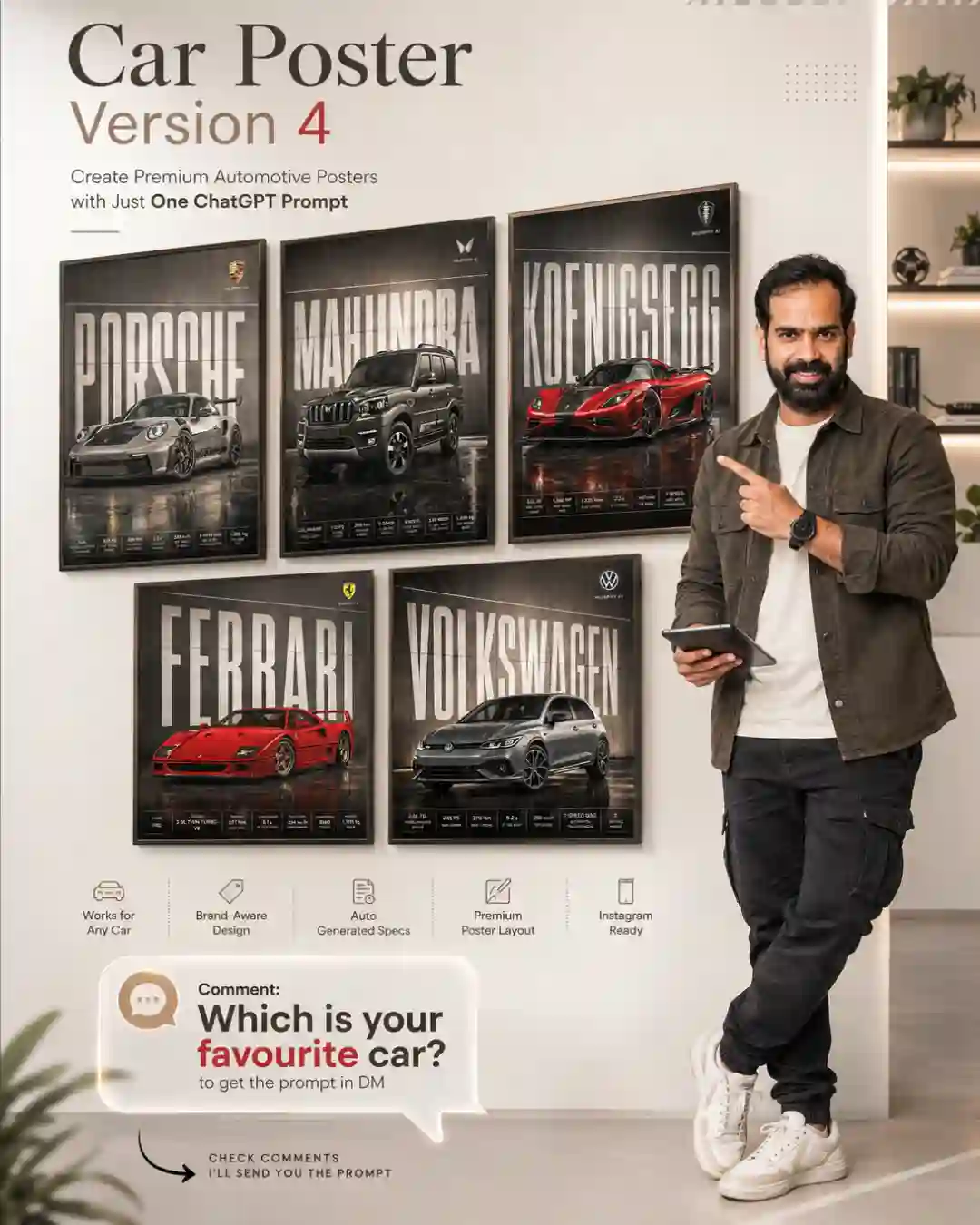
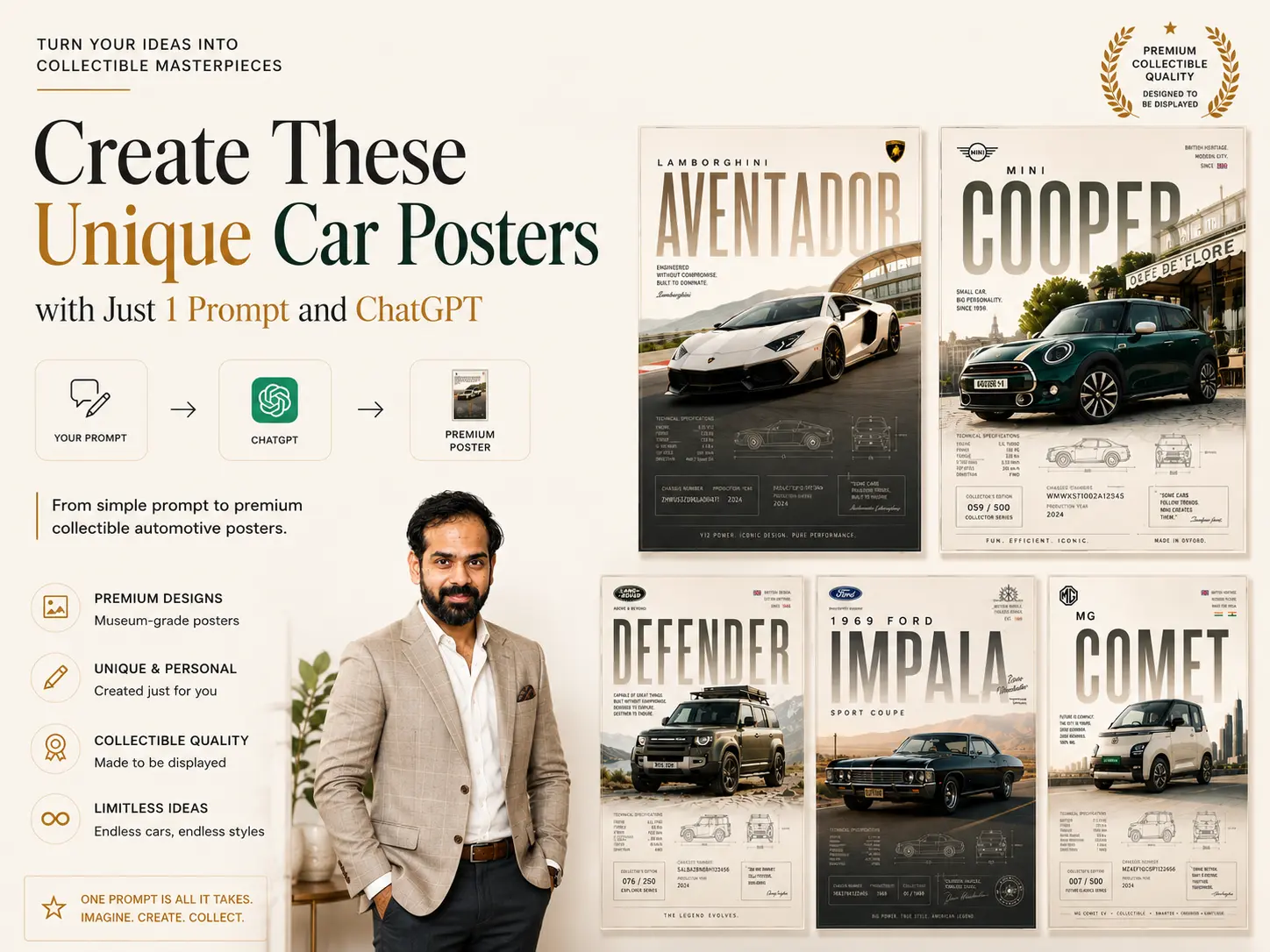
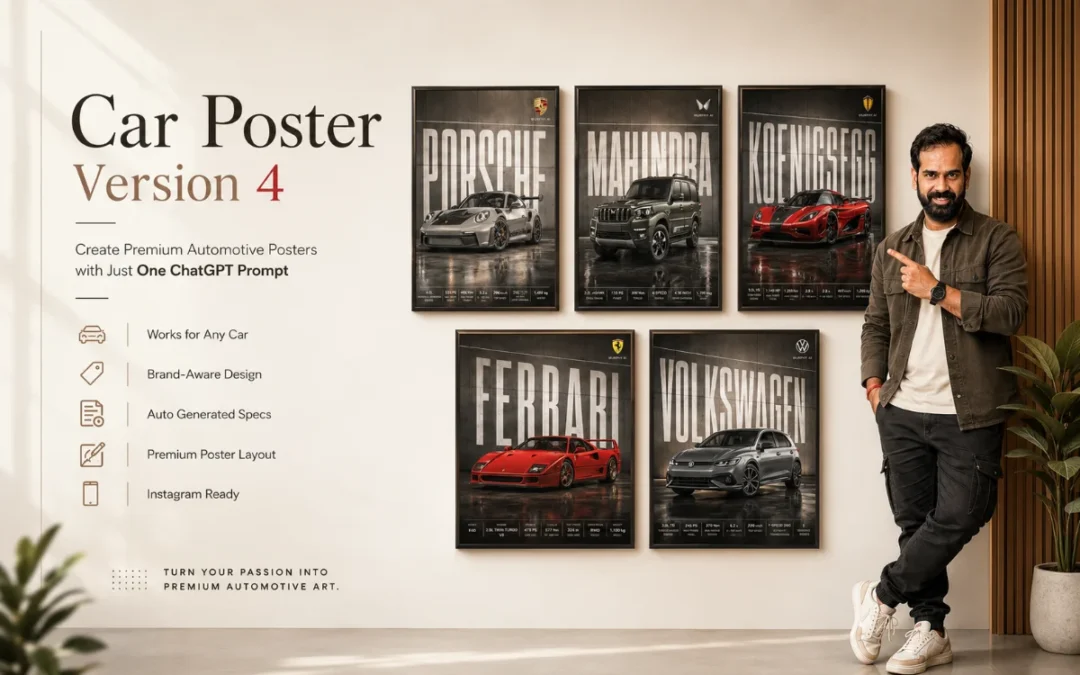
Create Premium Car Posters with a Single AI Prompt
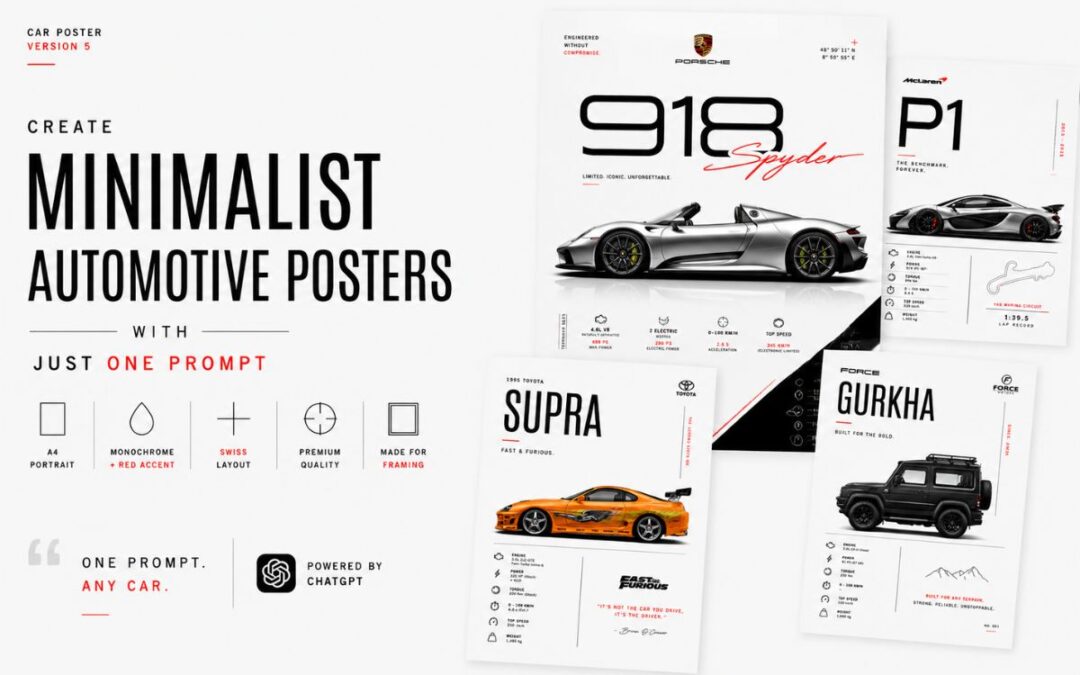
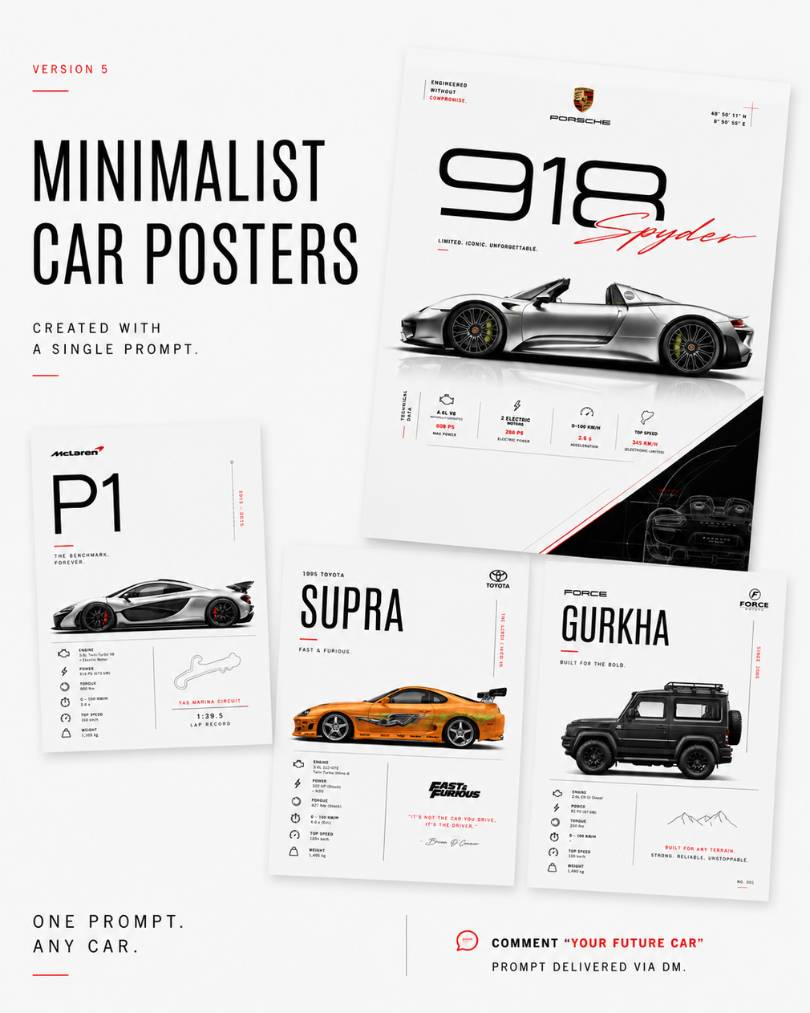
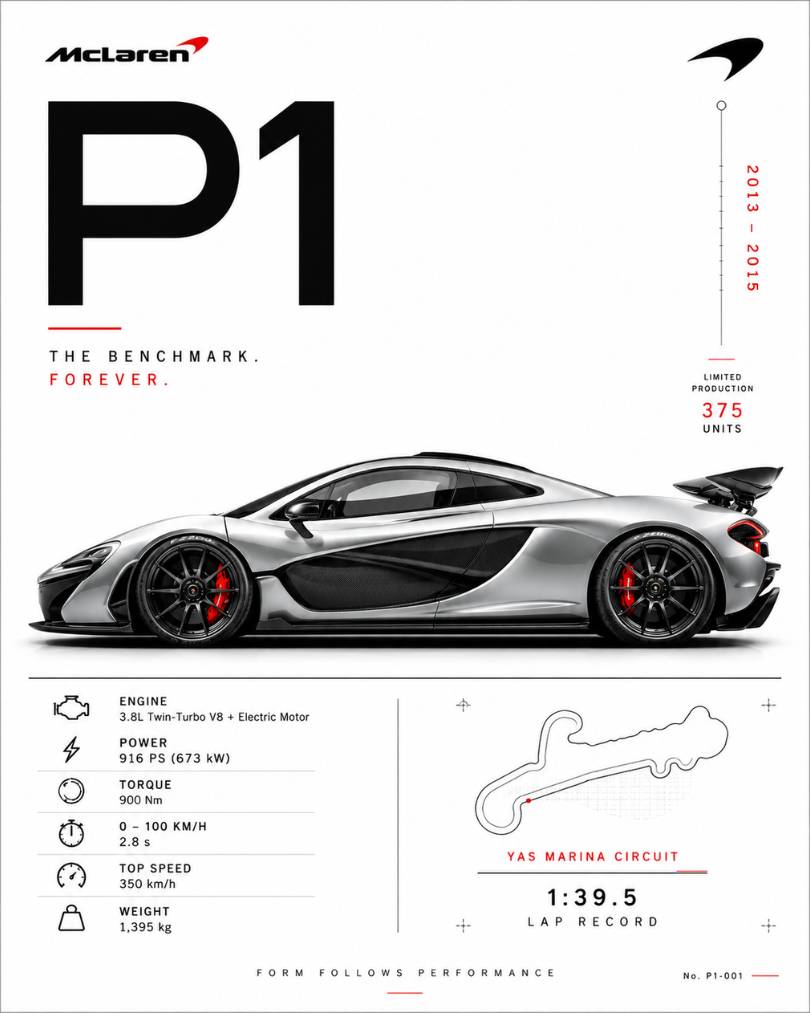
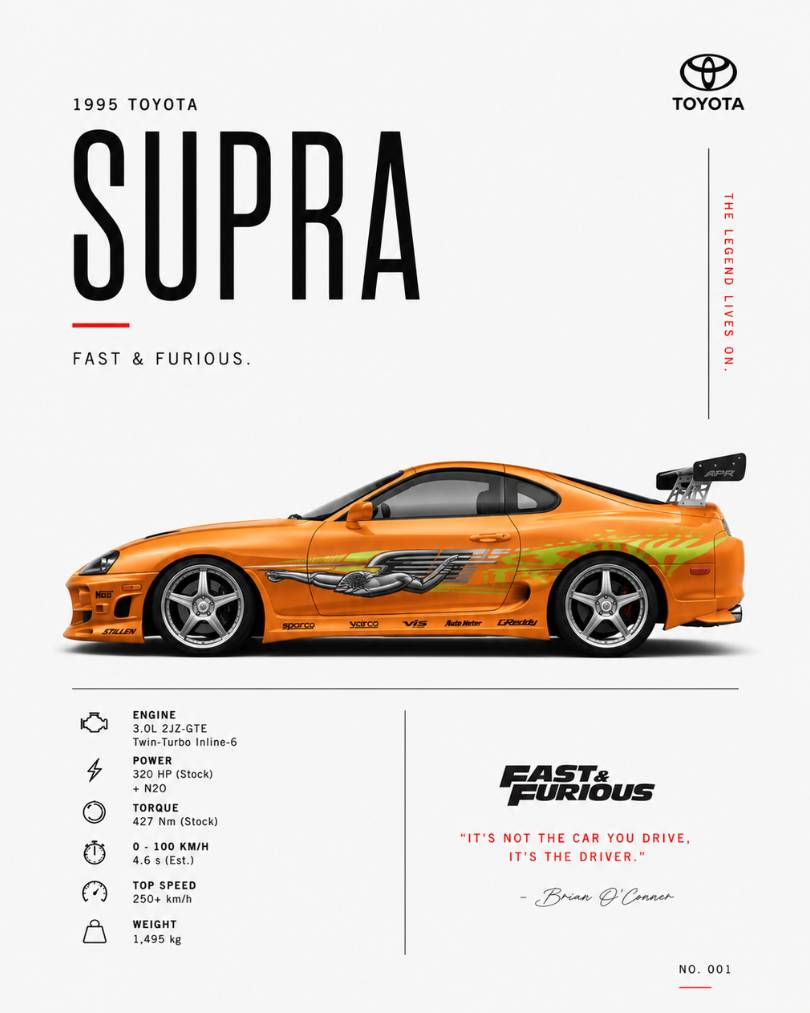
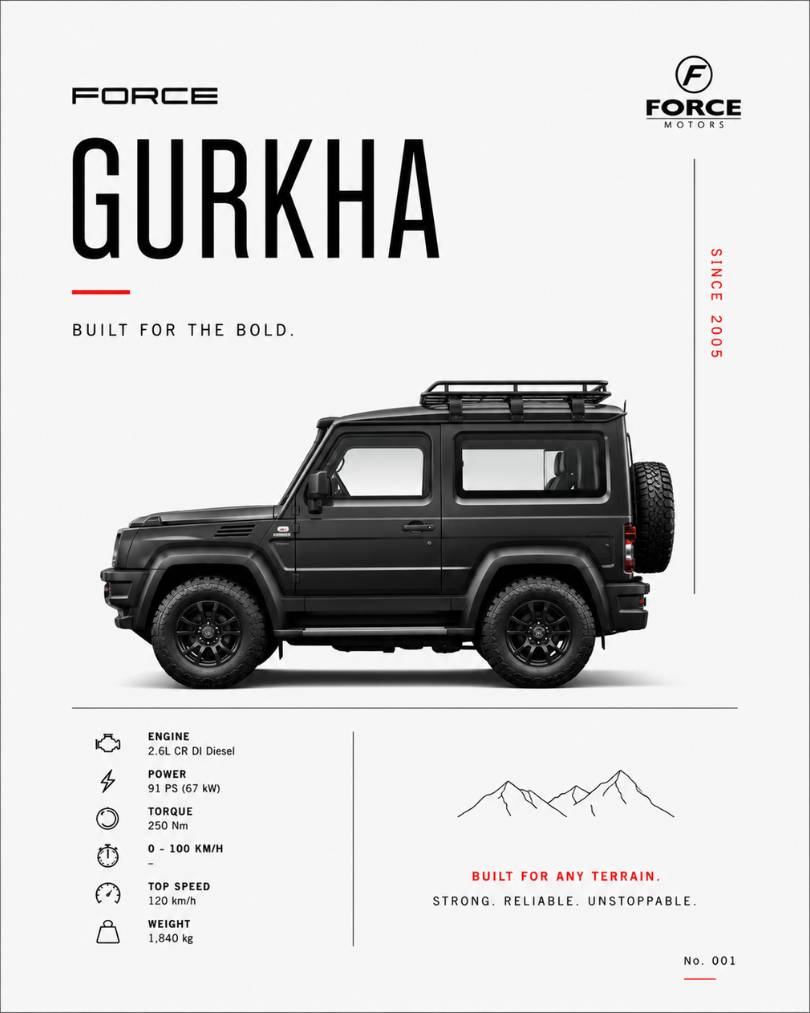
Whether you love Porsche, McLaren, Lamborghini, Toyota Supra, Nissan GT-R, Force Gurkha, or any other vehicle, this method can turn almost any car into a museum-quality poster design.
In this guide, I’ll show you exactly how I created these posters and how you can make your own in minutes.
Here is the Prompt:
Minimalist Automotive Poster Prompt
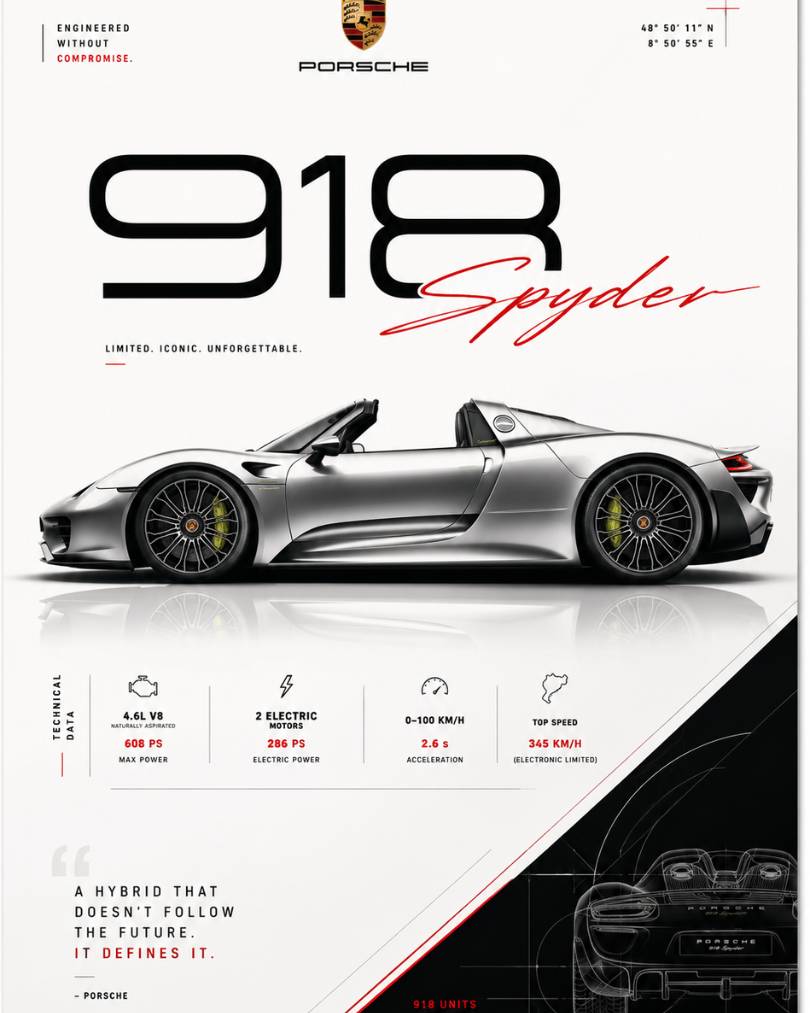
Minimalist automotive poster design in A4 portrait format for [CAR NAME]. A modern sports car shown in a clean side profile silhouette, premium automotive wall art aesthetic, vast negative space, monochrome black and white color scheme with a single red accent. Elegant Swiss-inspired layout, subtle technical specifications, thin geometric lines, refined typography, museum-quality print design, ultra-clean composition, luxury automotive branding style, high-end poster suitable for framing, professional graphic design, vector-inspired precision, premium paper print look.
Simplified Prompt – If above Copy Prompt button not working then Select and Copy Below Prompt
Prompt:
Minimalist automotive poster design in A4 portrait format for [CAR NAME]. A modern sports car shown in a clean side profile silhouette, premium automotive wall art aesthetic, vast negative space, monochrome black and white color scheme with a single red accent. Elegant Swiss-inspired layout, subtle technical specifications, thin geometric lines, refined typography, museum-quality print design, ultra-clean composition, luxury automotive branding style, high-end poster suitable for framing, professional graphic design, vector-inspired precision, premium paper print look.
What Is a Minimalist Automotive Poster?
A minimalist automotive poster is a clean and modern artwork that focuses on:
Side profile of a car
Premium typography
Technical specifications
Large negative space
Swiss-inspired design layout
Luxury wall-art appearance
Mountain Escape
Explore breathtaking landscapes
Ocean Vibes
Relax by the sea
Adventure
Discover hidden places
Nature
Reconnect with the outdoors
Dream Destination
Create unforgettable memories
These posters look great as:
Wall decor
Garage artwork
Desktop wallpapers
Social media content
Gifts for car enthusiasts
Examples of Cars You Can Create
This prompt works for almost any vehicle.
Examples include:
Porsche 918 Spyder
Porsche 911
McLaren P1
McLaren W1
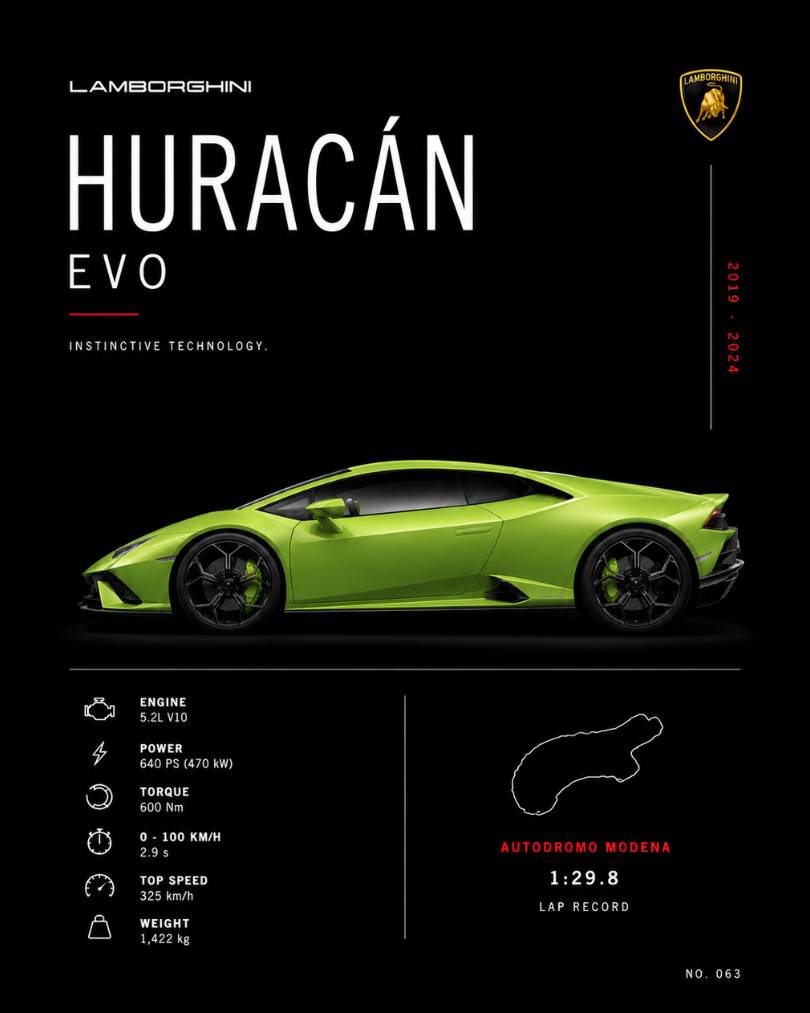
Lamborghini Huracán
Nissan GT-R R35
Toyota Supra MK4
Force Gurkha
BMW M4
Ferrari F40
Bugatti Chiron
Ford Mustang
Simply replace the car name inside the prompt.
The One Prompt That Creates Everything
Replace [CAR NAME] with any vehicle.
Example:
Porsche 918 Spyder
McLaren P1
Toyota Supra MK4
Force Gurkha
The AI will automatically generate a premium poster concept based on that vehicle.
Why This Prompt Works So Well
Most AI image prompts fail because they are too vague.
This prompt works because it clearly defines:
Layout
The prompt asks for:
A4 portrait format
Clean composition
Side profile vehicle view
Professional graphic design structure
Design Style
The prompt specifies:
Swiss design principles
Minimalist layout
Luxury automotive branding
Museum-quality poster appearance
Visual Consistency
The prompt keeps:
Black and white palette
Single red accent
Thin geometric lines
Technical specifications
Premium typography
This creates a consistent poster series.
Best AI Models for This Prompt
You can use:
ChatGPT Image Generation
Perfect for creating premium poster layouts directly.
Gemini
Excellent for clean graphic compositions.
Nano Banana
Great for highly detailed automotive renders.
Midjourney
Strong artistic and print-quality results.
Flux
Good for realistic automotive visuals.
How to Turn It Into a Poster Collection
Create a complete automotive wall-art series.
For example:
Supercar Collection
Porsche 918 Spyder
McLaren P1
Ferrari LaFerrari
Lamborghini Revuelto
JDM Collection
Supra MK4
Nissan GT-R R34
Mazda RX-7
Honda NSX
Off-Road Collection
Force Gurkha
Jeep Wrangler
Land Rover Defender
Toyota Land Cruiser
All posters will maintain a matching visual style.
With one well-structured prompt and ChatGPT, you can generate premium automotive wall art featuring your favorite cars in seconds.
The best part?
You only need to change one thing:
The car name.
Everything else remains consistent, professional, and ready for sharing, printing, or selling.
If you’re a car enthusiast, designer, or content creator, this is one of the easiest ways to build a stunning automotive poster collection using AI.
FAQ
Can I use this prompt for any car?
Yes. Simply replace the placeholder with any car model, and the design style remains consistent.
Can I sell posters created with this prompt?
That depends on the image generation platform’s commercial usage terms. Always check the licensing rules of the AI tool you use.
Which car works best with this prompt?
Performance and iconic cars such as Porsche 918 Spyder, McLaren P1, Toyota Supra MK4, Lamborghini Huracán, and Nissan GT-R generally produce the strongest results.
Do I need graphic design experience?
No. The prompt handles the layout, typography, and overall design direction automatically.
GTA Online hasn’t had a proper, marketed heist in years.
Sure, there’s been Dr. Dre. Clucking Bell. Oscar Guzman. All technically heists. But Rockstar hasn’t titled an update around one since the Cayo Perico Heist back in December 2020.
That changes this July.
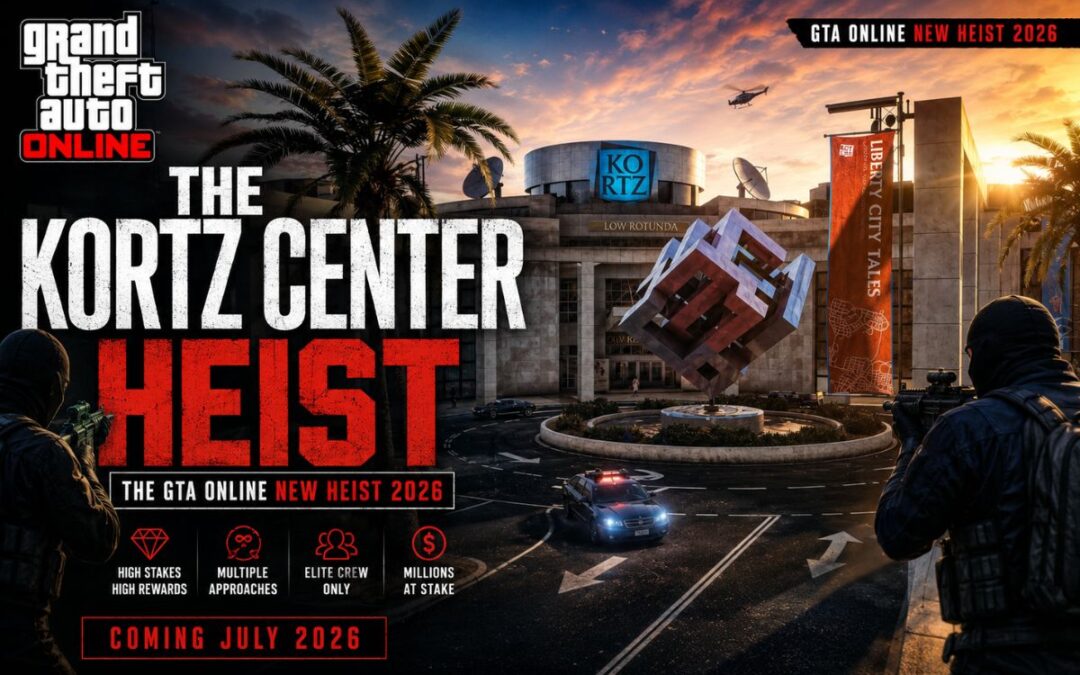
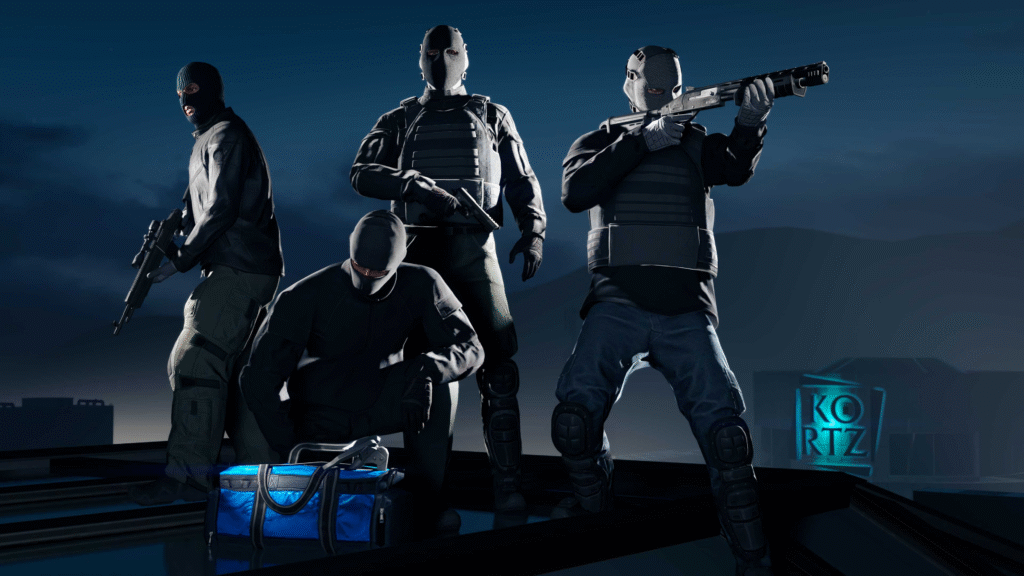
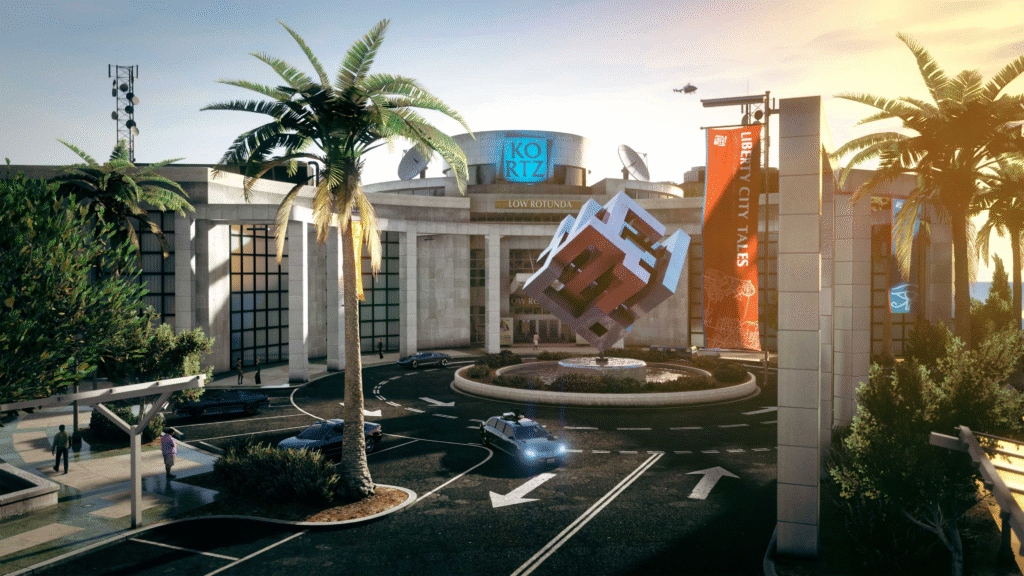
The Kortz Center Heist is the GTA Online new heist 2026 — and it already looks like one of the biggest updates the game has seen in a long time. Multiple approaches. A mansion requirement. Bonus money weeks incoming. And a fine art collector program that nobody fully understands yet.
Let’s break down everything Rockstar has teased — and more importantly, what you need to do right now to be ready.
Most people see ‘heist’ and assume it’s just another mission chain.
Here’s the truth: This is a full DLC update themed around a multi-stage heist. Not just one mission. You scope the location first, pick your approach, then infiltrate and escape the Kortz Center — a real in-game landmark sitting northwest of Los Santos on the Pacific Bluffs side.
Rockstar officially describes it as raiding the Kortz Center’s ‘prestigious galleries’ and ‘esteemed collection’ for personal gain. Multiple ways to do it. Multiple things to steal.
Here’s the truth: The last GTA Online update literally titled a ‘heist’ was Cayo Perico in December 2020. That’s almost 5 years ago. This is a big deal.
The Mansion Requirement — What You Need Before You Can Even Start
Common mistake: jumping into the update day one without the right property.
Rockstar has officially confirmed you need to own one of the new luxury mansions to access this heist. And that’s not the only cost — you’ll also need to install the Art Studio extension inside the mansion before you can begin setting anything up.
Based on the newswire language, the Art Studio isn’t optional. It’s a mandatory upgrade — similar to how previous businesses required equipment purchases before unlocking full features.
Fun detail: The Art Studio door has been sitting inside the mansion property the entire time — blocked by a wall and a bench. Literally no one noticed until data miners dug it up after the newswire dropped.
My recommendation: If you don’t own a mansion yet — start grinding now. You have about a month. Rockstar has also confirmed upcoming bonus money weeks specifically to help players prepare. More on that below.
Also worth noting: GTA Plus members are getting a $2 million discount on mansion properties. If you’re already subscribed, that’s a significant saving.
Multiple Approaches — How Replayable Is This?
Here’s where it gets interesting —
Rockstar specifically mentions ‘choosing an approach’ for the heist. That wording isn’t accidental. Multiple approaches means different entry methods, different setups, and potentially different targets — which is exactly how the Diamond Casino Heist worked.
We don’t have full details yet on how many approaches there are. But the language strongly suggests replayability is baked into this update from day one.
There’s also a ‘Fine Art Collector Program’ teased in the newswire. Nobody knows exactly what this is yet, but it sounds like a new progression layer tied to running the heist multiple times.
Simple rule: If this plays anything like the Diamond Casino Heist, you’ll want to run it multiple times with different approaches to maximize earnings. Don’t just one-and-done it.
The Preparation Weeks — How to Get Ready Before July
This is the section most people are going to skip. Don’t.
Rockstar’s newswire explicitly mentions ‘bonus money rewards,’ ‘record-breaking discounts,’ and ‘special events’ in the weeks leading up to launch. They know millions of players need to buy mansions and stack cash before July, so they’re structuring weekly updates around preparation.
Translation: the next few Thursdays should feature some of the best bonuses we’ve seen all year. Business bonuses, cash events, maybe even CEO Cargo weeks. If you’ve been waiting for a good time to grind — this is it.
If you don’t want to think too much: Log in every Thursday, check the weekly update, and play whatever is double or triple money that week. Do this for 3-4 weeks and you’ll be comfortable by launch day.
There’s also a 40% bonus on all GTA Shark Cards for a limited time. If you’re planning to spend real money, now is the window.
Need a guide on the best ways to make money in GTA Online right now? Check out our GTA Online Money Methods 2026 guide — updated for the current meta.
Free Console Upgrades — If You’re Still on Old Gen
Quick note for PS4 and Xbox One digital players.
Rockstar has confirmed that starting now, you can upgrade to PS5 or Xbox Series X versions of GTA V at no extra cost. Enhanced is objectively a better-looking, better-performing version of the game — faster load times, better draw distance, improved frame rate.
Simple rule: PS4 and Xbox One players — upgrade now. It’s free. Do it before the heist drops.
Solo or Crew? How to Approach the Kortz Center Heist
Rockstar mentions both solo and crew options in the newswire.
Solo players need the full mansion + Art Studio setup to run it independently. Crew play seems to be the alternative path — probably requiring less upfront investment but splitting the payout.
Common mistake: assuming solo is always better just because you keep the full cut. Depends entirely on how payouts scale and how the heist is balanced around player count.
Requirement: Mansion property + Art Studio extension (mandatory)
Approaches: Multiple (exact number TBA)
New feature: Fine Art Collector Program (details TBA)
GTA Plus bonus: $2M off mansion, 40% bonus on Shark Cards
Prep weeks: Bonus money events and record-breaking discounts on Thursdays
Play style: Solo or crew
Final Take
GTA Online is finally doing a real heist again.
Not a mission chain. Not a contract. A full multi-stage heist with scope, multiple approaches, and a dedicated DLC update.
If I had to say one thing — don’t wait. Get the mansion, stack the cash during the bonus weeks, and be ready day one. This is the kind of update worth showing up prepared for.
We’ll keep updating this post as Rockstar drops more details. Bookmark it.
Want to be fully ready before the Kortz Center Heist drops? Check out our GTA Online Beginner to Pro Guide — everything you need to walk in prepared.
FAQs — GTA Online New Heist 2026
When is the Kortz Center Heist coming out?
July 2026. Rockstar hasn’t confirmed the exact date, but the official newswire says ‘this summer’s exciting new update coming to GTA Online in July.’
Do I need a mansion for the Kortz Center Heist?
Yes. You must own one of the new luxury mansion properties and install the Art Studio extension before you can start.
Can you do the Kortz Center Heist solo?
Yes. Solo play is explicitly mentioned in the newswire. You’ll need the full mansion setup, but it’s doable without a crew.
What is the Fine Art Collector Program?
Not fully detailed yet. Rockstar teased it in the newswire but hasn’t given specifics. This post will be updated as more info drops.
Is this the biggest heist in GTA Online?
It’s the biggest heist-focused update since Cayo Perico in December 2020. Whether the payout tops Cayo remains to be seen — but the multiple-approach structure is a genuinely exciting return to form.
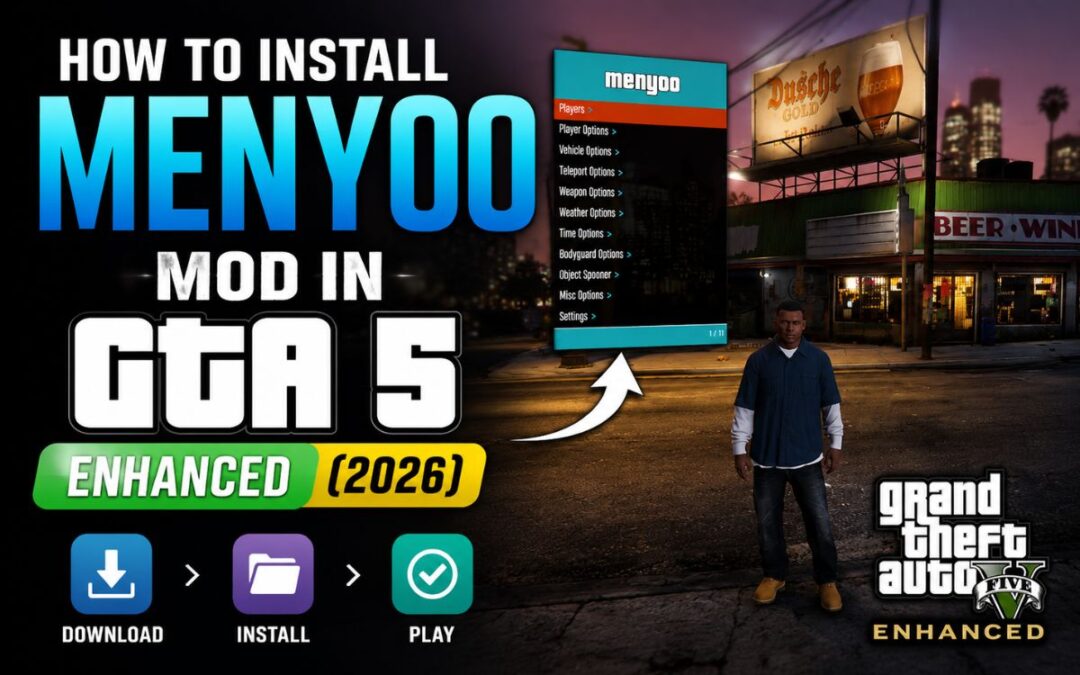
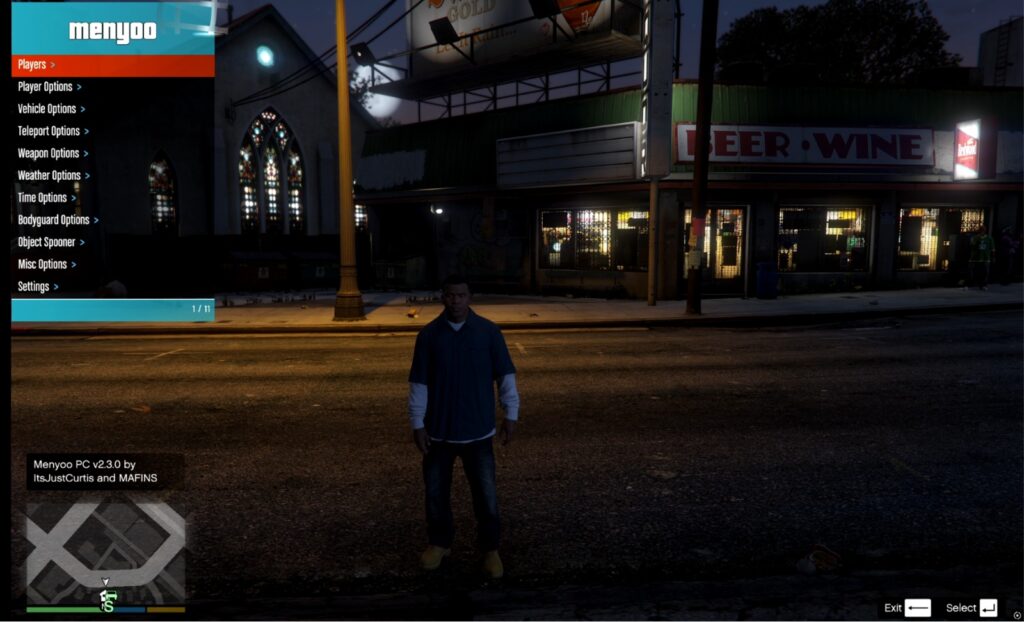
You want to know How to Install Menyoo Mod in GTA 5 Enhanced.
But the moment you search how to do it — suddenly there’s ScriptHookV, ScriptHookVDotNet, OpenRPF, ASI files… and it all feels way more complicated than it should be.
Don’t worry. I’ll make this simple.
This guide covers everything — which files to download, where to put them, and how to get Menyoo running in GTA 5 Enhanced step by step. No fluff, no confusion.
In This Post
What You Need Before Starting
Here’s the truth: Menyoo doesn’t work alone. It needs a few helper files to run. Most people mess up because they skip one of these.
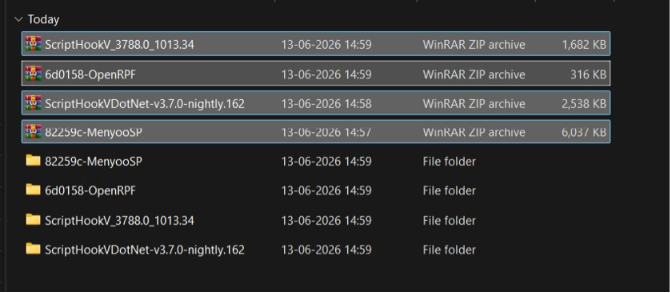
You need to download 4 things total:
Menyoo Mod (the actual mod menu)
ScriptHookV (lets the game run ASI mods)
ScriptHookV .NET / Community Script Hook (lets .NET scripts work)
OpenRPF (a tool Menyoo needs to load properly)
My recommendation: Download all 4 before you start installing anything. Don’t do it one by one — you’ll lose track.
Step 1 — Download All 4 Files
Head to your browser and go to gta5-mods.com. This is the only site you need — don’t download mods from random sites.
Search for “Menyoo” on gta5-mods.com. Download the latest version (at the time of writing, it’s v2.3.0). Save it in a folder you’ll remember — something like GTA5 Enhanced Mods works.
Search for “Script Hook V” on gta5-mods.com. Download the version that matches your current game version. You’ll see the version number listed — just grab the latest one.
Simple rule: If the site shows a blue Download button — click that. Skip any “insecure download” warnings from your browser — these files are safe.
Search for “OpenRPF” on gta5-mods.com and download it. All 4 download links will also be in the video description if you’re watching alongside.
Step 2 — Extract All Files
Once all 4 files are downloaded, select all of them and right-click. Use WinRAR or 7-Zip and choose Extract Each Archive to Separate Folder.
This gives each mod its own clean folder — which makes the next step way easier.
Common mistake: Extracting everything into one folder and then losing track of which file belongs to which mod. Separate folders = no confusion.
Step 3 — Install Everything Into GTA 5 Enhanced
Now open your GTA 5 Enhanced installation folder. If you’re not sure where it is — right-click the game in Rockstar Launcher and go to Properties or Open File Location.
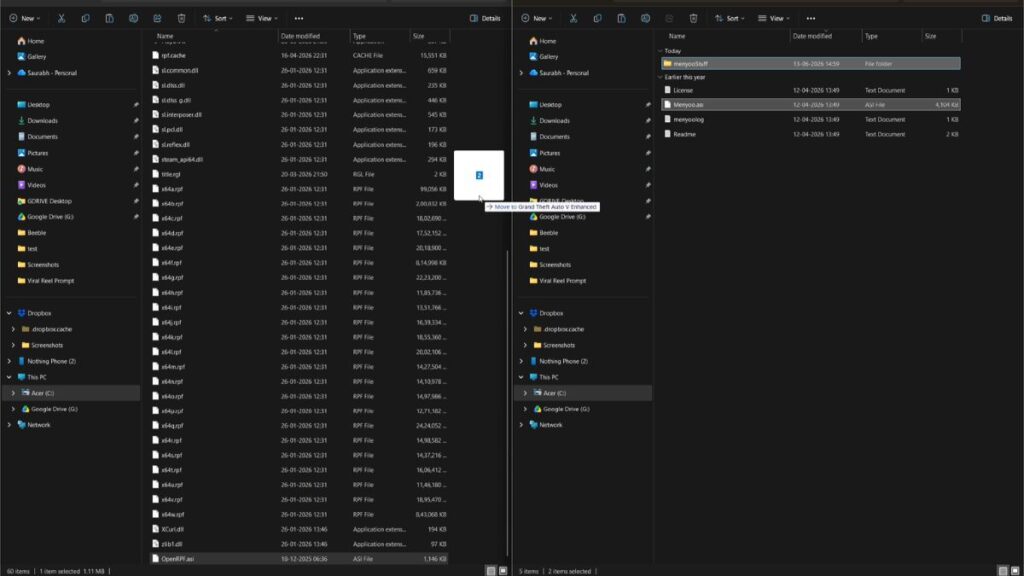
Here’s exactly what goes where: C:\Program Files (x86)\Steam\steamapps\common\Grand Theft Auto V Enhanced
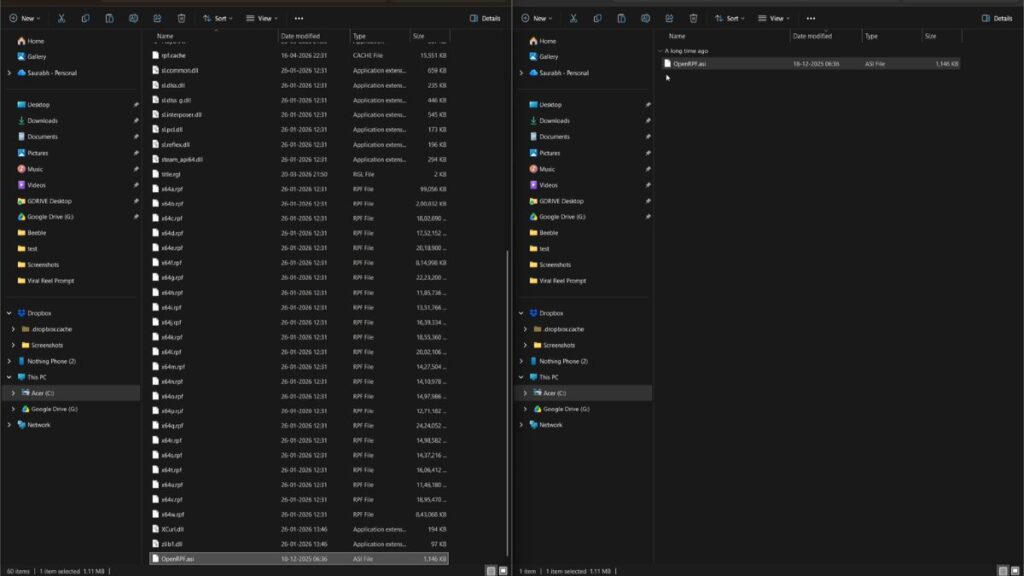
OpenRPF
Copy the OpenRPF.exe or .asi file and paste it directly into your GTA 5 Enhanced root folder.
Default location: C:\Program Files (x86)\Steam\steamapps\common\Grand Theft Auto V Enhanced
Default location: C:\Program Files (x86)\Steam\steamapps\common\Grand Theft Auto V Enhanced
ScriptHookV
Open the ScriptHookV folder, then go into the bin folder. From there, select these 3 files:
dinput8.dll
ScriptHookV.dll
NativeTrainer.asi (optional but recommended)
Paste all 3 into your GTA 5 Enhanced root folder.
Default location: C:\Program Files (x86)\Steam\steamapps\common\Grand Theft Auto V Enhanced
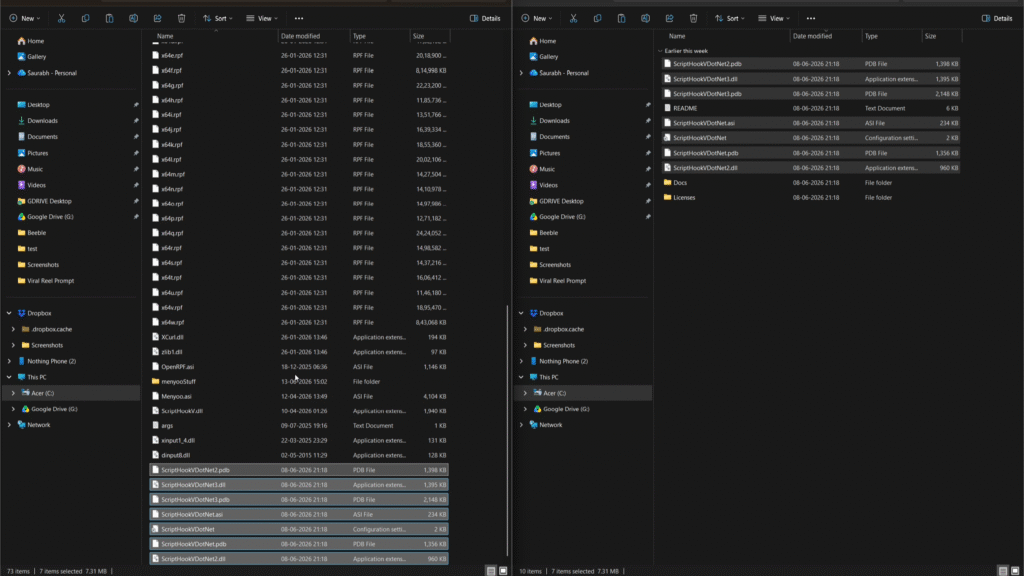
ScriptHookV .NET
Open the ScriptHookV.NET folder and copy everything inside — all files. Paste them into your GTA 5 Enhanced root folder.
My recommendation: After pasting everything, double check your GTA 5 Enhanced folder. You should see Menyoo.asi, ScriptHookV.dll, dinput8.dll, OpenRPF, and the Menyoo Stuff folder all sitting there.
Step 4 — One Important Setting in Rockstar Launcher
This is the step most people forget — and then wonder why mods aren’t working.
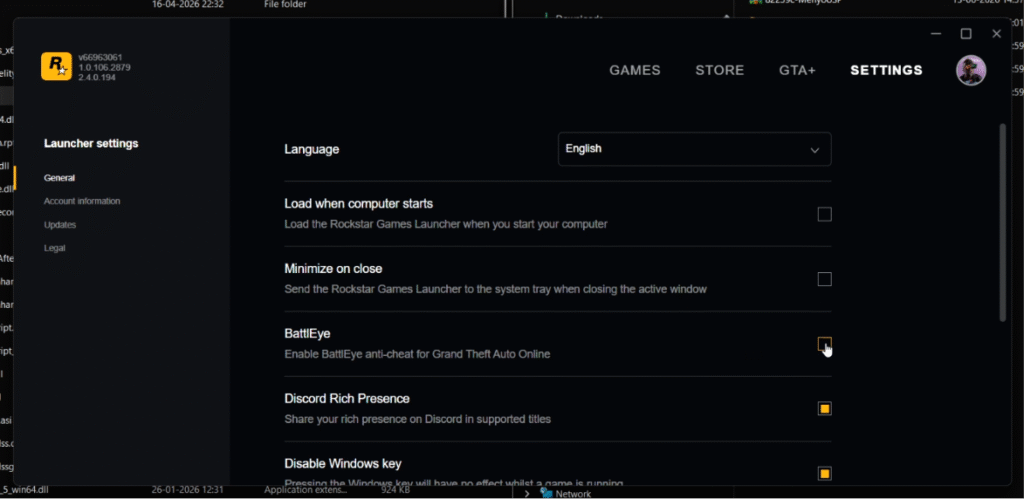
Open Rockstar Games Launcher and log in if needed. Then go to GTA 5 Enhanced settings and find the BattlEye option. Turn it OFF.
BattlEye is an anti-cheat system. It will block your mods from loading if it’s on. Simple as that.
Here’s the truth: You don’t need to turn off Discord overlay or anything else — just BattlEye. That’s the only one that matters for Menyoo to work.
Step 5 — Launch the Game and Test
Now just launch GTA 5 Enhanced normally through Rockstar Launcher.
Once you’re in the game — press F8.
That’s it. Menyoo should open up right there on your screen. If you see the menu — congrats, you did everything right.
If you don’t want to think too much: Just press F8 as soon as you load into story mode. If the menu appears, you’re good. If nothing happens, jump to the troubleshooting section below.
Menyoo Not Working? Try This
Still confused? Here are the most common reasons Menyoo doesn’t open:
BattlEye is still ON — go back to Rockstar Launcher and turn it off.
You missed a file — check that Menyoo.asi, ScriptHookV.dll, and dinput8.dll are all in the root GTA folder.
Wrong ScriptHookV version — make sure your ScriptHookV version matches your game version. If you updated GTA recently, you may need to re-download ScriptHookV.
You’re in Online mode — Menyoo only works in Story Mode. Never use mods in GTA Online.
Common mistake: Trying to use mods in GTA Online. Don’t. You will get banned. Story Mode only.
Final Thoughts
Installing Menyoo in GTA 5 Enhanced sounds complicated — but once you do it once, it takes less than 5 minutes next time.
If I had to tell you one thing: get all 4 files first, turn off BattlEye, and paste everything in the right folder. That’s literally the whole thing.
The Bodyguard feature is a solid addition — feels polished, works reliably, and genuinely changes how you play story mode.
Good luck — and don’t shoot Doggo.
GTA 6 Update: Trailer 3 Timeline and Release Date Confirmed : Read More
Frequently Asked Questions
1. How do I open Menyoo in GTA 5 Enhanced?
Press F8 once you’re in Story Mode. That’s the default key. If nothing happens, double-check that BattlEye is turned off in Rockstar Launcher and that all 4 files are installed correctly in your GTA 5 Enhanced root folder.
2. Does Menyoo work in GTA Online?
No — and don’t try it. Menyoo is a single-player mod only. Using any mod in GTA Online will get your account banned. Story Mode is the only safe place to run it.
3. Which files do I need to install Menyoo in GTA 5 Enhanced?
You need exactly 4 things: Menyoo itself, ScriptHookV, ScriptHookV .NET (Community Script Hook), and OpenRPF. Skip any one of these and Menyoo won’t load. All download links are available on gta5-mods.com.
4. Why is Menyoo not opening even after installation?
Most common reasons: BattlEye is still ON, your ScriptHookV version doesn’t match your current game version, or you placed files in the wrong folder. Check that Menyoo.asi, ScriptHookV.dll, and dinput8.dll are all sitting in the GTA 5 Enhanced root folder — same place as GTA5.exe.
5. Is Menyoo safe to download?
Yes — as long as you download from gta5-mods.com. That’s the only source you should trust. Don’t download from random sites or YouTube comment links. The mod is community-maintained, open-source, and widely used.
6. How to install Menyoo mod in GTA 5 Enhanced?
To install Menyoo Mod in GTA 5 Enhanced, first download the latest version of Menyoo and ensure that Script Hook V is already installed. Extract the Menyoo files into your GTA 5 Enhanced main game directory, then launch the game. Once in-game, press F8 (default key) to open the Menyoo trainer menu and verify that the mod has been installed successfully.
If you’ve ever wanted to create those insanely good-looking automotive posters you see on Instagram, you’re in the right place.
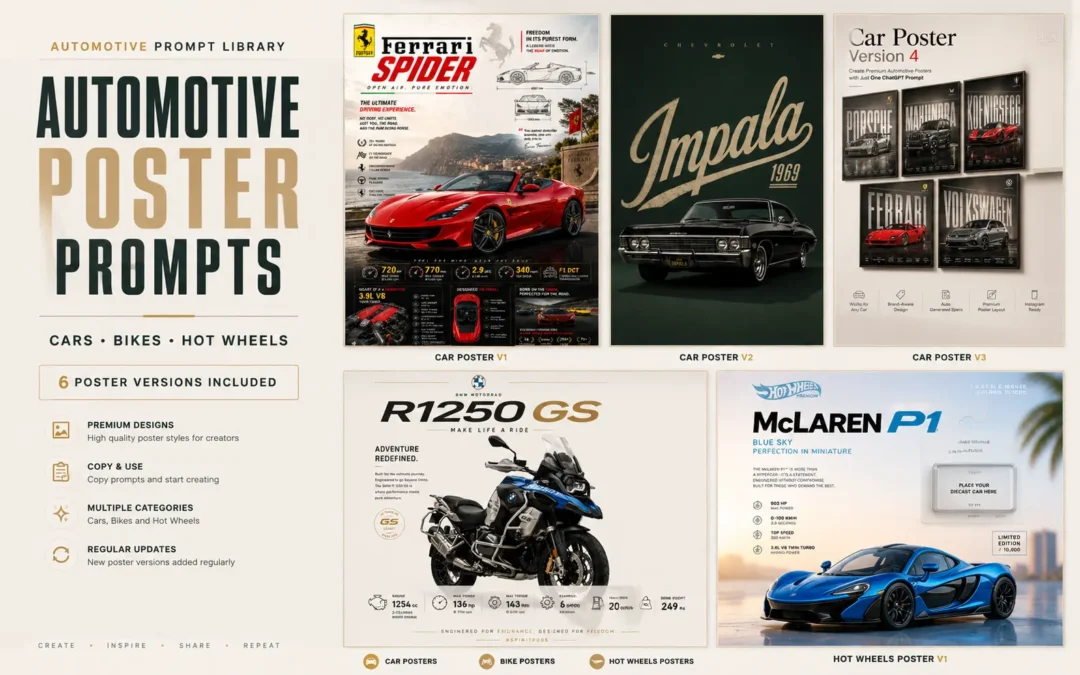
This page is where I keep all my automotive poster prompt versions in one place.
Right now you’ll find car posters, bike posters, and Hot Wheels poster prompts, and I’ll keep adding new versions whenever I create something worth sharing.
Just pick a poster style, copy the prompt, and start creating.
These are the poster versions available right now.
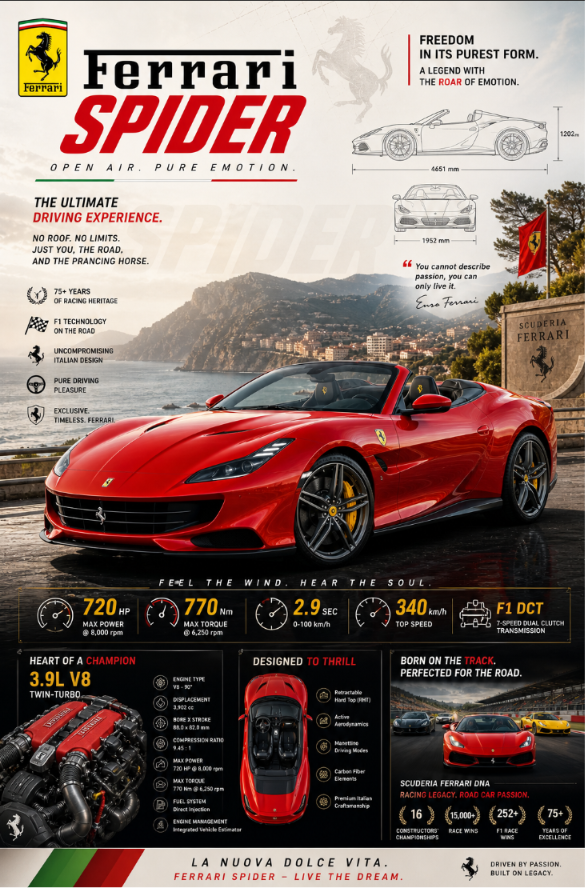
Automotive Poster Ver-1.0
Create an epic premium automotive poster of super[CAR NAME]. Place the car as the heroic central subject in a dynamic three-quarter side profile, visually dominant and impossible to ignore. Show the full beauty of the vehicle with aggressive stance, perfect proportions, premium wheels, signature headlights, aerodynamic lines, spoilers, performance details, and luxury design language. ar 9:16

Add bold premium typography with the brand name, model name, performance stats, horsepower, acceleration, top speed, engine specs, and iconic achievements beautifully integrated into the composition. Include subtle background elements inspired by the car’s heritage: faded blueprint lines, racing legacy, silhouette overlays, iconic tracks, engineering details, speed graphics, and collector-poster aesthetics.

Use strong visual contrast, bright premium colors (avoid dark black-heavy backgrounds), cinematic lighting, ultra-detailed reflections, glossy paint finish, luxury magazine quality, modern graphic design, and scroll-stopping masterpiece energy. Clean composition, high-end automotive advertisement style, collector poster aesthetic, highly detailed, visually powerful, premium masterpiece.
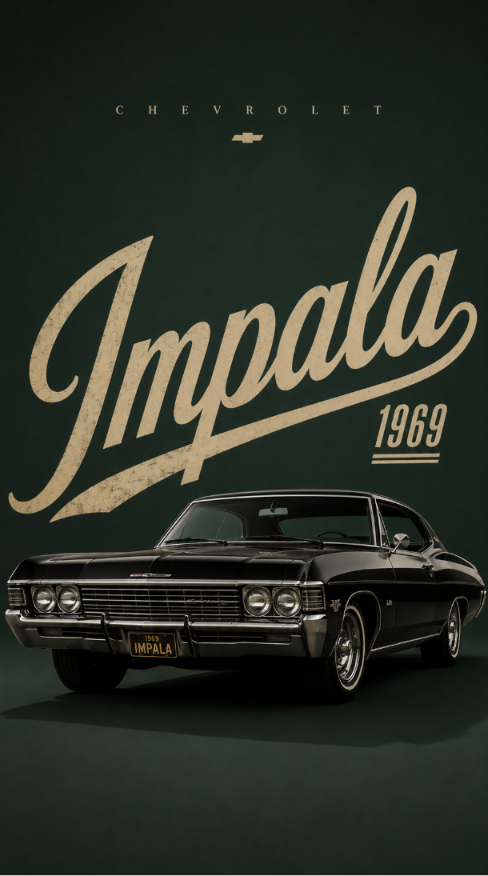
Automotive Poster Ver-2.0
Create a premium minimalist automotive poster for [CAR NAME / MODEL], inspired by luxury editorial car advertisements.

Use a clean vertical 9:16 Instagram Reels/Story composition with a bold solid color background in [BACKGROUND COLOR]. The background color should match the car’s personality, brand identity, era, and mood.

Place the car as the main subject in the lower-middle area. The car should look realistic, premium, sharp, glossy, and detailed, with accurate proportions, clean reflections, crisp edges, studio-quality lighting, and a natural shadow under the vehicle.

Behind the car, add huge oversized typography showing the car model name: “[BIG WORD]”.

Typography Direction:
Choose a typography style that matches the personality, era, and design language of the car. Do not use the same tall bold font every time.

Randomly select or intelligently choose one typography style:
- Tall condensed bold font for luxury sedans, SUVs, and classic premium cars
- Wide futuristic font for hypercars, EVs, and concept cars
- Aggressive sharp angular font for sports cars and performance cars
- Retro serif or vintage poster font for classic cars
- Elegant thin luxury serif font for premium luxury cars
- Creative cursive/script font for stylish lifestyle cars or heritage editions
- Glitch/distorted digital font for cyberpunk, electric, futuristic, or modified cars
- Rugged industrial stencil font for off-road SUVs and adventure vehicles
- Racing decal-style typography for track cars, rally cars, and supercars
- Minimal clean geometric sans-serif for modern EVs and clean luxury cars

The large background typography should feel unique to the car, not generic. It may be oversized, stretched, stacked, angled, partially cropped, transparent, outlined, embossed, shadowed, layered, or blended into the background depending on the car theme.

Add small spaced-out brand text at the top: “[BRAND NAME]”. Keep enough empty space at the top and sides for a clean premium layout.

Style: luxury automotive poster, minimalist editorial layout, high-end car magazine aesthetic, realistic car render, clean shadow, bold color contrast, premium typography, no extra objects, no people, no clutter.
Automotive Poster Ver-3.0
Generate image
Cinematic automotive billboard poster featuring [CAR MODEL NAME] as the hero vehicle.

Analyze the vehicle's design language, brand heritage, segment, performance character, luxury positioning, and visual identity. Automatically determine the most suitable paint color, finish, environment, camera angle, lighting, typography, materials, and color grading.

Position the vehicle center-frame with a dominant presence and premium advertising composition. Automatically select the camera angle that best showcases the vehicle's proportions and character.

Apply world-class automotive lighting with:

• soft cinematic key lights
• controlled rim lighting
• premium reflection shaping
• deep contrast
• realistic paint microtexture

Avoid excessive light streaks, lens flares, neon effects, or distracting visuals.

Create an environment that naturally reflects the vehicle's identity:

• Supercars → dramatic performance architecture
• Sports Cars → premium automotive-inspired industrial settings
• Luxury Sedans → elegant modern architecture
• SUVs → rugged landscapes and adventure scenery
• EVs → futuristic minimal environments
• Off-Road Vehicles → wild natural terrain

Massive billboard-style typography featuring the manufacturer's name in ultra-condensed white lettering integrated into the background architecture. Typography should span edge-to-edge behind the vehicle with subtle divider lines, premium execution, and no distortion.

Use premium architectural wall panels, geometric divisions, brushed metal, concrete, or showroom-inspired surfaces instead of aggressive light bars.

Add a sleek editorial specification strip along the bottom containing 5–8 premium vehicle details. Minimal typography, thin divider lines, luxury watch-catalog aesthetics.

Ground surface should be selected automatically and feature subtle controlled reflections.

Atmospheric effects such as haze, mist, smoke, or volumetric depth should be used only when they enhance the scene.

Place the manufacturer's logo subtly in the top-right corner with small uppercase text:

STRICT RULES

— no taglines
— no marketing copy
— no pricing
— no people
— no random props
— no license plate text
— no oversized specifications
— no excessive light streaks or neon effects

Render as hyper-realistic automotive photography with ultra-sharp details, physically accurate reflections, cinematic color grading, premium advertising quality, and award-winning automotive campaign aesthetics.

Composition must feel balanced, symmetrical, timeless, and worthy of a global automotive billboard campaign.

Format: 4:5 (1080X1350), ultra-high resolution, print-ready finish.
Automotive Poster Ver-4.0
Create a premium bright 4:5 collectible automotive poster for the [CAR NAME].

The design should look like a luxury museum-grade automotive print, combining realistic high-end car photography, editorial magazine layout, collectible motorsport details, and refined minimalist poster design.

The car must be the main hero subject, large in the frame, placed slightly off-center with a dynamic diagonal angle.
Keep the composition spacious, clean, premium, and bright.
Use intentional negative space in the upper area for large typography.

Add massive elegant masthead typography reading “[CAR MODEL]” across the upper background.
The typography should be integrated behind or around the car using subtle transparency, masking, overlap, and depth layering.
It should feel like a luxury automotive magazine cover, not a simple text overlay.

Environment should automatically match the personality of the car:
hypercar in a premium racetrack or futuristic city,
supercar on a sunlit coastal road or luxury mountain pass,
JDM car in a refined neon urban street,
luxury sedan near modern architecture,
vintage classic on a golden cinematic highway,
off-road SUV in bright dusty terrain,
Mini Cooper on retro European café streets,
muscle car on a refined American desert highway,
compact sedan near modern residential architecture or clean city roads.

Add subtle collectible elements:
technical specs, blueprint sketches, chassis number, serial ID, production year, signature mark, collector’s edition number, telemetry micro labels, premium border lines, heritage badges, and small editorial labels.

Lighting must be bright and premium:
soft daylight, golden-hour highlights, realistic glossy reflections, clean shadows, refined contrast, atmospheric depth, matte paper texture, subtle grain, and embossed print feel.

Use an elegant restrained color palette based on the car identity:
cream, beige, muted gold, soft black, graphite, silver, deep red, navy, or heritage green.
Avoid dark-heavy tones and oversaturation.

Final image should feel like a luxury gallery poster, collectible, polished, bright, editorial, and timeless.

Negative:
dark mood, black background, generic wallpaper, dealership ad, centered car, floating car, pasted look, oversaturated colors, excessive effects, cluttered layout, cheap racing graphics, fake HDR, low detail, cartoon look, distorted car, messy text, unreadable typography, wrong logo, harsh shadows, chaotic background.
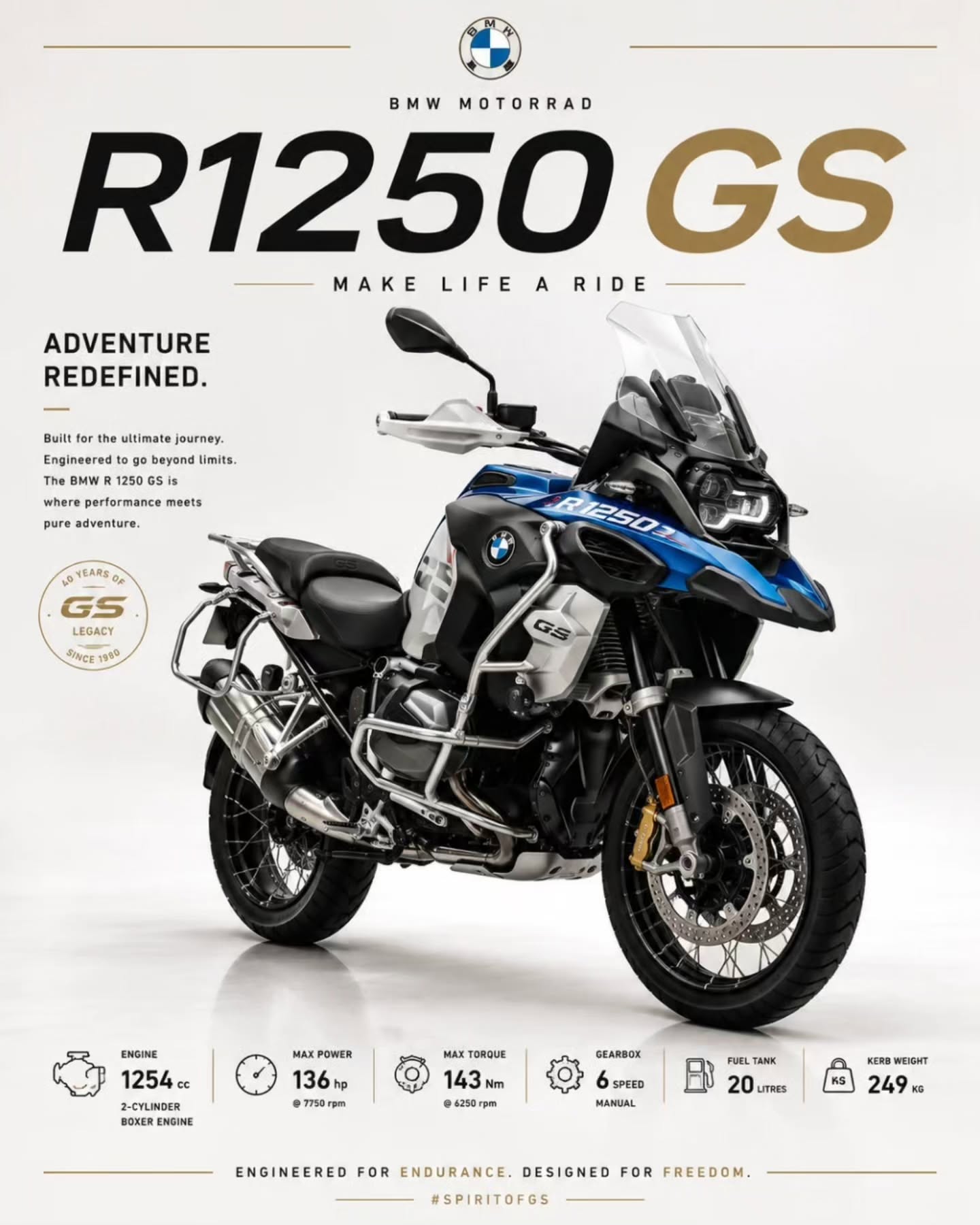
Bike Edition
Automotive Poster Ver-5.0
Create a premium bright 4:5 luxury museum-grade bike poster for the [Bike Name]. The bike should be the main hero subject, large in the frame, placed slightly off-center with a clean diagonal angle. Use realistic high-end automotive photography, bright studio lighting, soft shadows, glossy reflections, and a spacious premium white or light beige background.Add refined editorial poster layout elements: elegant title typography, small technical specification text, thin divider lines, subtle collectible badge, and minimal luxury branding details.Keep the composition clean, bright, expensive, modern, and print-worthy.Ultra-realistic, high-detail, premium automotive poster, luxury showroom aesthetic, 4:5 aspect ratio.
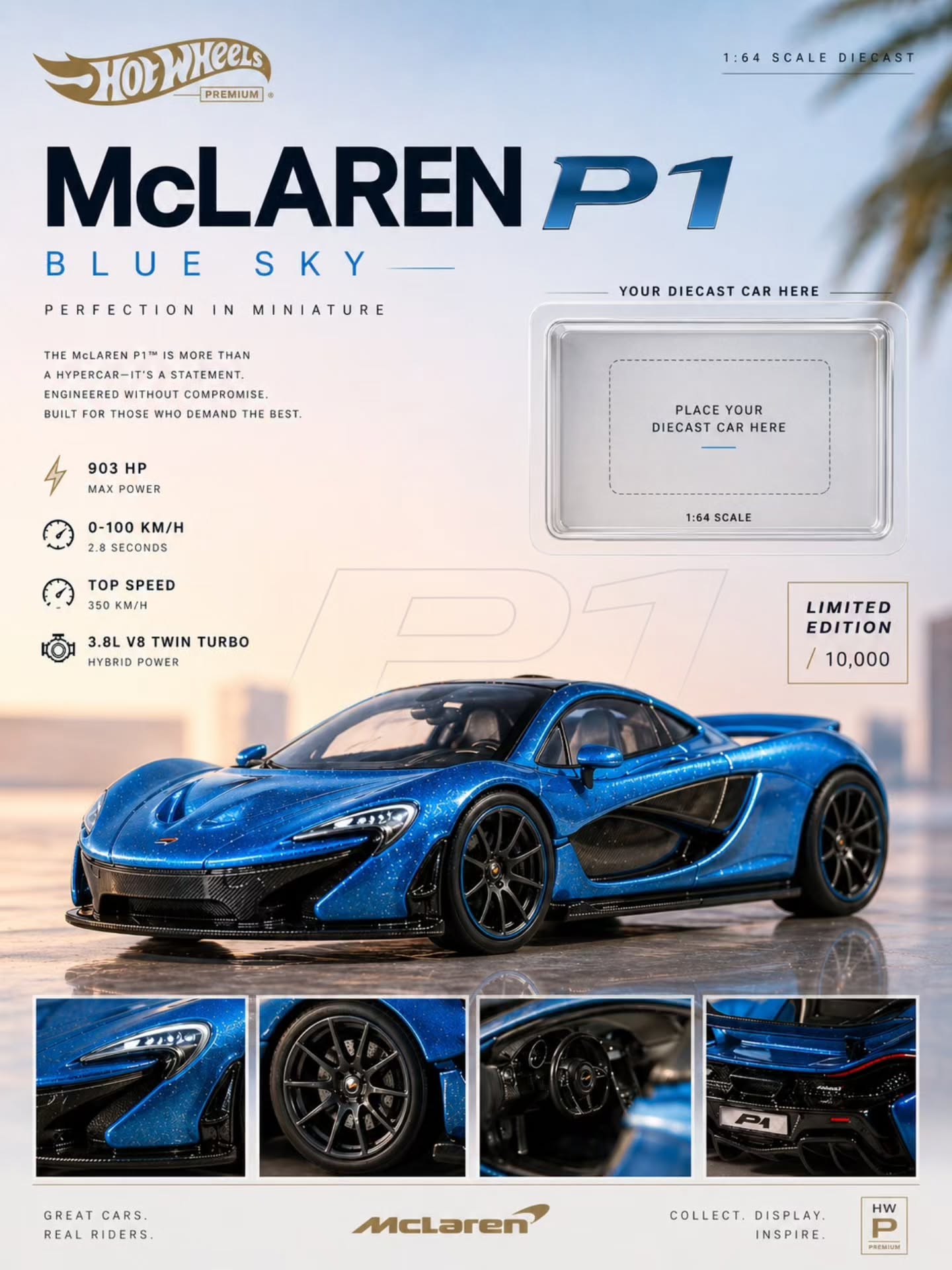
Hot Wheel Edition
Automotive Poster Ver-6.0
Create a premium aesthetic diecast poster for [CAR MODEL or uploaded image] (1:64). Show the car as the main hero at the bottom in a three-quarter angle, macro style with sharp focus — highlight metallic paint, reflections, panel lines, rubber tires, and fine details. Use a minimal soft gradient background based on the car’s color, with clean lighting and subtle shadows. Add clean typography: Brand + model name (bold) Small “1:64 scale” Minimal specs (optional) Include a small placeholder slot for a real diecast car: Position: top-right or mid-right Style: thin rounded frame / subtle blister tray look Add light shadow for depth Small text: “Place diecast here” Keep layout spacious, balanced, and grid-based. Style: luxury automotive poster, minimal, clean, high-end, frame-worthy.
Most of these prompts are shared on Instagram before they land on this page. Follow 🅾 𝐈𝐧𝐬𝐭𝐚𝐠𝐫𝐚𝐦 @thesaurabhsource for early access.
More Posters Coming Soon
I’m constantly testing new poster styles and adding the best ones here.
Upcoming ideas:
JDM Posters
Racing Posters
Off-Road Posters
Hypercar Posters
Automotive Editorial Posters
Vintage Car Posters
Dealership Advertisement Posters
Motorsport Posters
So if you enjoy creating automotive artwork, bookmark this page and check back from time to time.
Why I Created This Collection
I was tired of seeing generic prompts that produced average-looking results.
Most of the prompts you find online are either too short, too vague, or simply don’t create the premium automotive look many creators are after.
So I started building my own poster systems.
After testing hundreds of generations, refining layouts, adjusting lighting styles, and experimenting with different visual directions, I began saving the best versions.
This page is where I’ll keep sharing them.
Whether you’re creating content for Instagram, building a portfolio, printing wall art, or just having fun with AI, these prompts should give you a strong starting point.
Like These Posters?
These are just the final versions.
On Instagram, I share:
✅ New poster concepts before they’re published here
✅ AI workflows & tricks
✅ Prompt breakdowns
✅ Design resources
✅ Behind-the-scenes experiments
👉 Follow @thesaurabhsource and join thousands of creators exploring AI design and content creation.
Frequently Asked Questions
Which AI tools do these prompts work with?
Most of these prompts can be adapted for ChatGPT Images, Midjourney, Flux, Ideogram, and other modern AI image generators.
Are the prompts free to use?
Yes. Feel free to use them and experiment with your own variations.
Will new poster versions be added?
Absolutely. This page will keep growing as I create new poster styles.
Can I modify the prompts?
Of course. Think of these as a foundation. Change the car, environment, colors, lighting, or typography to match your vision.
Which poster style should I start with?
If you’re new, start with Car Poster V1. It’s the most versatile and works with almost any vehicle.
If you’ve seen Premium Car Posters on Instagram or Pinterest and wondered how they’re created, the process is now easier than ever with AI image generation tools.
In this guide, you’ll learn how to create stunning Premium Car Posters using ChatGPT, helping you design professional, collectible, editorial-style automotive artwork with a luxury-grade finish.
Generate image
Cinematic automotive billboard poster featuring [CAR MODEL NAME] as the hero vehicle.

Analyze the vehicle's design language, brand heritage, segment, performance character, luxury positioning, and visual identity. Automatically determine the most suitable paint color, finish, environment, camera angle, lighting, typography, materials, and color grading.

Position the vehicle center-frame with a dominant presence and premium advertising composition. Automatically select the camera angle that best showcases the vehicle's proportions and character.

Apply world-class automotive lighting with:

• soft cinematic key lights
• controlled rim lighting
• premium reflection shaping
• deep contrast
• realistic paint microtexture

Avoid excessive light streaks, lens flares, neon effects, or distracting visuals.

Create an environment that naturally reflects the vehicle's identity:

• Supercars → dramatic performance architecture
• Sports Cars → premium automotive-inspired industrial settings
• Luxury Sedans → elegant modern architecture
• SUVs → rugged landscapes and adventure scenery
• EVs → futuristic minimal environments
• Off-Road Vehicles → wild natural terrain

Massive billboard-style typography featuring the manufacturer's name in ultra-condensed white lettering integrated into the background architecture. Typography should span edge-to-edge behind the vehicle with subtle divider lines, premium execution, and no distortion.

Use premium architectural wall panels, geometric divisions, brushed metal, concrete, or showroom-inspired surfaces instead of aggressive light bars.

Add a sleek editorial specification strip along the bottom containing 5–8 premium vehicle details. Minimal typography, thin divider lines, luxury watch-catalog aesthetics.

Ground surface should be selected automatically and feature subtle controlled reflections.

Atmospheric effects such as haze, mist, smoke, or volumetric depth should be used only when they enhance the scene.

Place the manufacturer's logo subtly in the top-right corner with small uppercase text:

STRICT RULES

— no taglines
— no marketing copy
— no pricing
— no people
— no random props
— no license plate text
— no oversized specifications
— no excessive light streaks or neon effects

Render as hyper-realistic automotive photography with ultra-sharp details, physically accurate reflections, cinematic color grading, premium advertising quality, and award-winning automotive campaign aesthetics.

Composition must feel balanced, symmetrical, timeless, and worthy of a global automotive billboard campaign.

Format: 4:5 (1080X1350), ultra-high resolution, print-ready finish.
Use can use this simplified structure:
Generate image Cinematic automotive billboard poster featuring [CAR MODEL NAME] as the hero vehicle.
Analyze the vehicle’s design language, brand heritage, segment, performance character, luxury positioning, and visual identity. Automatically determine the most suitable paint color, finish, environment, camera angle, lighting, typography, materials, and color grading.
Position the vehicle center-frame with a dominant presence and premium advertising composition. Automatically select the camera angle that best showcases the vehicle’s proportions and character.
Massive billboard-style typography featuring the manufacturer’s name in ultra-condensed white lettering integrated into the background architecture. Typography should span edge-to-edge behind the vehicle with subtle divider lines, premium execution, and no distortion.
Use premium architectural wall panels, geometric divisions, brushed metal, concrete, or showroom-inspired surfaces instead of aggressive light bars.
Add a sleek editorial specification strip along the bottom containing 5–8 premium vehicle details. Minimal typography, thin divider lines, luxury watch-catalog aesthetics.
Ground surface should be selected automatically and feature subtle controlled reflections.
Atmospheric effects such as haze, mist, smoke, or volumetric depth should be used only when they enhance the scene.
Place the manufacturer’s logo subtly in the top-right corner with small uppercase text:
STRICT RULES
— no taglines — no marketing copy — no pricing — no people — no random props — no license plate text — no oversized specifications — no excessive light streaks or neon effects
Render as hyper-realistic automotive photography with ultra-sharp details, physically accurate reflections, cinematic color grading, premium advertising quality, and award-winning automotive campaign aesthetics.
Composition must feel balanced, symmetrical, timeless, and worthy of a global automotive billboard campaign.
Each tool produces slightly different styles, so experiment with multiple generations.
Final Thoughts
Creating Premium Car Posters no longer requires professional graphic design expertise. With the right AI prompt structure, cinematic lighting, premium typography, and automotive-focused composition, you can produce showroom-quality Premium Car Posters in just minutes.
Whether you’re passionate about vintage muscle cars, JDM legends, luxury sedans, or exotic supercars, the secret to exceptional Premium Car Posters lies in building a strong visual identity around the vehicle—transforming it into a collectible piece of art rather than simply generating another car image.
FAQ
What are premium car posters?
Premium Car Posters are high-quality automotive artworks designed for display and collection.
Can I create Premium Car Posters with AI?
Yes, AI tools can generate professional-looking car posters from detailed prompts.
Which cars work best for poster designs?
Supercars, sports cars, luxury vehicles, muscle cars, and classic cars all work well.
What makes a car poster look premium?
Cinematic lighting, clean typography, premium composition, and high-resolution visuals.
What size is best for printing car posters?
Popular choices include A3, A2, 18×24, and 24×36-inch prints.