

So you’ve finally decided to buy an AC. Maybe the last summer broke you, or maybe you’re just done pretending that a ceiling fan is “enough.” Either way — welcome to this AC buying guide 2026. You’re in the right place.
I’ve been through this whole process myself, and honestly? It’s way more confusing than it needs to be. Tonnage, BEE star ratings, inverter compressors, split vs window, Wi-Fi enabled, PM 2.5 filters… it feels like you need an engineering degree just to buy something that blows cold air.
So let me break it all down for you — simple, honest, and without the fluff. This AC buying guide 2026 covers everything from the absolute basics to the stuff even “experienced” buyers miss.
Let’s get into it.
In This Post
Too many brands. Too many features. Too many misleading terms.
If you choose wrong, you will:
- Waste electricity
- Get poor cooling
- Regret your purchase for years
This guide simplifies everything. No technical jargon. No fluff.
How much ton you need
Here’s a simple formula that works for Indian conditions:
If you don’t want to read everything, here’s the simple rule:
| Room Size | Recommended Tonnage |
|---|---|
| Small room Up to 100 sq ft | 0.75 ton |
| 100 – 150 sq ft | 1 ton |
| Medium room 150 – 200 sq ft | 1.5 ton |
| Large room 200 – 250 sq ft | 2 ton |
| Living room250 sq ft and above | 2+ ton |
For most Indian homes:
1.5 Ton 5 Star Inverter AC is the safest choice
But wait — room size alone isn’t the full story.
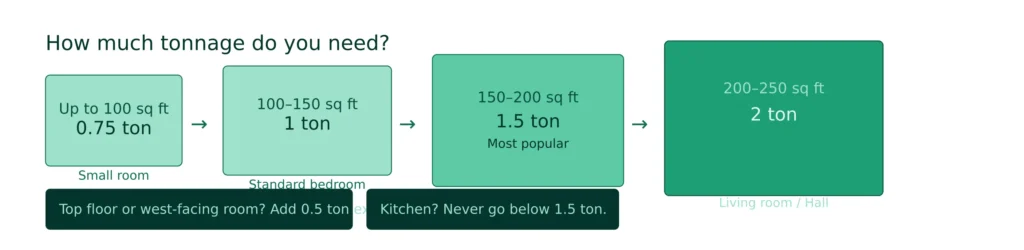
A few things can change your AC ton requirement:
- Top floor flat? Add 0.5 ton. The roof absorbs a ton of heat (pun intended).
- West-facing room? Same — add 0.5 ton. Afternoon sun is brutal.
- More than 4–5 people regularly in the room? Bodies generate heat. Factor that in.
- Large windows with direct sunlight? Consider going up a size.
- Kitchen? Never go below 1.5 ton regardless of size.
Not sure which size is right? Read our detailed guide on 1 Ton vs 1.5 Ton AC
Link → Click here to read
The common mistake is people buy a 1-ton AC because it’s cheaper, put it in a 180 sq ft room, and then wonder why it runs all day without cooling properly. Undersized AC = higher electricity bill + shorter AC lifespan + you still sweating.
Types of AC (AC Buying Guide 2026)
1. Split AC (Best for Most People)
The one with an indoor unit on your wall and an outdoor unit outside. This is what most people buy today and for good reason.
Pros:
- Quieter operation (compressor is outside)
- Better cooling distribution
- Sleeker look
- Available in higher tonnage and efficiency ratings
- More brands and models to choose from
Cons:
- Requires professional installation (drilling, piping)
- Installation cost: ₹2,000–₹4,000 extra
- If you move houses, reinstallation is a hassle and cost
Best choice for bedrooms and living rooms
2. Window AC
The single unit that sits in a window or wall opening.
Pros:
- Easier installation
- Cheaper upfront
- Good for rentals where you might move frequently
- No separate outdoor unit to worry about
Cons:
- Noisier (compressor is right inside the unit)
- Less efficient options available
- Limited to smaller rooms
Good for budget buyers
My take: If you own your home or plan to stay for 2+ years — split AC, no question. If you’re a renter who moves every year, window AC makes more sense practically.
3. Portable AC (Avoid)
- Easy to move
- Poor cooling
Not worth it in Indian heat
Inverter vs Non-Inverter AC — Just Buy Inverter
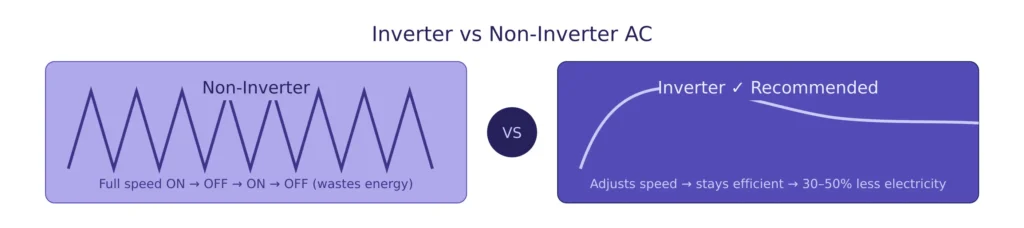
Non-Inverter AC
The compressor runs at full speed, then shuts off, then runs again at full speed, then shuts off. It’s like driving a car by flooring the accelerator and then hitting the brakes repeatedly.
- Old technology
- High electricity consumption
Inverter AC (Recommended)
The compressor adjusts its speed based on how much cooling is needed. Once the room is cool, it slows down and maintains the temperature. Much more efficient.
- Adjusts speed automatically
- Saves electricity
- Better cooling control
The result? Inverter ACs use 30–50% less electricity compared to non-inverter ACs. In India, where electricity bills in summer can be painful, this matters a lot.
My recommendation: Always go inverter. No exceptions.
The only scenario where non-inverter makes sense is if you’re using the AC for very short periods (like 2–3 hours a day at most). For regular daily use — inverter, always.
3 Star vs 5 Star AC (Don’t Buy Anything Below 3 Star in 2026)
The BEE (Bureau of Energy Efficiency) star rating tells you how energy efficient an AC is. More stars = less electricity consumed.
For 2026, here’s what I’d recommend:
| Star Rating | Who Should Buy |
|---|---|
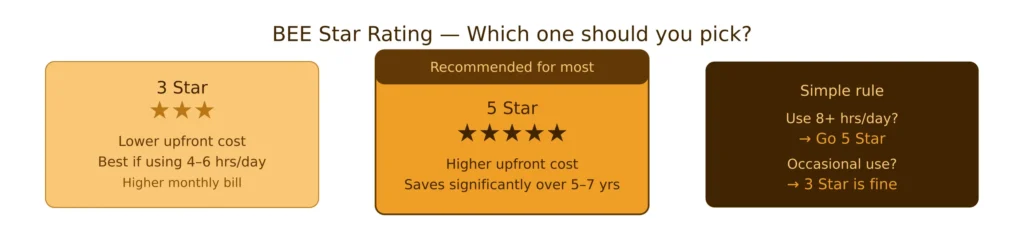
| 3 Star | Budget buyers, limited usage (4–6 hrs/day) |
| 4 Star | Good balance of cost and efficiency |
| 5 Star | Daily heavy usage, long-term savings priority |
5 Star AC
- Higher efficiency
- Lower electricity bills
- Higher price
3 Star AC
- Cheaper
- Higher electricity consumption
Simple Rule:
If you’re running your AC 8+ hours a day (which most people in Delhi, Mumbai, or Chennai do in peak summer), go 5-star. The electricity savings over 5–7 years are significant.
Still confused? Check full comparison: 3 Star vs 5 Star AC – Which One Should You Buy
Link → 3 Star vs 5 Star AC
Pro tip: Check the ISEER value on the label, not just the stars. Higher ISEER = better efficiency. Two 5-star ACs can have different ISEER values, and the higher one will save you more money.
- Use AC daily → go for 5 Star
- Use occasionally → go for 3 Star
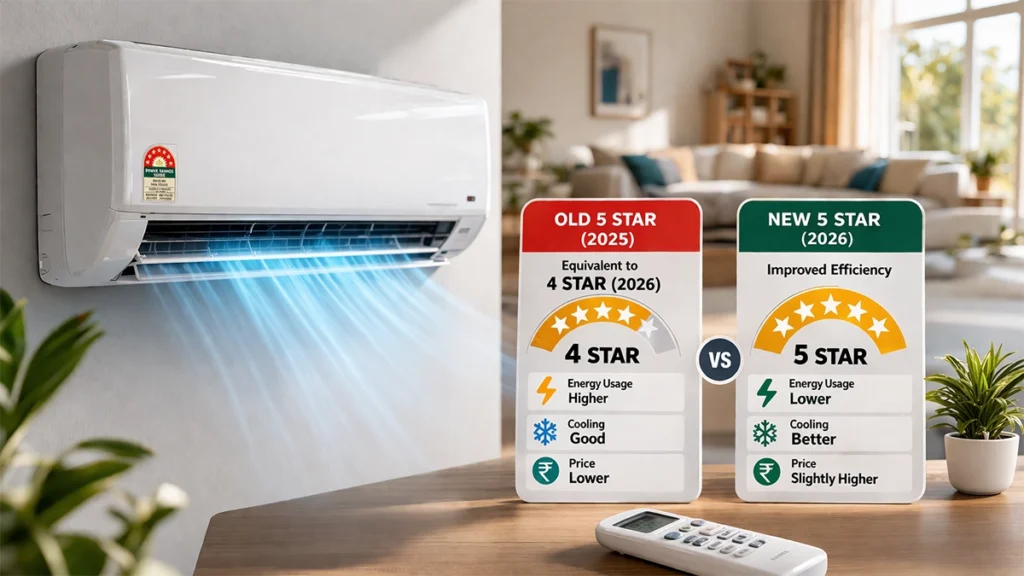
2026 Star Rating Change (Important)
In 2026:
- Old 5 star → now 4 star equivalent
- New models are slightly more efficient
But savings are small
If a 2025 model is ₹4000–5000 cheaper, buy that instead
Convertible Modes (Truth You Should Know)
Brands advertise:
- 5-in-1
- 6-in-1
- 7-in-1
Reality:
Mostly marketing.
You only need:
- Turbo mode
- Auto mode
How to Use AC Properly (Most Important Section)
Best Cooling Strategy
- Start with Turbo Mode
- Run for 20–30 minutes
- Switch to Auto Mode
This:
- Cools room faster
- Saves electricity
- Improves efficiency
Hidden Costs of Buying an AC
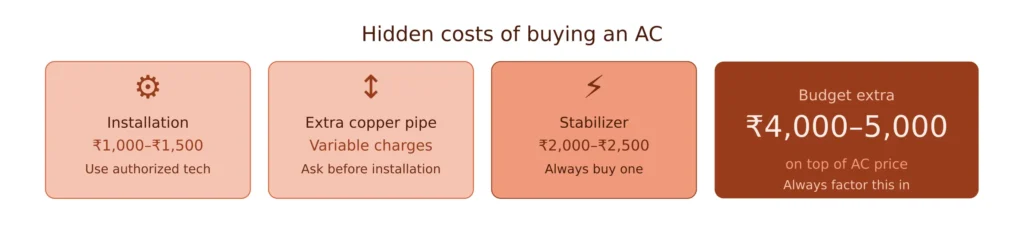
Extra Costs You Must Expect
- Installation: ₹1000–1500
- Extra copper pipe: extra charges
- Stabilizer: ₹2000–2500
Total extra: ₹4000–5000
Should You Buy a Stabilizer?
Yes. Always.
Even if brands say “stabilizer-free”.
Voltage fluctuations can damage your AC
A ₹2000 stabilizer can save a ₹50,000 AC.
Installation Tips (Critical)
Before installation:
- Ensure proper vacuuming of pipes
- Use brand-authorized technician
- Check copper pipe length
Skipping vacuuming reduces cooling efficiency
Best AC Brands in India (2026)
Reliable Brands:
| Brand | Best For | What They’re Known For |
|---|---|---|
| Daikin | Best overall quality | Japanese engineering, reliable compressor, great after-sales |
| Voltas | Value for money | India’s best-selling brand, wide service network |
| LG | Features + efficiency | Good ISEER ratings, solid build quality |
| Samsung | Premium features | Wind-Free technology, app integration |
| Hitachi | Quiet operation | Silent compressors, Japanese quality |
| Blue Star | Commercial-grade reliability | Great for large rooms, solid warranty |
| Carrier | Underrated pick | Good efficiency, less hyped but very reliable |
My honest picks:
- Best overall: Daikin (slightly expensive but worth it long-term)
- Best budget pick: Voltas (massive service network across India is a huge plus)
- Best for features: LG or Samsung
- Most underrated: Carrier
Want recommendations? See our list of Best AC in India (2026)
One thing I always tell people — check the service network in your city before buying. A great AC from a brand with no service center nearby is a headache waiting to happen.
What’s the Actual Cost? (2026 Price Guide)
Here’s a rough price range to set your expectations:
| Type | Tonnage | Star Rating | Price Range |
|---|---|---|---|
| Split Inverter | 1 ton | 3 Star | ₹28,000 – ₹35,000 |
| Split Inverter | 1 ton | 5 Star | ₹38,000 – ₹48,000 |
| Split Inverter | 1.5 ton | 3 Star | ₹33,000 – ₹42,000 |
| Split Inverter | 1.5 ton | 5 Star | ₹45,000 – ₹60,000 |
| Split Inverter | 2 ton | 5 Star | ₹58,000 – ₹80,000 |
| Window AC | 1 ton | 3 Star | ₹22,000 – ₹28,000 |
| Window AC | 1.5 ton | 3 Star | ₹28,000 – ₹35,000 |
Add ₹2,000–₹4,000 for installation (split AC). Always get it done by the brand’s authorized installer — DIY or local electricians can void your warranty.
If your budget is limited, check: Best AC under ₹40,000 in India
Where to buy: Flipkart, Amazon, and brand websites frequently run good deals especially during January–March (off-season pricing). If you’re buying offline, Reliance Digital and Croma often price-match online rates if you ask.
Common Mistakes to Avoid
- Buying based on price alone. The cheapest AC in the showroom will cost you more in electricity over 5 years.
- Ignoring tonnage. I said it before, I’ll say it again. Undersized AC is the #1 mistake.
- Skipping AMC (Annual Maintenance Contract). The first year is usually free under warranty. After that, get an AMC — ₹1,500–₹3,000/year for regular servicing. It keeps the AC efficient and extends its life significantly.
- Not servicing regularly. Clean the filter every 2–3 weeks in heavy use months. Get professional servicing once a year. A dirty AC can use 15–20% more electricity.
- Buying last year’s unsold stock without checking. Always check the manufacture date. If a dealer is pushing a “new” AC that was manufactured 2 years ago — that’s 2 years off your warranty effectively.
Learn how to reduce bills: How to Save Electricity with AC
AC Buying Checklist 2026 (AC Buying Guide 2026)
Before you finalize your purchase, run through this:
- Measured room size accurately
- Accounted for top floor / west-facing / extra heat sources
- Chosen inverter AC (not non-inverter)
- Minimum 3-star rating (5-star if using 8+ hours/day)
- Checked ISEER value on the energy label
- Verified brand has service center in your city
- Confirmed stabilizer-free operation range
- Budgeted for installation cost
- Asked about AMC options
Final Thoughts
Buying an AC isn’t complicated once you know what to look for. In this AC Buying Guide 2026, get the tonnage right, go for an inverter AC, choose the right star rating based on your usage, and pick a brand with a strong service network in your area. Everything else is secondary.
If I had to give you one piece of advice: don’t rush it. Spend 20 minutes getting the basics right, and you’ll be happy with your purchase for the next 8–10 years. Rush it to save ₹2,000, and you might regret it every month on your electricity bill.
Hope this AC buying guide 2026 helped.
If you want to go deeper:
- Best AC under ₹40,000
- 1 Ton vs 1.5 Ton AC
- AC electricity saving tips
If you follow this guide, you will:
- Save money
- Get better cooling
- Avoid long-term regret
FAQs
1. What size AC should I buy for my room?
If your room is up to 120 sq ft, go for 1 ton. For 120–170 sq ft, 1.5 ton works best. Bigger rooms need 2 ton. Always consider sunlight and room heat, not just size.
2. Is inverter AC better than non-inverter AC?
Yes. Inverter AC adjusts power based on need, cools faster, and saves electricity. Non-inverter is outdated and less efficient.
3. Should I buy a 3 star or 5 star AC?
If you use AC daily for long hours, go for 5 star. If usage is limited, 3 star is enough and saves upfront cost.
4. What is the most important thing in an AC buying decision?
Cooling capacity and correct tonnage. If that is wrong, no feature or brand can fix poor cooling.
5. What does this AC Buying Guide 2026 recommend for most users?
This AC Buying Guide 2026 recommends a 1.5 ton inverter AC with a good star rating and strong service support, as it suits most Indian homes and usage patterns.


0 Comments