
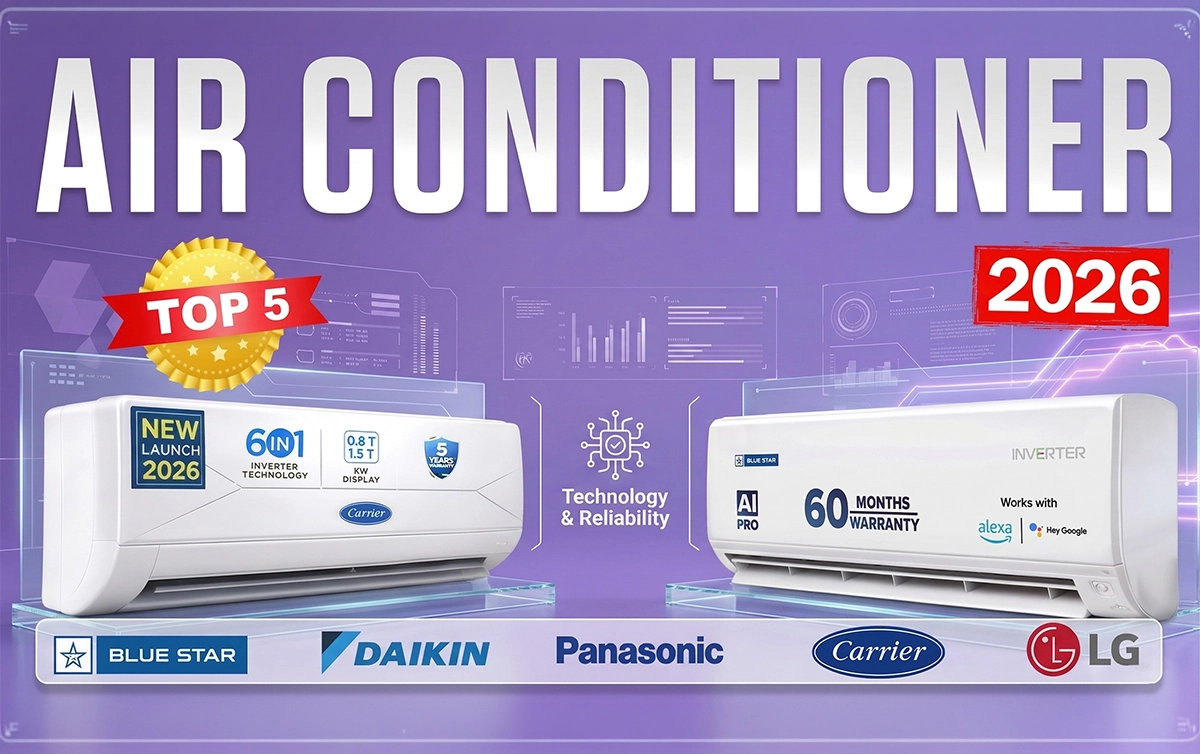

Buying an AC feels simple… until you actually try.
Tonnage, star ratings, inverter vs non-inverter, ISEER, copper coils — suddenly everything feels like a tech exam you never signed up for.
Don’t worry. I’ll make this simple.
This guide to the Best 1.5 Ton 5 Star AC in India 2026 is based on real testing — not spec-sheet reading or unboxing videos. Every AC mentioned here was actually purchased, installed, and used to give you an honest and reliable recommendation.
New to AC buying altogether? Start with our complete AC Buying Guide first.
Let’s get into it.
In This Post
Best 1.5 Ton 5 Star AC in India 2026
Here’s the ranking — based on real usage, real testing, real rooms.
| Brand | Rank | Price (approx) | Cooling capacity | ISEER | Wi-Fi | PM 2.5 filter | Best for room size |
|---|---|---|---|---|---|---|---|
| Panasonic | #1 | ~₹48–50K | 1.45 ton | 5.8 | ✓ | ✓ | Up to 170 sq ft |
| Daikin | #2 | ~₹48–50K | 1.42 ton | 5.7 | ✕ | ✓ | Up to 165 sq ft |
| Blue Star | #3 | ~₹46,500 | 1.45 ton | 5.63 | ✓ | ✕ | Up to 170 sq ft |
| LG | #4 | ~₹47,500 | 1.42 ton | 5.7 | ✕ | ✕ | Up to 165 sq ft |
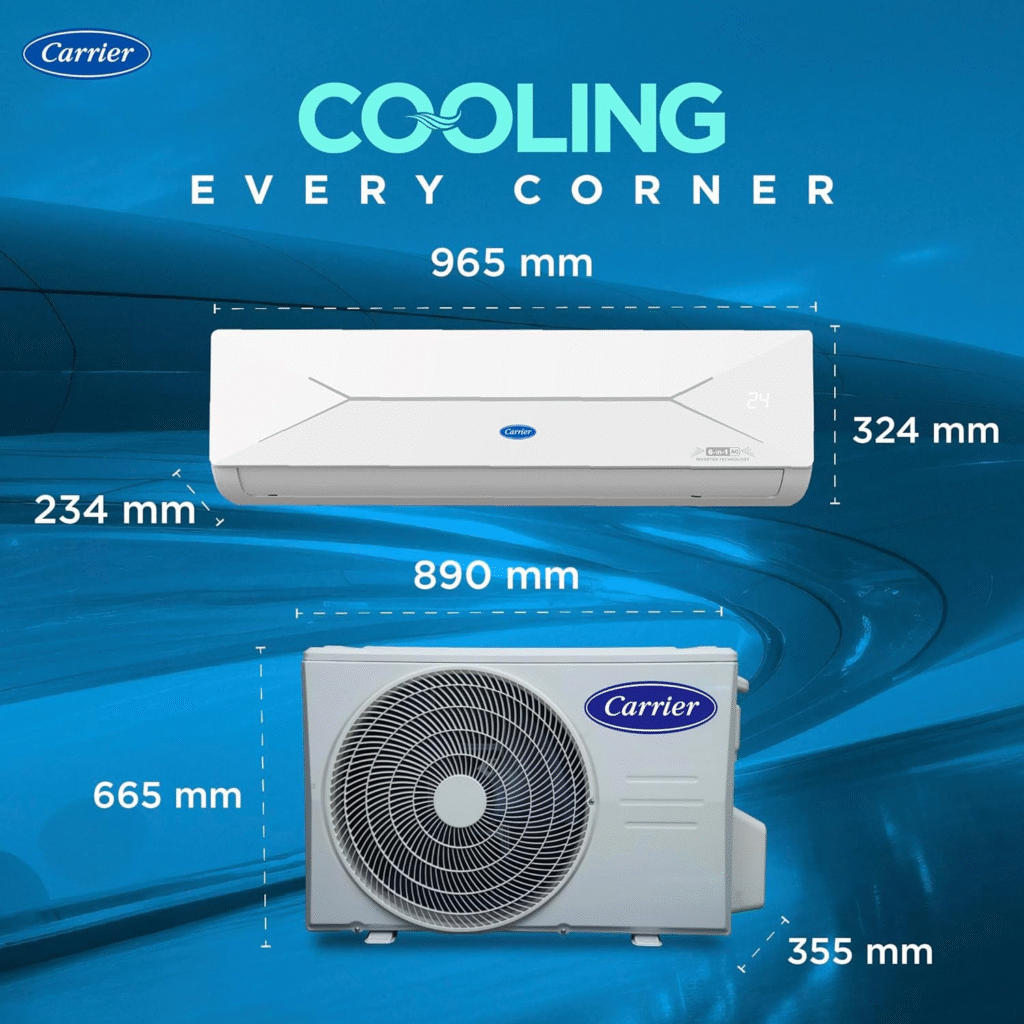
| Carrier | #5 | ~₹42,000 | 1.36 ton | 5.6 | ✕ | ✓ | Up to 155 sq ft |
#5 — Carrier 1.5 Ton 5-Star 2026 Model
Images sourced from Amazon. All copyrights belong to their respective owners.
Best for: Rooms up to 150–155 sq ft | Budget: ~₹42,000
Let’s start with Carrier.
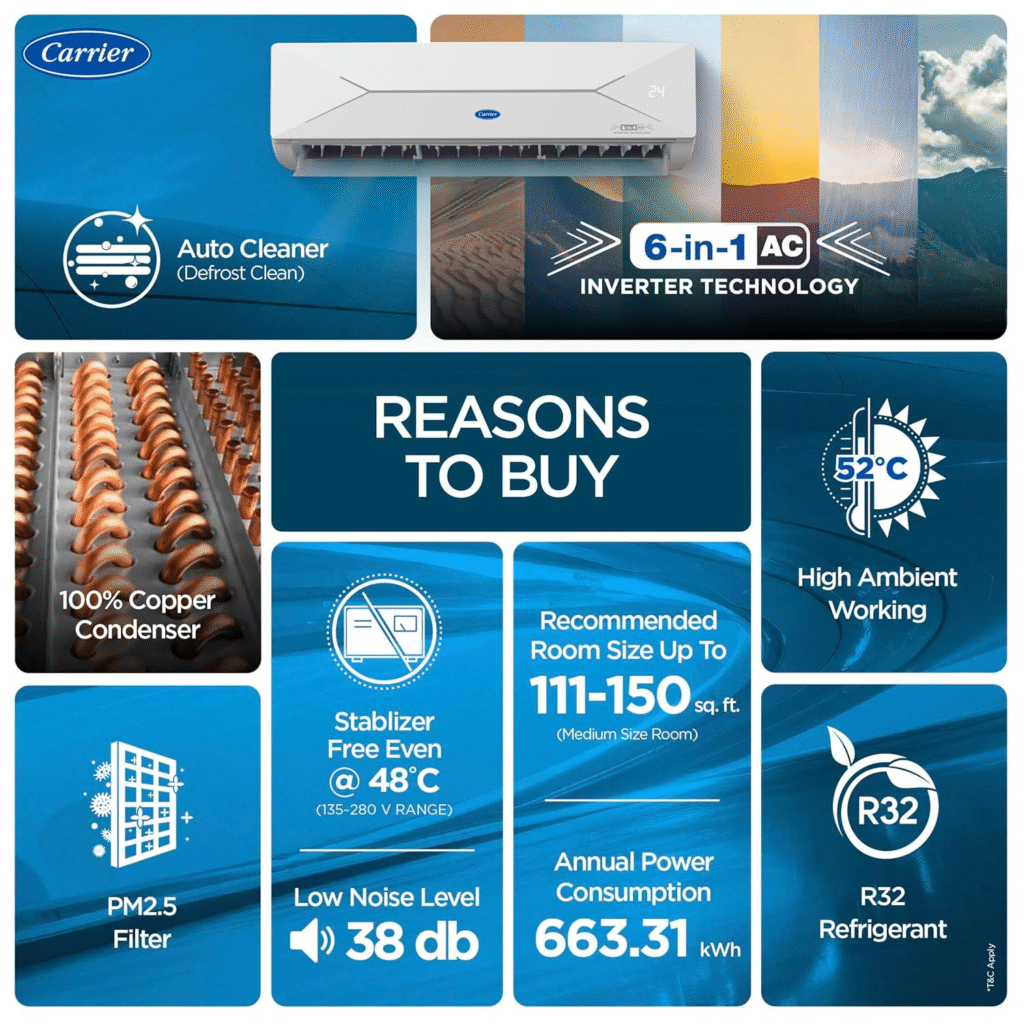
The first thing to know — the actual cooling capacity here is 1.36 tons. Not 1.5. So if your room is larger than 155 sq ft, just skip this one.
Here’s where it gets interesting — Carrier compensates with a solid ISEER rating of 5.6, which is very good. Lower cooling capacity, but more efficient use of the electricity it draws.
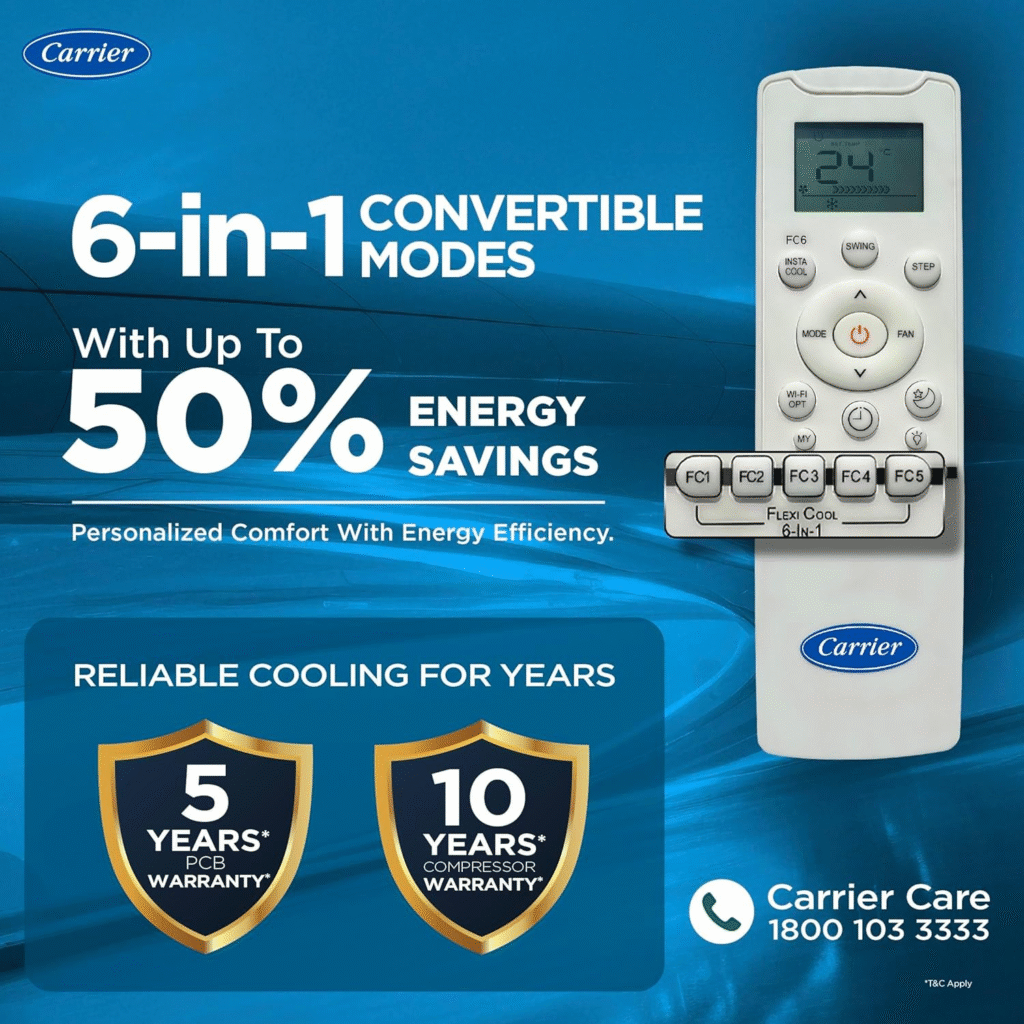
You get Carrier’s AI Flexi Cool inverter tech with convertible 6-in-1 modes, ranging from 0.8 ton to 1.7 ton in theory.
Common mistake: Getting excited about the 1.7 ton “turbo” mode. At full blast, this AC will run at that mode for only 20–25 minutes before automatically dropping back to auto. So don’t expect sustained high-capacity cooling.
That said — in the right room size (150–155 sq ft), this AC performs brilliantly. Tested it in a challenging setup with more open area than a normal room, and it handled the load well.
Quality check passed: 100% copper condenser and tubes — verified by opening the unit before installation. Carrier’s Aqua Clear coating on outdoor coils and Hydro Blue coating on indoor coils are genuinely good anti-corrosion protection.
You also get dual filtration — HD filter + PM 2.5 filter — and auto-clean technology that actually works.
The one real con: No Wi-Fi. Carrier mentions “AI mode” but without connectivity, it’s more of a marketing label than a real feature.
Noise level: Around 40 decibels in real use (company claims 38 dB).
Warranty: 1-year comprehensive | 5 years on PCB | 10 years on inverter compressor
Check the latest price on Amazon: Amazon Link
My recommendation: If your room is 150 sq ft or under and your budget is around ₹42,000 — this is a solid buy. If your room is bigger, look at the options below.
#4 — LG 1.5 Ton 5-Star 2026 Model
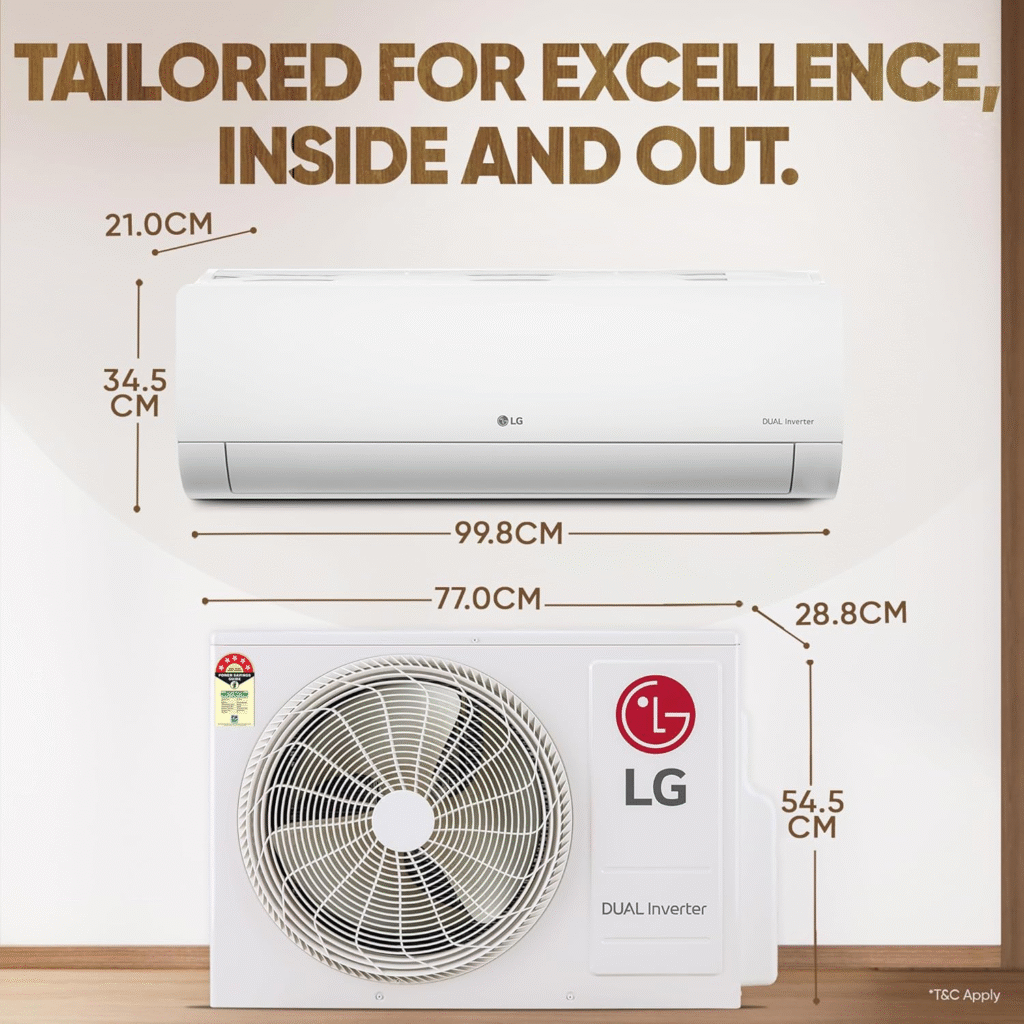
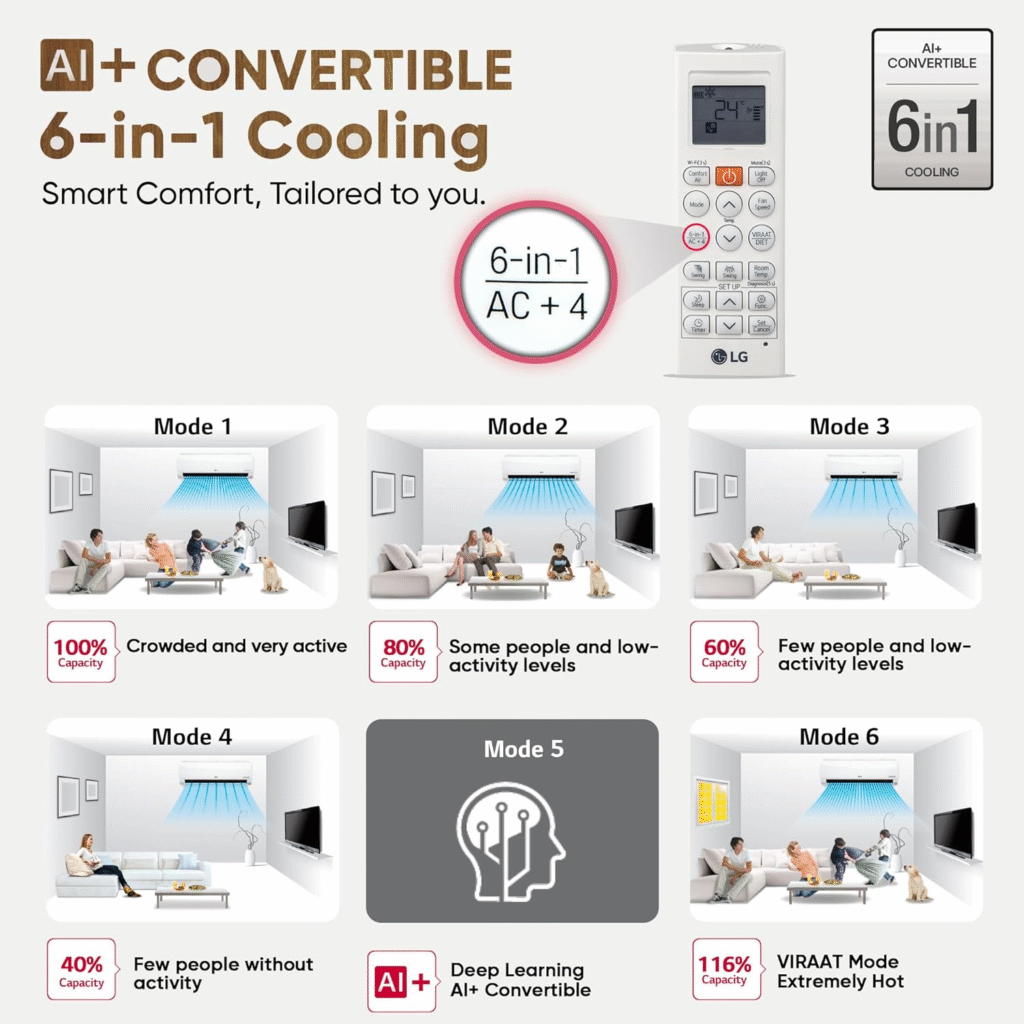
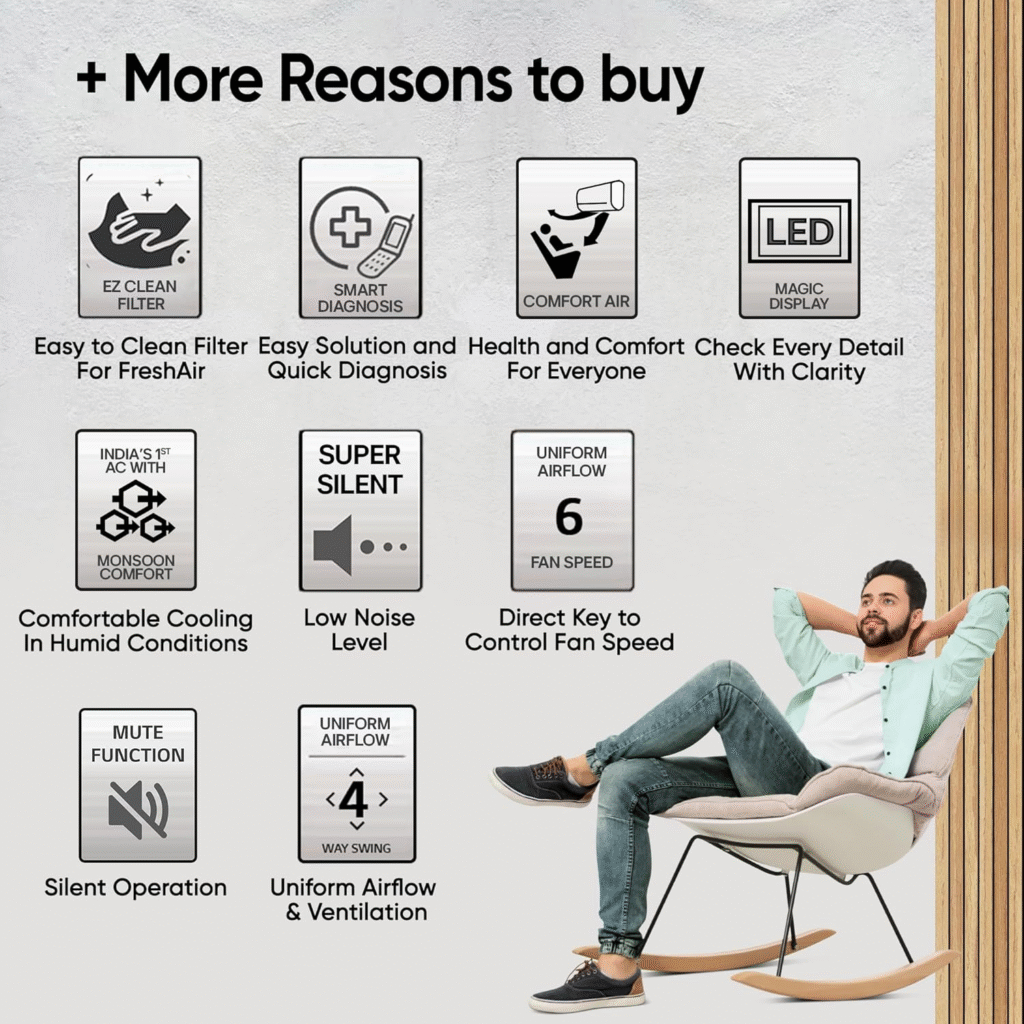
Images sourced from Amazon. All copyrights belong to their respective owners.
Best for: Rooms up to 160–165 sq ft | Budget: ~₹47,500
LG is LG. Six years of buying and testing their ACs, and the consistency never disappoints.
Cooling capacity here is 1.42 tons — same as last year’s model, but the ISEER has improved significantly to 5.7. How? The compressor hasn’t changed much — it’s the motor that’s been upgraded. Same cooling, less electricity. That’s the right kind of progress.
LG’s Dual Rotary Inverter Compressor is one of the best in this price range. Tested extensively across rooms and multiple years — performance doesn’t degrade over time. Noise levels don’t increase. That long-term consistency is rare.
Here’s where it gets interesting: LG gives you four-way air swing. This sounds like a small feature. It’s not. When you use it in a bedroom — where the AC placement is rarely perfect — four-way swing means the cold air actually reaches every corner. You’ll feel the difference the first week.
Also get: AI convertible 6-in-1 modes (40% to 110%), Virat mode (LG’s name for the turbo boost we discussed), Gold Fin Plus and Ocean Black Protection on coils, auto-clean, smart diagnosis.
Quality check: Inner grooved copper tubes — a detail most brands skip. The refrigerant passes through faster, meaning slightly better cooling efficiency. Verified before installation.
The cons — and I’ll be direct:
No Wi-Fi. In 2026. That’s a real miss. If you want Wi-Fi on LG, you’re paying ₹2,500 extra for a separate model — which already puts it above Blue Star pricing.
Also no PM 2.5 filter — just the standard HD filter. For Indian air quality, that’s a gap.
Noise level: LG claims 31 decibels. Ambient noise in a room is already 37–38 dB, so you literally cannot measure 31 dB. What this means in practice: you can barely hear it’s on.
Warranty: 1-year comprehensive | 5 years on PCB (both indoor and outdoor — important detail) | 10 years on compressor
Note on gas charging warranty: Only covered for the first year. After that, gas top-ups are at your expense.
Check the latest price on Amazon: Amazon Link
My recommendation: If cooling performance and long-term reliability are your priority, and Wi-Fi is not a deal-breaker — LG is an excellent choice for rooms up to 165 sq ft.
#3 — Blue Star 1.5 Ton 5-Star 2026 Model
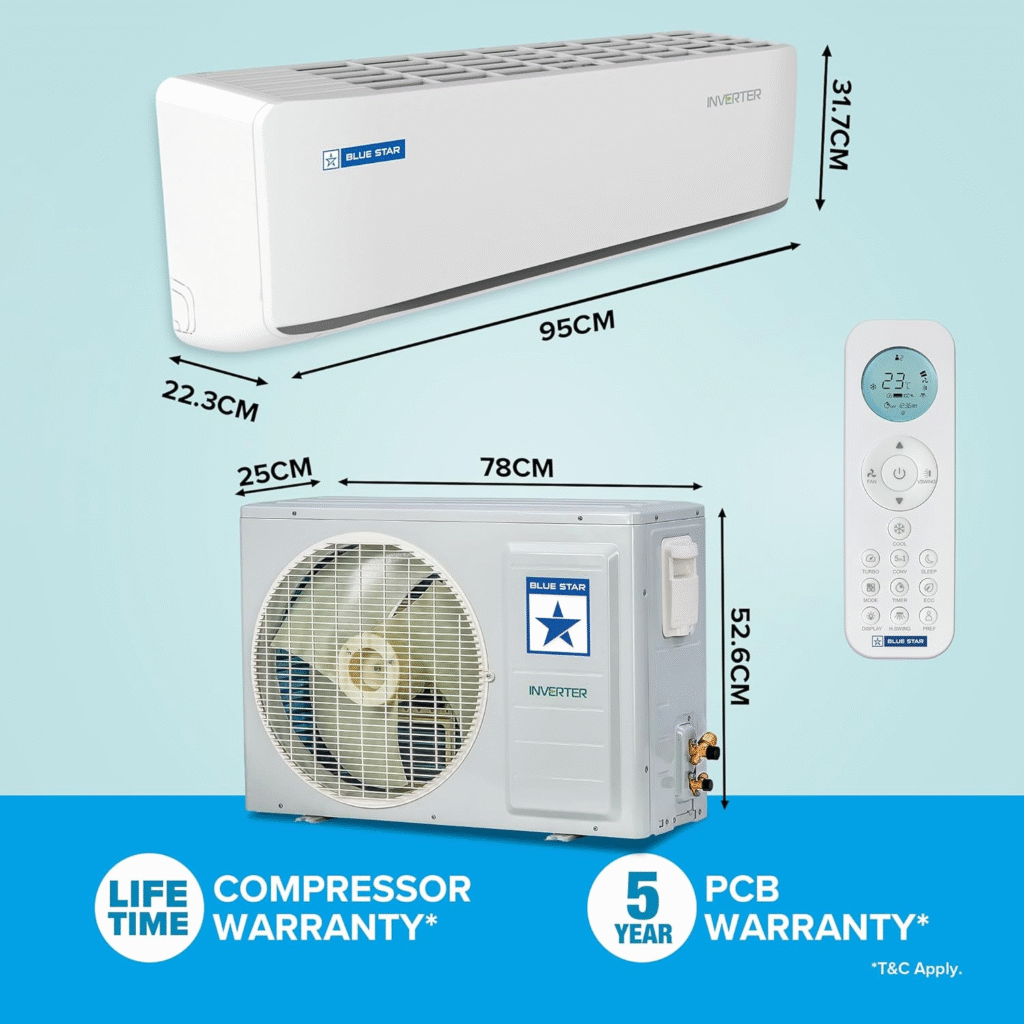
Images sourced from Amazon. All copyrights belong to their respective owners.
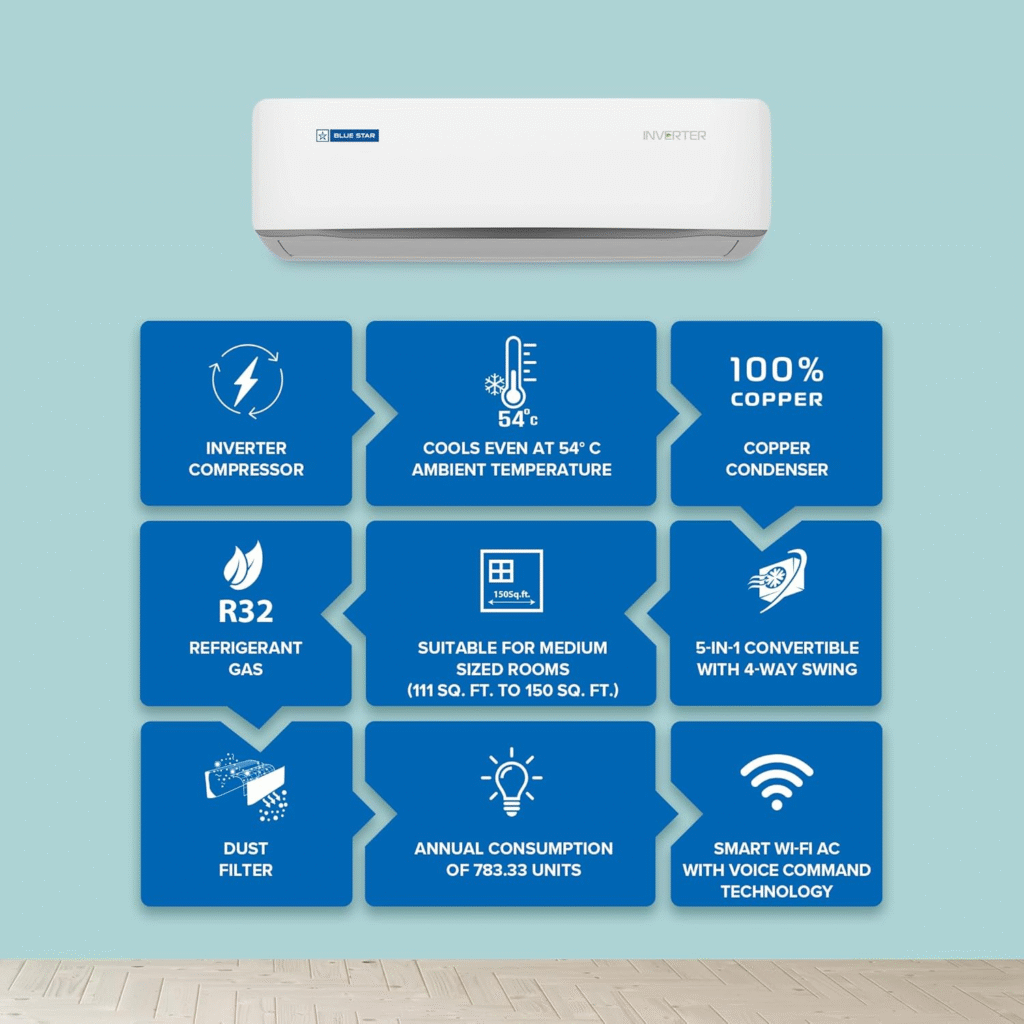
Best for: Rooms up to 165–170 sq ft | Budget: ~₹46,500
Last year this was my #1. This year it’s tied at #2 with LG — and honestly, it could easily be argued as the better pick of the two.
Cooling capacity: 1.45 tons — the highest among the #2 and #3 picks. Tested it in a 170 sq ft room. It handled it. That’s not what the spec sheet says is recommended — that’s what actually happened in the test.
ISEER of 5.63 — incredibly good for the capacity it’s delivering.
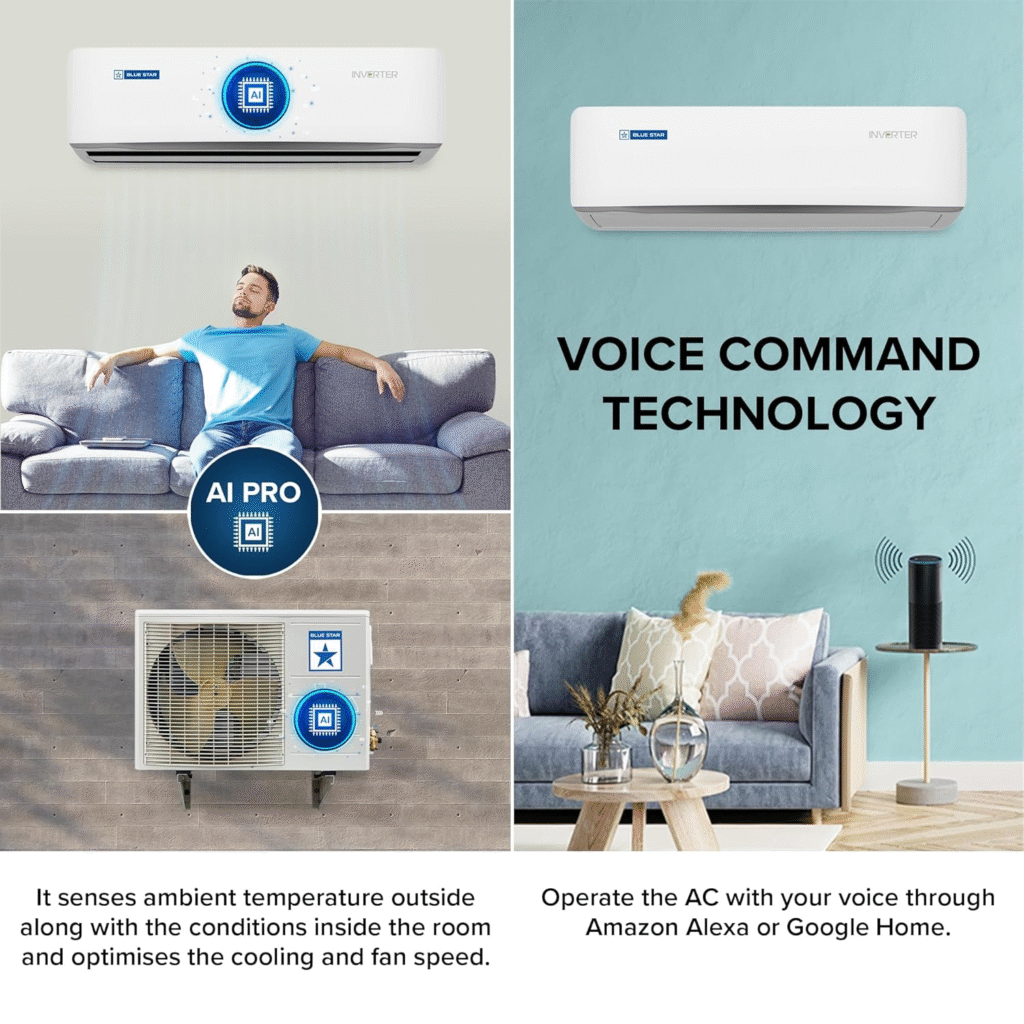
The AI Pro inverter compressor with 5-in-1 convertible modes (40% to 110%) works flawlessly. Quality check before installation: 100% copper tubes, compressor blanket covering — everything top notch. Anti-corrosive Blue Fins on indoor and outdoor coils — proper chemical coating, not marketing.
What Blue Star gets right that LG doesn’t:
Wi-Fi. Built-in. Works with Alexa, Google Assistant, and the Blue Star app. No extra cost, no separate model needed.
And the warranty — this is where Blue Star genuinely pulls ahead. 5-year comprehensive warranty (covering all technical faults, except plastic parts and remotes). That kind of assurance at this price is rare. Plus 10 years on the compressor.
Four-way air swing — yes, same as LG. Both have it.
The one real con: No PM 2.5 filter. Just a basic dust filter. In 2026, in Indian cities, this is genuinely frustrating. Blue Star, if you’re reading this — please fix it.
Noise level: Very quiet. Comfortable for bedrooms.
Check the latest price on Amazon: Amazon Link
My recommendation: If you want Wi-Fi, a stronger warranty, slightly more cooling capacity, and a room up to 170 sq ft — Blue Star edges ahead of LG. The only thing LG does better here is the PM 2.5 filter (which Carrier has, but Blue Star and LG don’t offer at this tier).
#2 — Daikin 1.5 Ton 5-Star 2026 Model
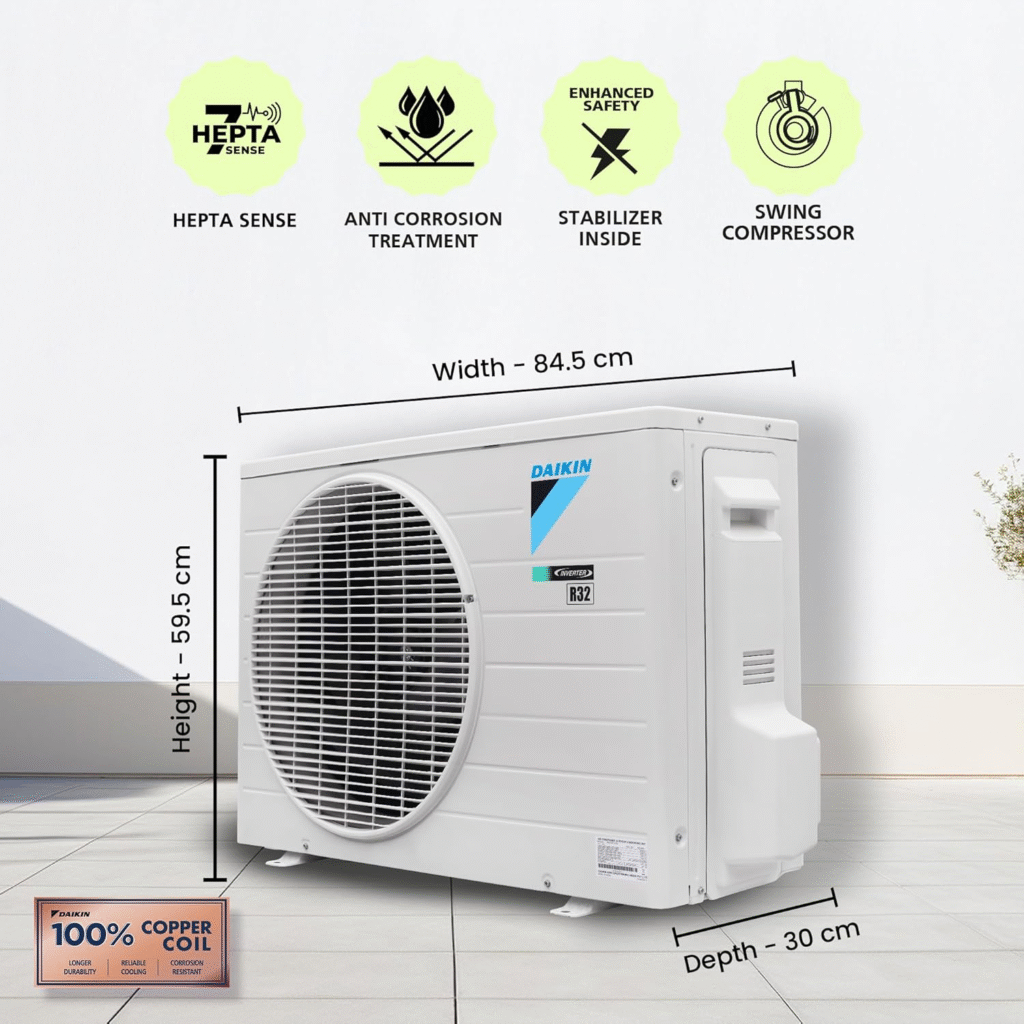
Images sourced from Amazon. All copyrights belong to their respective owners.
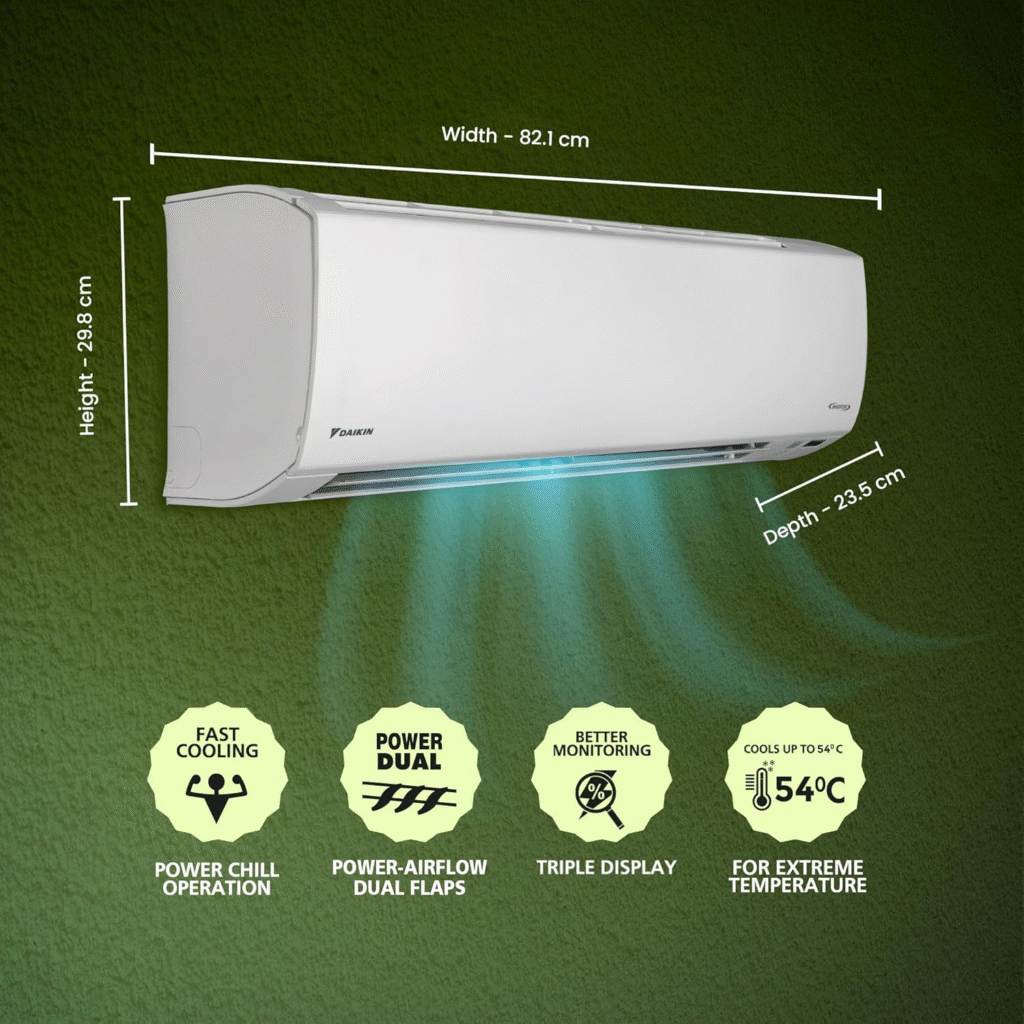
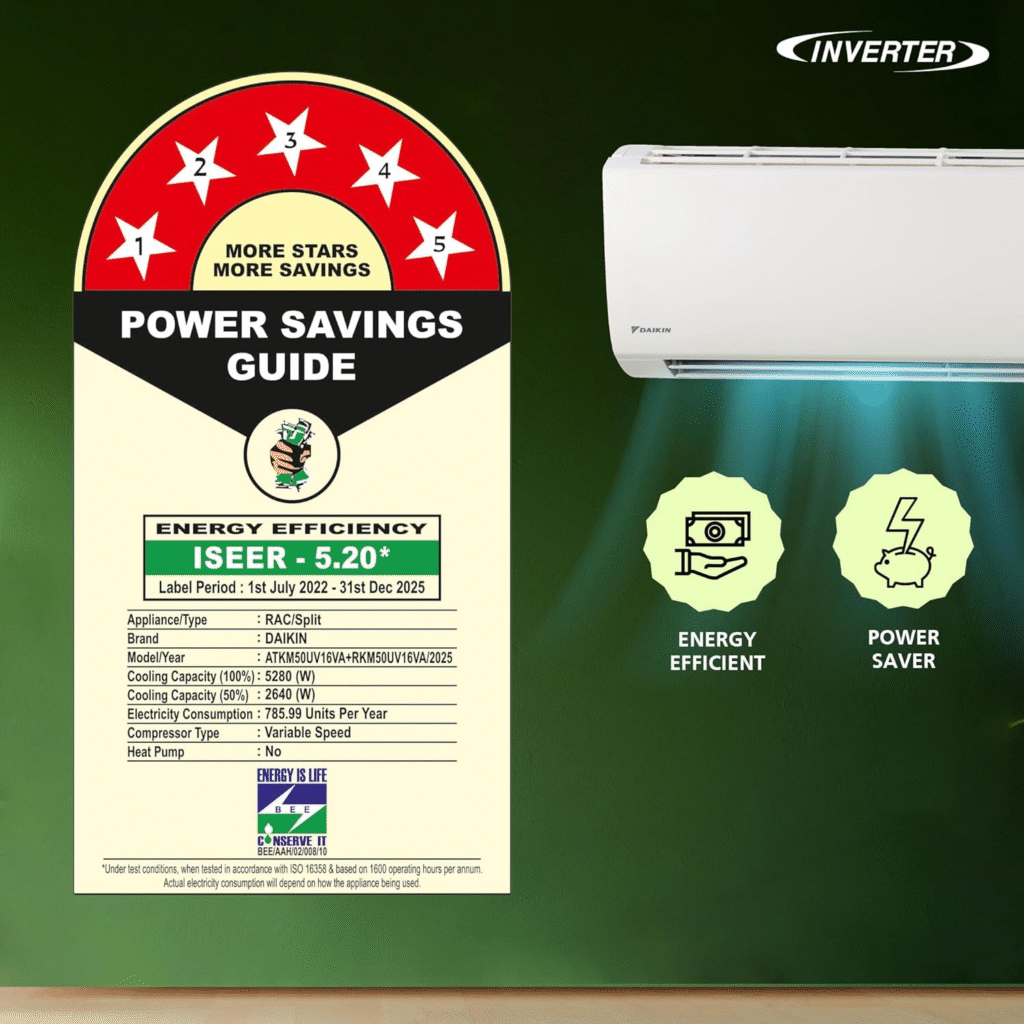
Best for: Rooms up to 160–165 sq ft | Budget: ~₹48,000–50,000
This is where it gets interesting.
Cooling capacity dropped this year — 1.42 tons, down from a full 1.5 tons last year. That’s disappointing on paper.
But here’s the truth: it doesn’t matter. Because this is Daikin. The technology they pack into that 1.42-ton capacity makes it perform like other brands’ 1.5-ton units. Tested it. Compared it. The result is unbeatable cooling in its room size range.
Swing Inverter Compressor technology, 100% copper condenser coils, Coanda air flow — all verified before installation. Quality is just what you expect from a Japanese brand that’s been doing this longer than most.
New addition in 2026: PM 2.5 filter + Active Carbon filter. Both. That’s a significant upgrade for air quality inside your room — especially in Delhi, Mumbai, or any metro.
The honest con: No convertible modes. Daikin’s philosophy is that convertible modes make an inverter AC behave like a non-inverter — and they’re not wrong in principle.
But here’s the thing — as a user, having that option is convenience. We can choose not to use it. Brands taking that choice away from us, even with good intentions, is still a limitation.
This has been a Daikin con for 5 years. It’s still a Daikin con in 2026.
Also no Wi-Fi — which in 2026 feels increasingly like a miss at this price point.
Noise level: Claims 34 dB. Essentially silent in practice.
Voltage range: 130V–285V. Very good.
Warranty: Standard — 1-year comprehensive, 5 years PCB, 10 years compressor.
Check the latest price on Amazon: Amazon Link
My recommendation: If your priority is pure, reliable, Japanese-quality cooling — Daikin is still one of the best you can buy. Room size up to 165 sq ft. Accept the lack of convertible modes and Wi-Fi if those aren’t essential for you.
#1 — Panasonic 1.5 Ton 5-Star 2026 Model
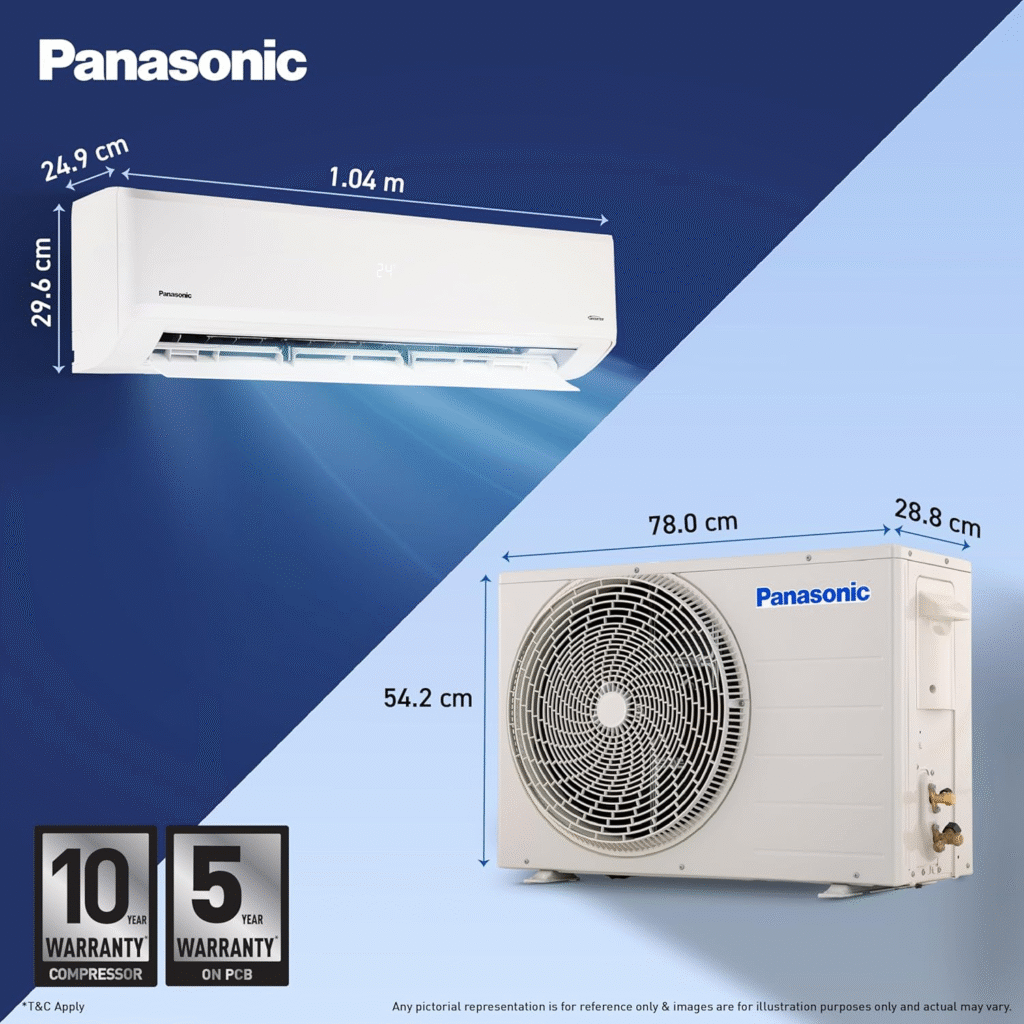
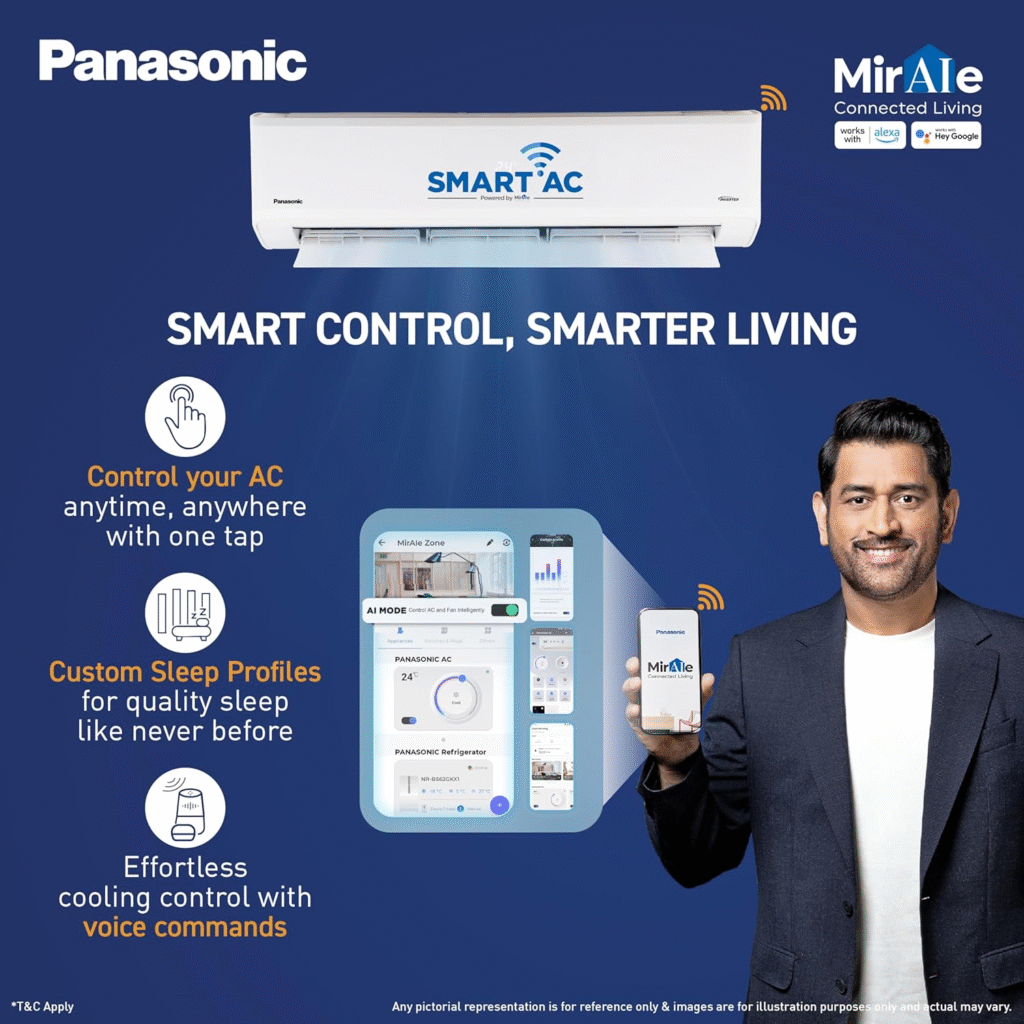
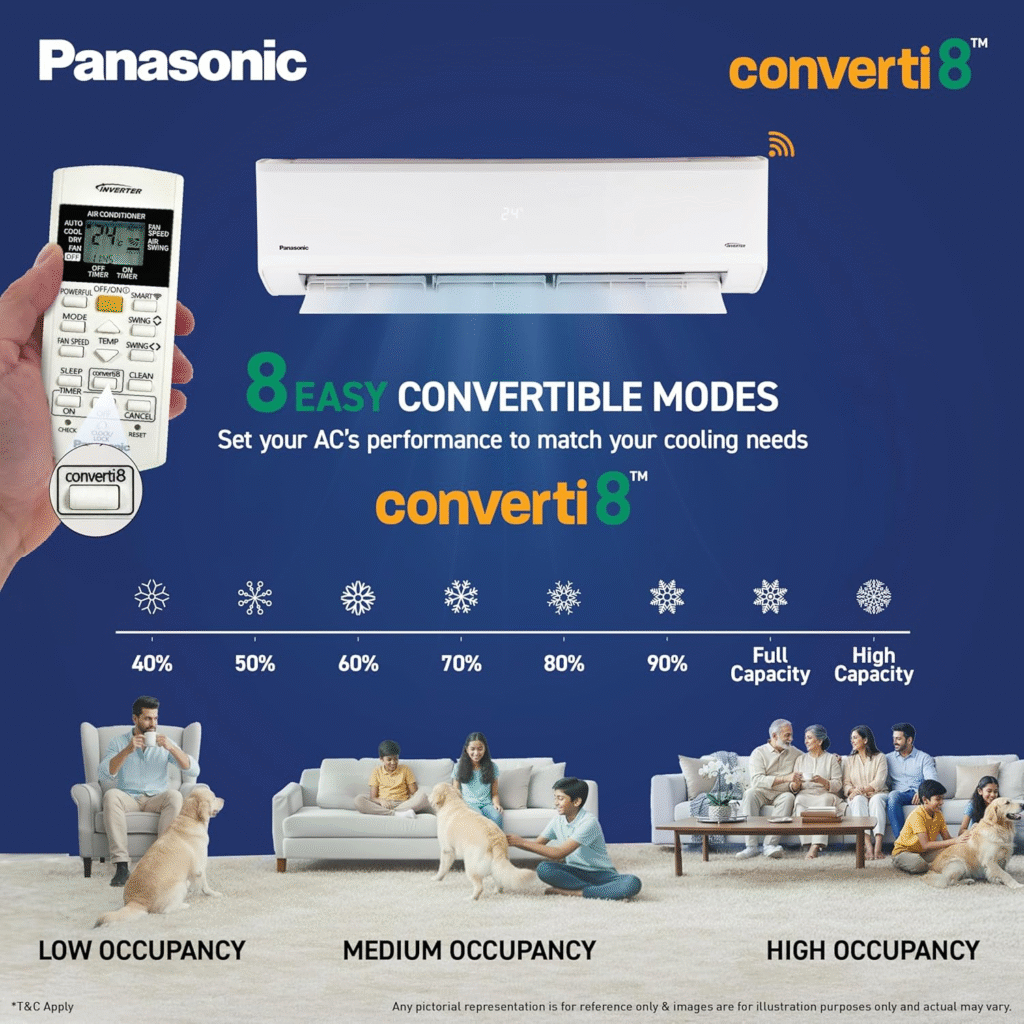
Images sourced from Amazon. All copyrights belong to their respective owners.
Best for: Rooms up to 170+ sq ft | Budget: ~₹48,000–50,000
If you’re going to spend ₹48,000–50,000, this is where I’d personally put that money.
Cooling capacity: 1.45 tons — same as last year, but this year Panasonic made significant internal changes.
ISEER: 5.8 — the best in this entire list. More cooling capacity AND better efficiency. That’s not easy to pull off.
Here’s what’s new in 2026:
The indoor blower has been upgraded — physically larger. Air flow has jumped to 730 cubic feet per minute (from around 500–550 earlier). That is a massive increase. You feel it the moment you turn it on.
Also upgraded to 18-in-1 convertible modes — from 40% to 110%, at every 10% step. Delhi summer? Use 100%. Kerala humidity? Drop to 60%. Mumbai monsoon? 70%. The AC stays the same; you adjust it to your city and your needs.
Features that actually matter:
- Wi-Fi built-in — and the mAir app is genuinely the best AC companion app available. You can create sleep profiles, set family member preferences individually, control via Alexa or Google Assistant.
- Dust Buster — when you switch off the AC, the outdoor unit runs the fan in reverse to clean dust and sediment off the outdoor coils automatically. No other AC in this list does this.
- Four-way air swing — same as LG and Blue Star.
- Shield Blue Technology — chemical coating on both indoor and outdoor coils. Quality verified before installation. Top notch.
- Noise level reduced to 34 dB this year (was 36–38 dB last year). Effectively silent.
- Voltage range: 100V–290V. The widest range in this list.
The con — and it’s a small one:
The indoor unit is slightly larger than other brands because of the bigger blower. Not a dealbreaker, but worth noting for tight wall spaces.
Warranty: 1-year comprehensive | 5 years PCB | 10 years compressor.
Check the latest price on Amazon: Amazon Link
My recommendation: If you want the best of everything — cooling capacity, efficiency, Wi-Fi, app quality, air flow, and smart features — Panasonic is the answer. It’s the one AC in this list where I genuinely have no major complaints.
Final Decision Guide — Pick Your AC in 60 Seconds
If your room is under 155 sq ft and budget is ₹42,000: → Go with Carrier. No overthinking needed.
If your room is 155–165 sq ft and Wi-Fi doesn’t matter: → LG. Best long-term reliability, incredibly quiet, inner grooved copper tubes.
If your room is 155–170 sq ft and you want Wi-Fi + strong warranty: → Blue Star. Better warranty than LG, Wi-Fi included, slightly more cooling capacity.
If you want Japanese build quality and don’t need Wi-Fi or convertible modes: → Daikin. Pure cooling performance, PM 2.5 + Active Carbon filter, unbeatable reliability.
If you want the absolute best and you’re willing to pay for it: → Panasonic. Best ISEER, highest airflow, best app, Dust Buster, 18-in-1 modes. The complete package.
Before You Pick Any AC — Read These 3 Points First (Best 1.5 Ton 5 Star AC in India 2026)
Most people skip this part. That’s exactly why they regret their purchase later.
Star Ratings Changed in 2026 — Here’s What That Actually Means
Here’s the truth: the star rating system was completely revised in January 2026.
Any AC that was rated 5-star in 2025 is now technically a 4-star AC under the new norms. The government raised the bar.
The new 2026 five-star ACs consume slightly less electricity while delivering the same cooling. Sounds great, right?
But here’s the practical part — the actual savings difference between a 2025 model and a 2026 model is not dramatic enough to justify a ₹4,000–5,000 price premium.
Simple rule: If you find a 2025 model of the Best 1.5 Ton 5 Star AC in India 2026 at a significant discount right now — just buy it. Don’t let the star label on the box make the decision for you. Your electricity savings won’t cover that price gap anytime soon.
Room Size Is Not Just Square Footage
You’ve seen this everywhere on Flipkart and Amazon:
- Up to 100 sq ft → 1 Ton AC
- Up to 150 sq ft → 1.5 Ton AC
Forget that. It’s oversimplified.
For a 1.5 Ton 5-Star AC, the right room size depends on:
- Sun exposure — Does your room get direct afternoon sun? That changes everything.
- Ceiling height — High ceilings = more volume = more load on the AC.
- How packed the room is — Furniture, people, electronics all add heat load.
- How often the door opens — A bedroom is different from a living room with foot traffic.
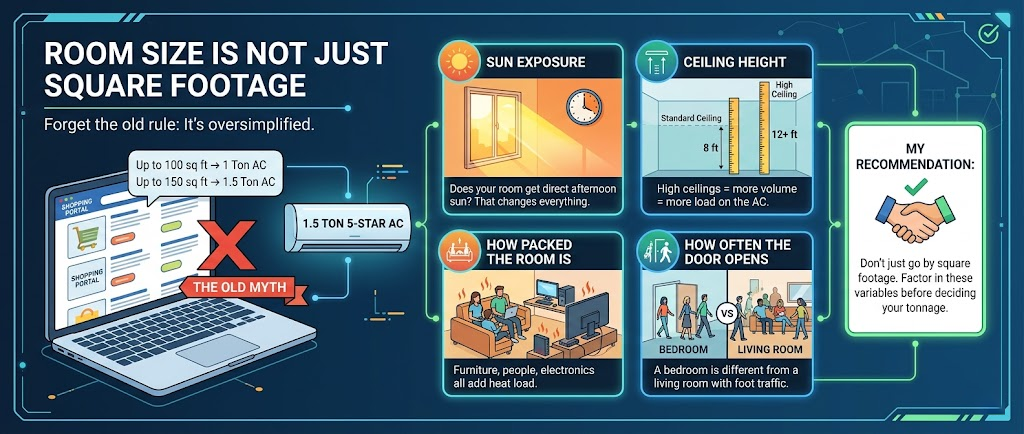
My recommendation: Don’t just go by square footage. Factor in these variables before deciding your tonnage.
We’ve covered room size calculation in detail in our complete AC guide — worth a read before you decide.
Cooling Capacity ≠ Tonnage Category
This is where most people get fooled.
Every brand will call their AC “1.5 Ton.” But the actual cooling capacity inside that 1.5 Ton label varies brand to brand. One brand’s 1.5 Ton might actually cool at 1.36 tons. Another might deliver 1.45 tons.
Here’s the truth: 1.5 Ton is a category, not a fixed spec. Always check the actual cooling capacity in the technical details — not just the headline tonnage.
I’ll tell you the exact cooling capacity for every AC in this list. That’s what will actually help you decide.
How to Use Your Inverter AC the Right Way
Still confused about inverter ACs? Let’s make this simple.
Non-inverter ACs are basically extinct in the residential market now. 99% of brands don’t even make them anymore. So whatever your old mechanic told you about “inverter ACs having expensive repairs” — that advice is from another era. Move on.
Here’s where it gets interesting —
Every inverter AC today comes with convertible modes. You’ll see 5-in-1, 6-in-1, 8-in-1. Don’t get excited about those numbers — it’s mostly marketing.
What actually matters is how you use it:
When you turn on your AC in peak summer, your walls are hot. The room has absorbed heat all day. If you start the AC on auto mode, it’ll take forever to cool down.
Common mistake: Turning on the AC at normal mode and then complaining it doesn’t cool fast enough.
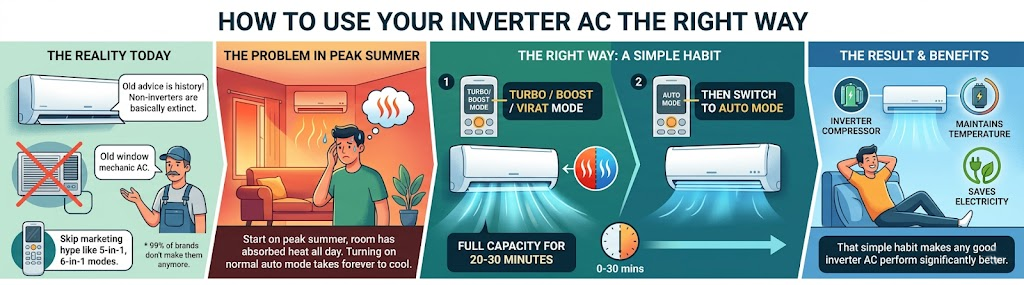
The right way:
- Start on Turbo/Boost/Virat mode (whatever your brand calls it) — full capacity for 20–30 minutes.
- This cools down your hot walls fast.
- Then switch to Auto mode.
- The inverter compressor takes over, maintains the temperature, and saves electricity.
That’s it. That simple habit will make any good inverter AC perform significantly better.
Before Installation — Don’t Skip These Steps
Copper Pipe Vacuuming
When your AC gets installed, insist on vacuuming the copper pipes before the unit is switched on.
If the installation team says they don’t have a vacuum pump — stop them. That’s a red flag. Don’t let them proceed without it. Skipping this step can damage your AC over time.
Budget for Extra Costs
Your AC price is not your total cost. Here’s a realistic breakdown:
- AC price — what you see online
- Installation charges — up to ₹1,500 (always use the brand’s authorized installer; warranty depends on it)
- Extra copper pipe — if your indoor and outdoor units are more than 3 meters apart, you’ll pay extra per foot
- Stabilizer — ₹2,000–2,500
Total extra budget to keep aside: ₹4,000–5,000 over and above the AC price.
Do You Actually Need a Stabilizer?
Every brand will tell you their inverter AC has built-in voltage stabilization. And that’s true — to a point.
But if there’s a voltage surge in your home and your ₹47,000 AC gets fried, the brand may not honor the warranty claim.
A ₹2,000–2,500 stabilizer is cheap insurance for an expensive appliance. Just buy it.
What About Samsung, Mitsubishi, and Voltas?
Fair question.
Mitsubishi and General are genuinely excellent ACs and could easily compete for the title of the Best 1.5 Ton 5 Star AC in India 2026. Their build quality and cooling performance are hard to fault.
But here’s the catch — they’re not easily available on platforms like Amazon or Flipkart, and their service networks are strongest in Tier 1 cities.
If you live in a Tier 2 or Tier 3 city, make sure you check service availability and spare parts access before making the purchase.
The product might be outstanding; the after-sales experience could be the real challenge.
Samsung will be covered separately — it deserves its own detailed review.
Still not sure where to start? Our complete AC Buying Guide covers everything from scratch.
Voltas is a different category and price point — worth considering if budget is the primary constraint.
One Last Thing
If I had to recommend just one thing from this entire Best 1.5 Ton 5 Star AC in India 2026 guide — get the tonnage and room fit right. Everything else is secondary.
A ₹50,000 AC in the wrong room size will always underperform a ₹42,000 AC in the right room size.
That’s the one mistake that no brand, no warranty, and no feature can fix.
Get that right. Everything else falls into place.
Frequently Asked Questions (FAQs)
1. Which Is the Best 1.5 Ton 5 Star AC in India (2026)?
Panasonic offers the best combination of performance, efficiency, and smart features, closely followed by Daikin.
2. Is it worth buying a 2026 model over a 2025 model?
If the price difference exceeds ₹4,000–₹5,000, a 2025 model can provide better value with minimal efficiency compromise.
3. What room size is suitable for a 1.5 Ton AC?
Typically, 150–170 sq. ft., depending on sunlight exposure, insulation, and ceiling height.
4. Do I need a stabilizer for an inverter AC?
Yes. Although many ACs support stabilizer-free operation, an external stabilizer offers additional protection against voltage fluctuations.
5. Which brand provides the best warranty?
Blue Star stands out with its 5-year comprehensive warranty, offering significant peace of mind.
Prices mentioned are approximate at time of testing. Always check current prices and available offers before purchasing. Use authorized brand installers to keep your warranty valid.
0 Comments